
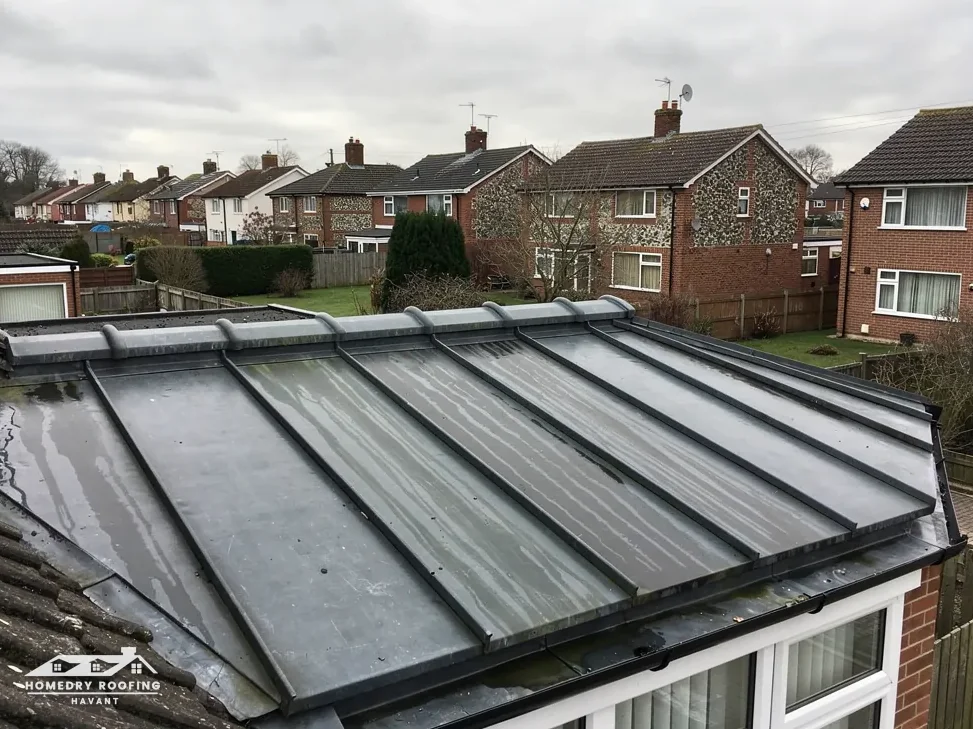
Flashings
The strip of metal that bridges a slope and the wall it butts into.
If an edge lifts there, rain tracks behind the covering and into the masonry.

Oving is 14 road miles east of Havant. Rain is followed across its roofs from the first wall junction to the last downpipe, and the survey ends in a single written total price.
10-year workmanship guarantee, in writing
The strip of metal that bridges a slope and the wall it butts into.
If an edge lifts there, rain tracks behind the covering and into the masonry.
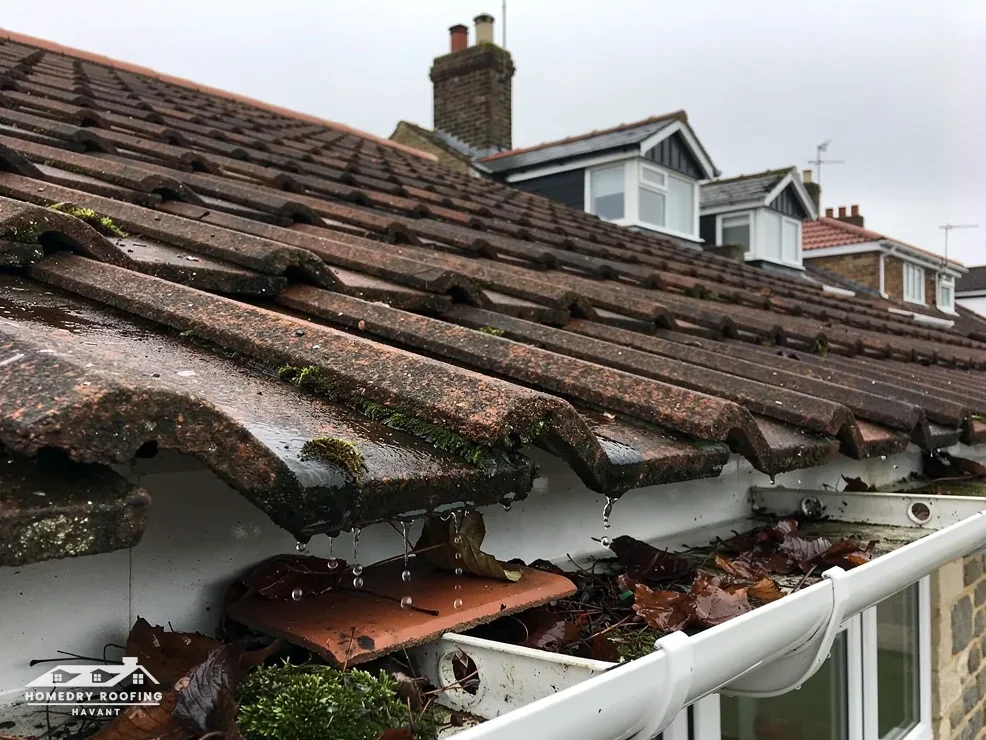
The clips that hold a gutter at the slight angle it needs to drain.
One pulled out of the fascia leaves a dip, and the dip keeps a puddle.
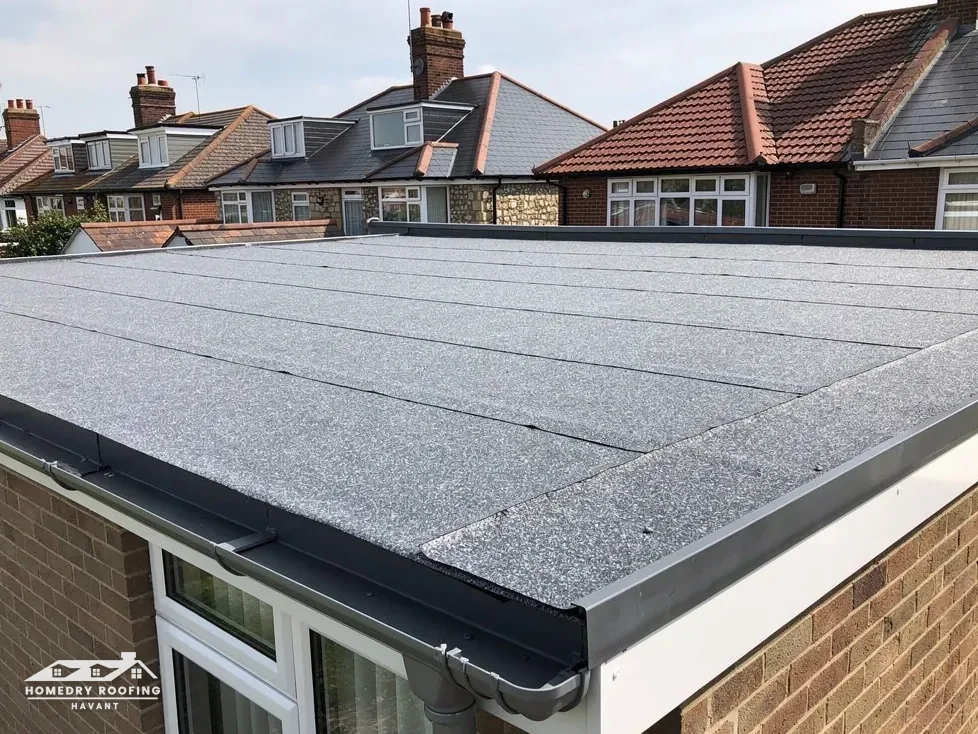
The single opening through which a flat extension roof sheds its rain.
Packed with grit and leaves, it leaves a shallow pool that lingers on the roof for days.
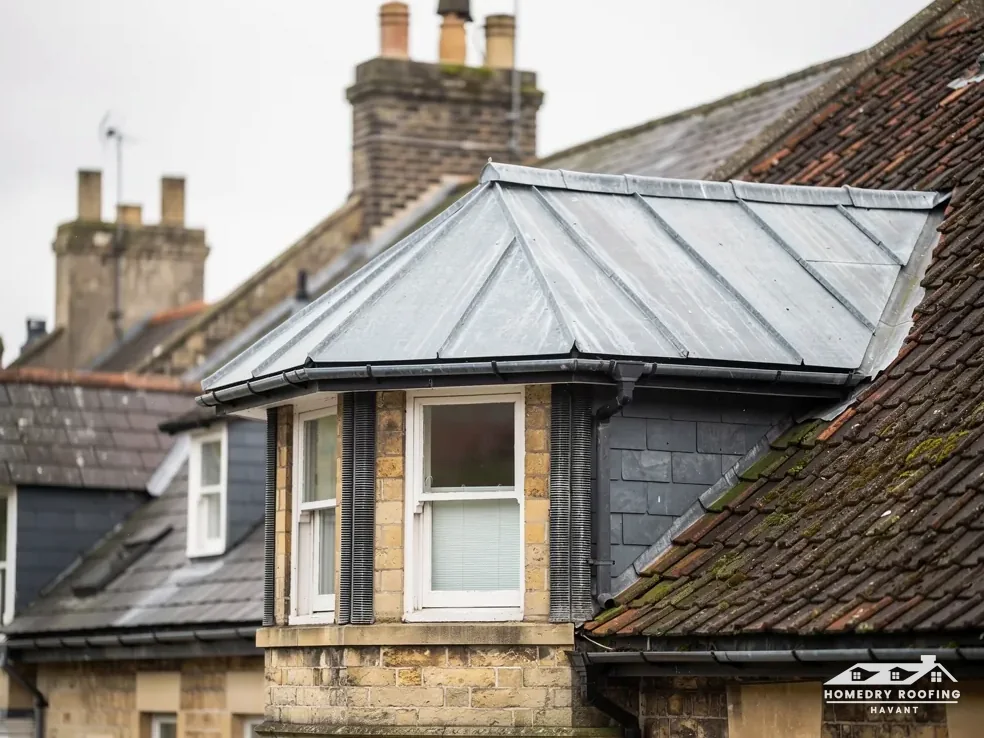
A junction relies on the metal that bridges it.
Roofs that meet walls rely on a thin strip of metal, and in Oving that strip gets the first part of the survey. The flashing is followed along its length, edge by edge, for lifting, for open laps and for a gap in the mortar line cut above it. Indoors, the same wall is checked from the loft, where a stain line on the timbers shows that the junction has been leaking. Tiles that have slipped next to the wall are included, since they can pour extra water onto the very same corner. Our leadwork page describes the lead itself, and the survey tells you which lengths are worth keeping and which have had their day. A flashing that is sound is left alone.
The National Heritage List has plenty of Grade II entries for Oving, The Parish Church of St Andrew, The Almshouses and Manor Farmhouse among them. Worship continues at St Andrew's, which makes it a Church of England church in use, so repairs to the building are decided through the faculty system and not through the council's listed building consent. Your own house is a separate matter. If it carries a list entry, listed building consent comes into play for anything that alters its character, so read that entry closely before any date goes in the diary.
Oving also has a conservation area, whose boundary Chichester District Council can confirm for your address. Rights can also be withdrawn by an Article 4 direction, and your own road can only be settled by the council, so check with Chichester District Council before planning anything beyond a repair. Our planning guide for roof work covers the rules that govern a roof and leaves the survey findings to this page.
A flashing that looks sound from the lane can be failing where the wall meets it, so it is read twice, once from the ladder and once from the loft. When the stain indoors lines up with the junction outdoors, the cause is found. We photograph the lifted edge or the open lap and show you, and the repair covers the length of lead that has failed, which may be longer than the spot that dripped.
A brown ring on the ceiling beside a chimney breast, or a damp patch on an upstairs wall that returns after every wet spell.
A lifted lead edge at the wall, or a missing stretch of mortar in the line above the flashing.

A pool that stays on the covering means the water has no fall to follow or the outlet is choked, and each fault has its own repair. We clear the opening first, watch where the water sits next, and then explain whether the covering needs relaying or only cleaning.
Gutters finish the roof's work, and a ladder is the best way to judge them. Each joint is checked for a drip, each bracket for a run that has started to sag, and the whole length for the slope towards the outlet; a channel that holds a pool is wrong even if it has not yet overflowed. The fascia and soffit boards behind are probed with a thumb for softness, because timber that has been wet for a season will not take a new screw. Moss and silt are cleared by hand as we go, which shows the true state of the gutter bed beneath and lets us judge the fall without debris hiding it. When a whole run has to go, our gutters, soffits and fascias page sets out the choices.
Flat roofs on extensions and porches are read in a different order. The covering rises against the house wall in an upstand, then falls gently towards a single outlet. We check the top edge of that upstand, look for any shallow pool on the surface, and look into the outlet itself. A pool points to a fall that is wrong or an opening that is blocked; the first needs the covering relaid, the second needs clearing, and the survey tells you which one you have. Our flat roofing page describes the coverings we lay.
According to the Environment Agency, Flood Zone 3 land lies near Oving. That describes flooding on the ground, and it places no condition on a roof covering, yet it makes the foot of each downpipe worth a glance. A downpipe that discharges beside a wall earns a photograph and a suggestion: carry the water further out, to ground that can drain. The covering itself stays as the survey finds it, and nothing on the flood map alters how it is fixed.
The roof ends where the pipe empties, not where the gutter stops.
A downpipe is the end of the roof's route, and the survey follows the rain to where it leaves the building. We look at the shoe at the bottom, the gully it feeds, and the ground around it. If water is dropped onto a path, a step or the foot of a wall, it goes into the photographs, so the fix is a longer shoe or a different outlet.
Map of Oving and the places around it, with the dashed line of our 30-mile service area from Havant. The same places are listed below the map.
Along every junction between slope and masonry, the lead is traced from end to end. We note lifted edges, laps that have opened and the mortar line cut into the brickwork above. Then the loft is checked beside the same wall, since a stain on the timbers shows that water has been arriving and whether the slope next to it feeds the same spot. You are given photographs and an opinion on whether the metal can be repaired or a length needs renewing, with the reasons set out in plain words and no jargon left unexplained.
The Planning Portal sets two tests that apply together: the work should affect less than 25 per cent of the building envelope and less than 50 per cent of the roof before an application can be skipped. Separately, a new covering that weighs 15 per cent or more above its predecessor needs approval. For Oving addresses, Chichester District Council's building control team hears about the plan from us ahead of the first tile coming off, and what comes back reaches you in plain words, so you decide on facts and not on hope, and the reply can be kept for your records.
Scaffolding on the road or pavement is licensed under section 169 of the Highways Act 1980. In Oving, scaffold licences come from West Sussex County Council, whose fee is £266 for one month, with at least 10 working days' notice requested. We arrange the licence with our scaffolder and fit the start around that notice, so the date agreed with you can be relied on. Whether the scaffold is inside a quote's total is worth putting to any firm; ours states it, and there is nothing further for you to chase. We also look at where the poles would stand.
Listed Grade II, The Parish Church of St Andrew holds Oving's worship, and it continues as a Church of England church. Works to a church in that position go through the faculty system of the Church of England, which takes the place of listed building consent for it. The Almshouses and Manor Farmhouse have list entries of their own, so listed building consent applies to work that changes their character. Search the list for a listed address before anything is ordered or a date is fixed, and tell us at the survey if yours is one.
Ask Chichester District Council, which holds the boundary and can confirm whether your address falls inside the Oving conservation area. Further rights may be lost under an Article 4 direction, and for one single road it is the council that can answer, so check with Chichester District Council. Our roof-work planning guide lays out the rules, and the survey notes anything on your roof that could matter to the council. A short call or email with your postcode is enough to get the council's answer.
No. The Environment Agency places land near Oving in Flood Zone 3, but that is about flooding at ground level and imposes nothing on roof coverings or fixings. Where it does matter is drainage: a downpipe that empties against the foot of a wall adds to the damp at its base. At the eaves we note each outlet and propose a change wherever one runs somewhere unhelpful. Everything else we examine belongs to the roof, whose needs decide the covering, never the flood map, so nothing about the quote changes because of it.
Go outside the morning after a wet night and see whether water is still lying on the covering. A pool that stays points to a wrong fall or a blocked outlet. Then check the upstand where the covering rises against the wall for splits or lifting, and look at the pipe below the outlet to see where the water goes. Photographs taken that day help us, and you learn whether a mend will hold or the covering must go down again, with the reasons written out for you. A damp patch on the ceiling below, or a bubble in the covering, is worth showing us as well.
Once the survey is done, never before it. Someone has to climb up and look, so that the figure describes what the roof needs and is not a guess made from the road. It comes as one total in writing, and sets out if VAT and scaffold are part of it. A repair that will hold comes first, and a repair that would fail is explained with photographs. The quote is a good and fair one for what that particular roof needs, and the garden and drive get swept before we go. Ask any other firm whether scaffold and VAT sit inside its figure, and compare the two on that footing.
You'll get one written total price.
Fill in what you like. It opens WhatsApp with your message ready to send.