
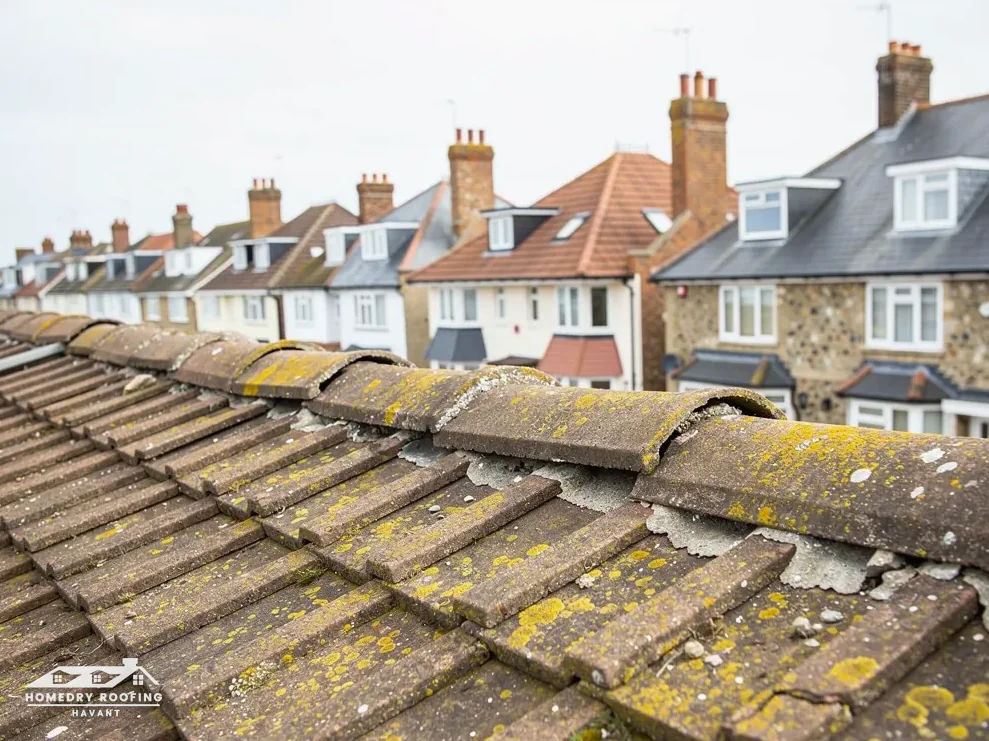
Hips
The slanting line where two roof planes meet at an outside corner.
Tiles along it are fixed on the diagonal, so one that slides leaves a gap running downhill.

Boxgrove is 14.9 road miles east of Havant. Its hips, slopes and eaves are traced from the crest down to the gutter, and one written total price follows the survey.
10-year workmanship guarantee, in writing
The slanting line where two roof planes meet at an outside corner.
Tiles along it are fixed on the diagonal, so one that slides leaves a gap running downhill.
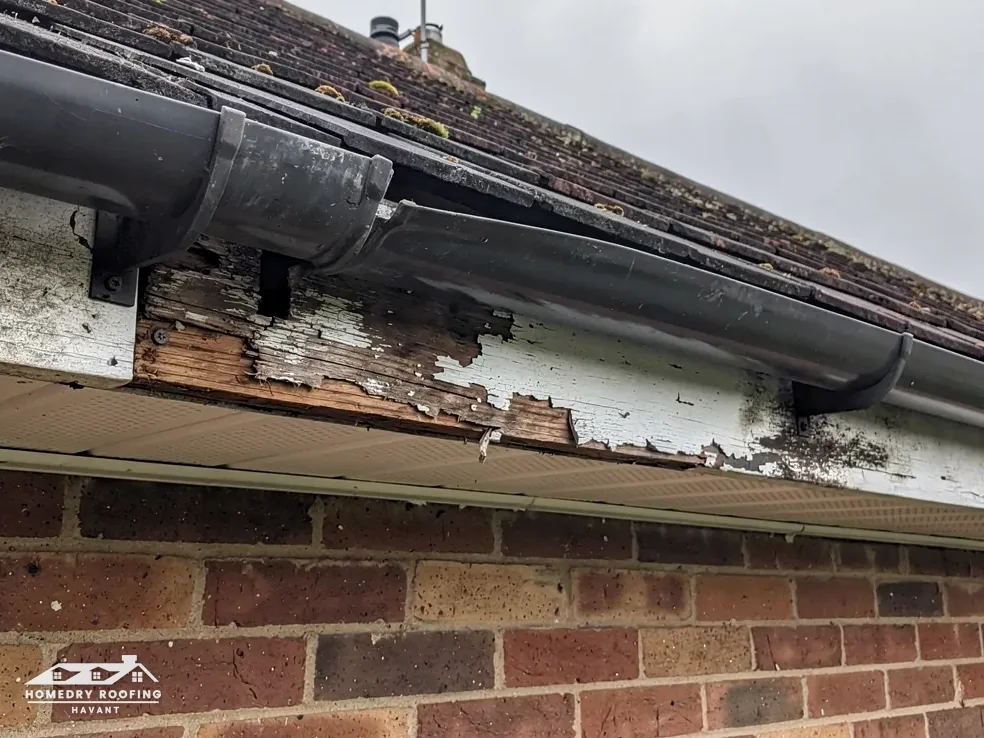
The boards beneath the eaves that close the gap between wall and roof edge.
Once one softens or splits, rain reaches the rafter ends it was shielding.
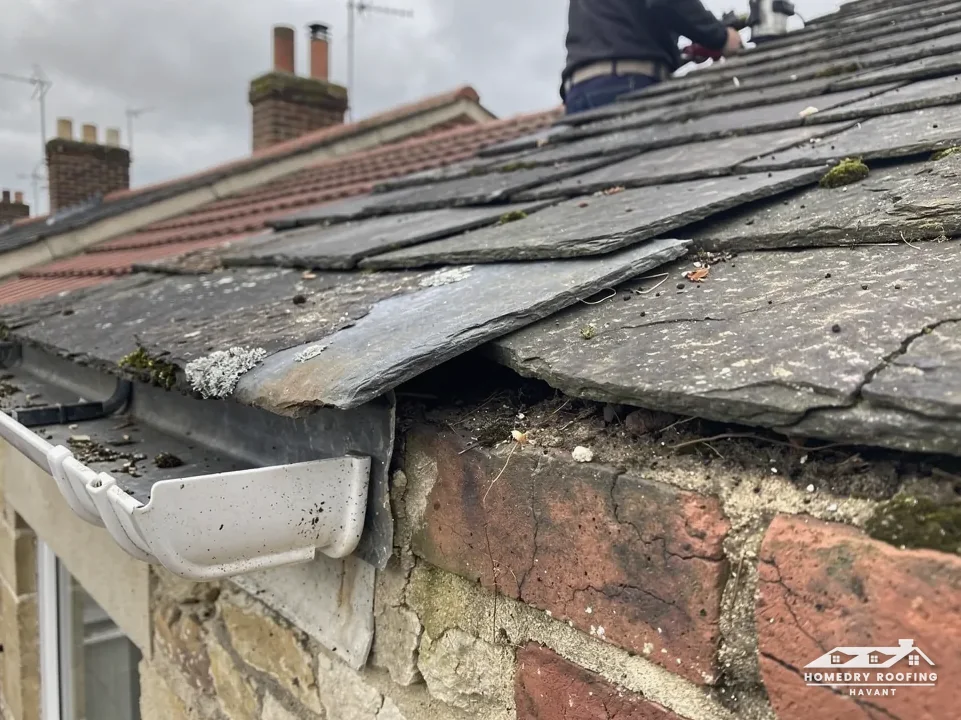
The inward fold where two slopes meet and a single lining takes the water of both.
Debris packed into the fold makes the lining carry a load it was never fitted for.
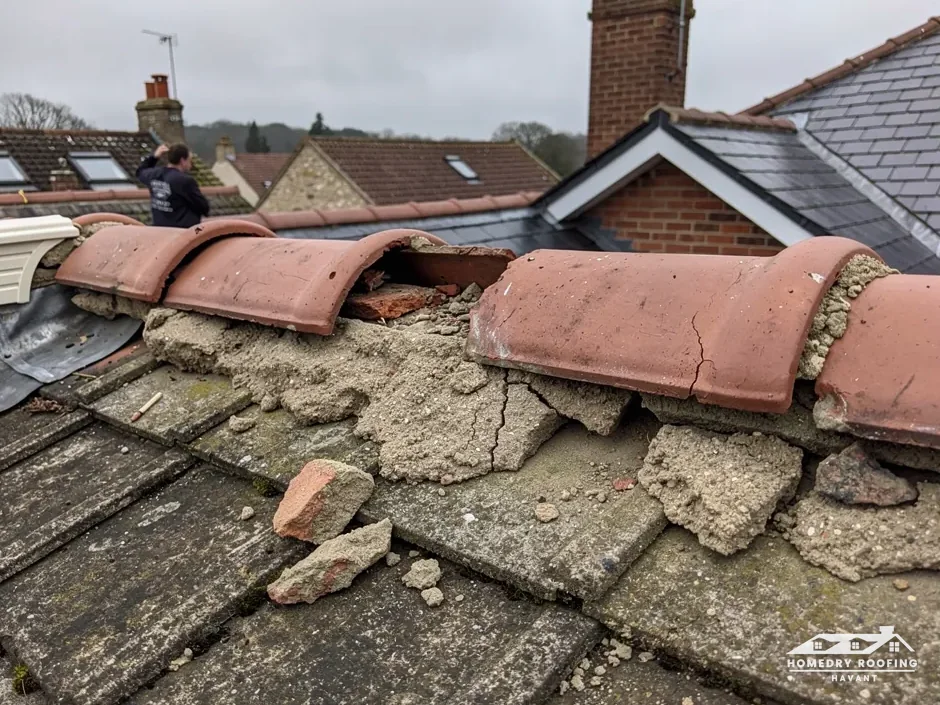
A hip end is exposed on two sides, and its fixings carry the load.
A hip is the slanting line where two roof planes meet at an outside corner, and the tiles that cover it are fixed along the diagonal. In Boxgrove we look along each hip from the ground and again from the ladder for tiles that have slid, for open joints where it lands on the eaves, and for the end tile at the top. A hip end is exposed on two sides, so its fixings are tested by hand, one after another. Across the slopes we look for tiles that are cracked, slipped or missing, and for moss packed into the courses. Our pitched roofing page covers re-covering a slope, and our roof repairs page covers the smaller fixes.
Inside, the same roof is read from beneath. We look for pinpricks of daylight between the tiles, for dark rings on battens and rafters, and for insulation that has gone damp at the eaves. A stain can sit well away from the fault that made it, because water runs along timber before it drops, so the mark we find is followed uphill to where it started. Photographs from both sides go into the findings, which means you can compare the tiles outside with the staining inside.
Boxgrove carries Grade I listings for the Priory Church of St Mary and St Blaize and for the Ruins of the Monastic Buildings of Boxgrove Priory, and Nightingale Cottage is listed Grade II. Worship goes on in the priory church as part of the Church of England, which puts its repairs under the faculty system and not under the council's listed building consent. A listed house of your own is another matter, and listed building consent covers any work that touches its character.
Because hip tiles are cut and fixed on a slant, a slid tile leaves a gap that runs downhill, and that gap is easy to miss from the lane. We count the tiles along each hip against the fixings holding them, and photograph any that move. The repair may be a matter of refixing the ones that have come away, with the sound ones left in place so the line stays as it is.
A thin line of daylight in the loft beneath a corner of the roof, or a stain on the wall plate below a hip.
A slid tile along the hip, or an open joint where the hip lands on the eaves.
A board that has taken water gives under a thumb long before it shows a hole. Pressing it tells us how far the softness runs, and whether a new board would meet sound rafter ends or soft ones.
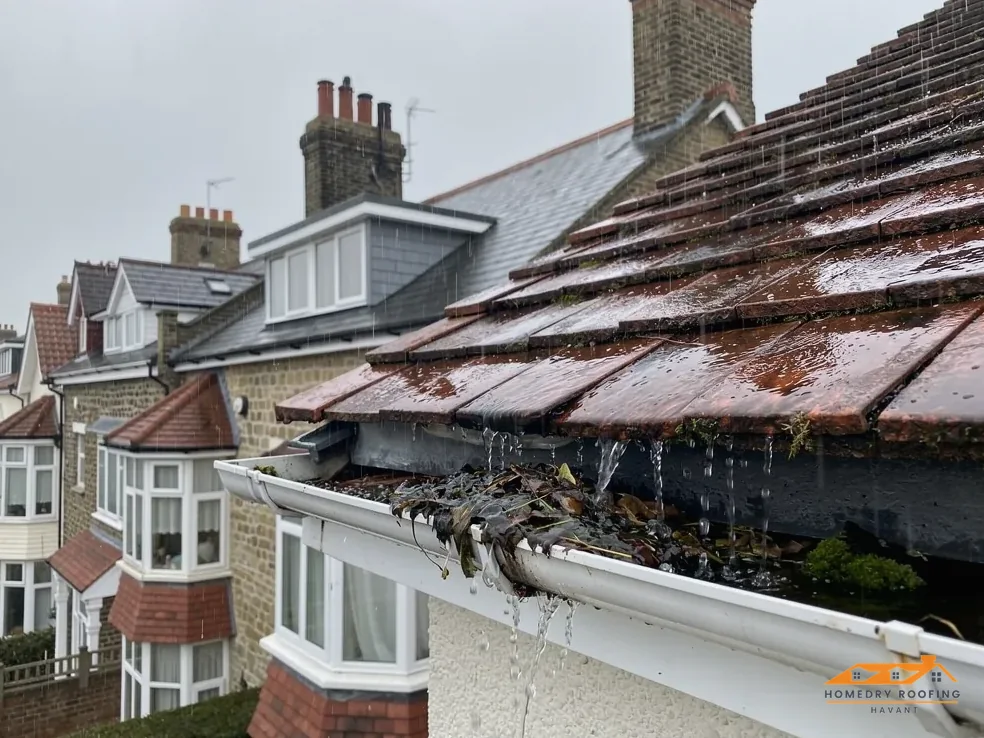
The eaves are the last stop for a roof's water, and they are made of several parts that all have to agree. The gutter sits on brackets screwed to the fascia board, the soffit board closes the underside between that board and the wall, and the rafter ends sit hidden behind both. We press each fascia and soffit for softness, look at the paint for blistering, and follow every gutter joint by eye for drips. Where a board has failed, the rafter ends behind it get looked at before anything new is fixed, because a fresh board screwed to soft timber has nothing sound to hold it. Any run that has to be renewed is measured on the day, so the written price rests on real lengths and not estimates. Our gutters, soffits and fascias page shows the options for a replacement run.
Two conservation areas lie near the village, Boxgrove and Halnaker, and the planning officers of Chichester District Council can place your address in relation to each. An Article 4 direction can reach a single road, so check with Chichester District Council on that as well. Boxgrove Priory is a scheduled monument, and works to a scheduled monument need scheduled monument consent, so a roof beside the priory grounds is worth a question before it is touched. Our planning guide for roof work covers the rules.
The centre of Boxgrove lies outside the South Downs National Park, though the Park touches the area round it, so an address on the edge may come under the National Park Authority. Building control is separate and stays with Chichester District Council's building control team whichever authority handles planning. A scaffold on the road is licensed by West Sussex County Council, and we arrange the licence with our scaffolder; your written price says whether it is inside the total.
Behind every fascia board, the rafter ends are doing quiet work.
The visible face of the eaves is only part of it. Behind a fascia board the rafter ends carry the weight of the roof edge, and a gutter that has leaked for a season can have softened them without a mark showing outside. We probe what can be reached, tell you what we find, and say whether new boards would be fixed to sound timber or whether a rafter end needs attention first.
Map of Boxgrove and the places around it, with the dashed line of our 30-mile service area from Havant. The same places are listed below the map.
From the ground we sight down the hip for tiles that have shifted, then go up and press the hip end, where two edges are exposed and the fixings carry the most. Each tile along the diagonal is tested by hand, and the joint where the hip lands on the eaves is looked at closely, together with the tiles either side of the line, since they can show movement too. Under the corner, the loft is read for daylight and for staining on the timbers. You receive photographs and a view on whether refixing will do or the line should be relaid, with the reasons set out.
Works to a scheduled monument need scheduled monument consent, and carrying them out without authority is an offence, but that applies to the monument and not to every house nearby. The entry for Boxgrove Priory on the National Heritage List shows what is scheduled, and Chichester District Council can help if your address sits close. Tell us at the survey if your roof is near the priory grounds, and nothing will be ordered until you know which rules apply. A short note of the answer you were given, kept with the survey sheet, saves anyone repeating the question later.
The church is listed Grade I and is in use for worship as a Church of England church. For a church in that position, repairs go through the Church of England's faculty system, which stands in for the council's listed building consent. The Ruins of the Monastic Buildings of Boxgrove Priory are listed Grade I as well, and Nightingale Cottage is Grade II, so a listed cottage or house is a separate case, where listed building consent applies to work changing its character. Read the entry for any listed address before a date is fixed, and show it to us at the survey so the plan can allow for it.
Halnaker and Boxgrove are the two conservation areas near the village, and Chichester District Council is where to ask whether your address falls within either. Boxgrove is in the district council's records and Halnaker in the National Park Authority's, though that council answers for both. An Article 4 direction can take further rights away, and only the council can answer for a single road, so check with Chichester District Council. The roof rules are set out in our planning guide for roof work, and the survey sheet records what you were told and when you were told it.
In the Planning Portal's guide an application can normally be skipped if less than 25 per cent of the building envelope and less than 50 per cent of the roof is affected. A new covering 15 per cent or more heavier needs approval regardless. For Boxgrove addresses, Chichester District Council's building control team is told about the plan before work starts, and its answer comes back to you in plain words, so a heavier covering is never discovered after the first tiles are up. Nothing about the tests changes because a house is old or sits near a priory.
Licences for scaffolding on the road here come from West Sussex County Council, at £266 for one month, on at least 10 working days' notice. The legal basis is section 169 of the Highways Act 1980. We arrange the licence with our scaffolder, and we agree the start date with you around that notice. Whether the scaffold sits inside a quote's total is a fair question to put to any firm you ask. We also note where the scaffold would stand, because a licence comes into it only when the scaffold stands on or over the highway.
The centre of Boxgrove lies outside the South Downs National Park, though the Park touches the area round it, so an address on the edge may fall to the National Park Authority. Chichester District Council processes applications for the Authority in its part of the Park. Building control is not the Authority's service and stays with the district. Ask which authority covers your address before planning anything beyond a repair, and let us know the answer, so that the survey and the paperwork are addressed to the right body from the first page.
It covers the job as the survey found it, one total in writing, with a line stating if VAT and scaffold come within it. Nobody can price a roof they have not climbed onto, which is why the figure comes after the visit and never before. A repair that will hold comes before any replacement, the price is set fairly, and tiles, offcuts and packaging are cleared away before we leave. Two quotes only compare once each states what it includes, and the total is laid out so a reader sees at once what it covers.
You'll get one written total price.
Fill in what you like. It opens WhatsApp with your message ready to send.