
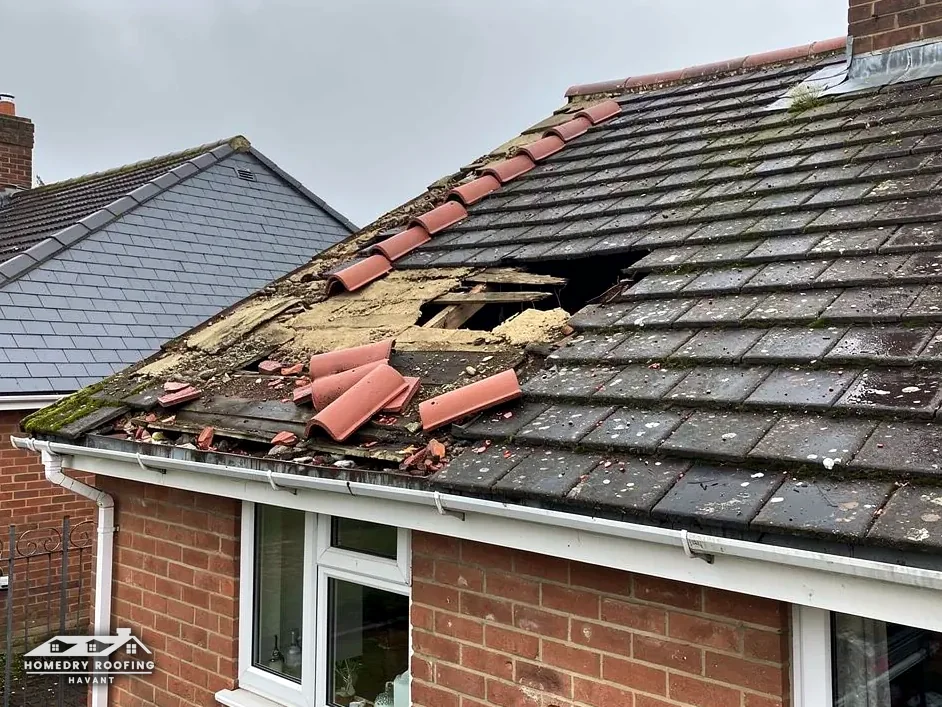
Hips
The sloping line that runs down a corner where two roof planes meet.
A shifted cap along it, or a loosened fixing at its foot, lets rain through.
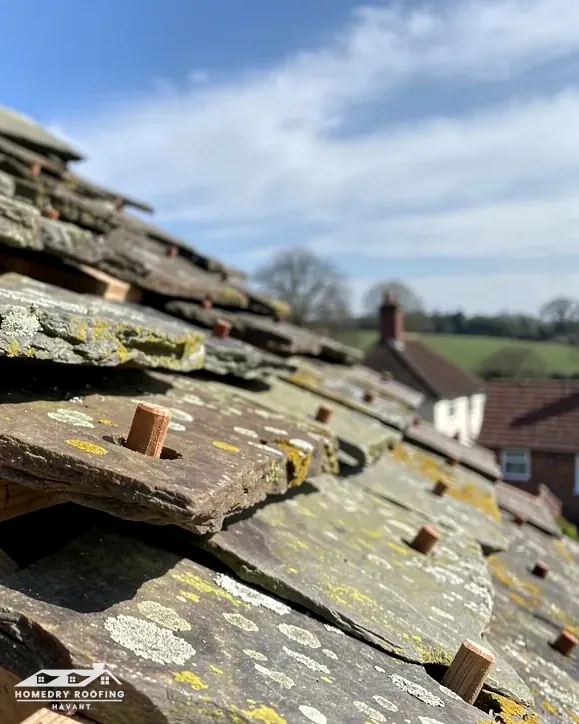
Westhampnett is 13.1 road miles east of Havant; slopes, battens, eaves and downpipes there are examined from the loft and the ladder, with a single written total at the end of the survey.
10-year workmanship guarantee, in writing
The sloping line that runs down a corner where two roof planes meet.
A shifted cap along it, or a loosened fixing at its foot, lets rain through.
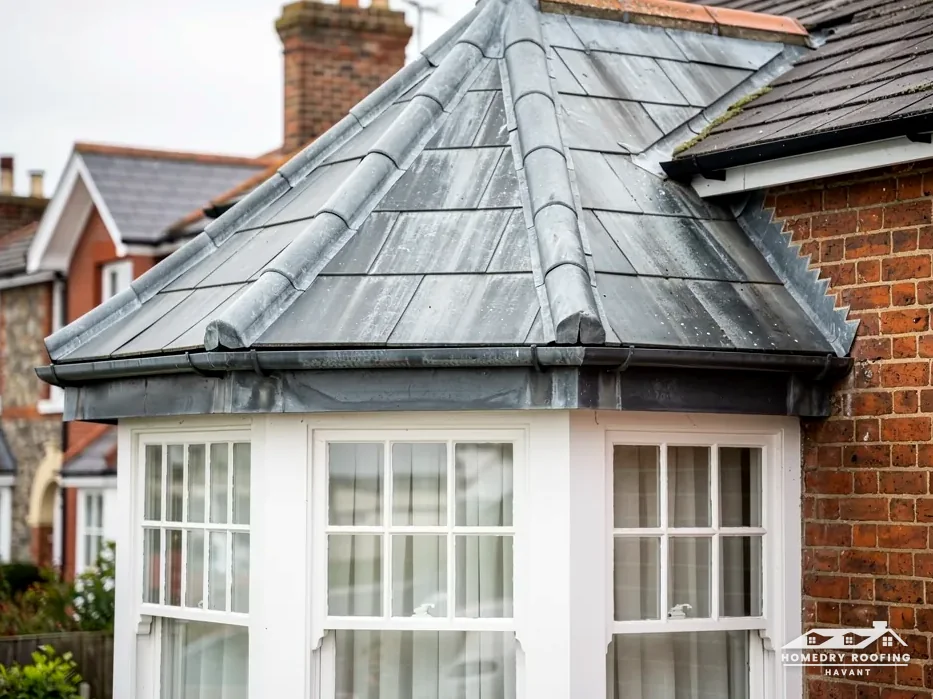
Where a roof slope butts against a taller wall and a flashing covers the join.
Should the top of that flashing lift, the wall behind it takes the rain.
The upright pipe that brings gutter water to a gully or a soakaway at ground level.
A loose clamp, or a shoe that misses the gully, splashes water onto the wall.
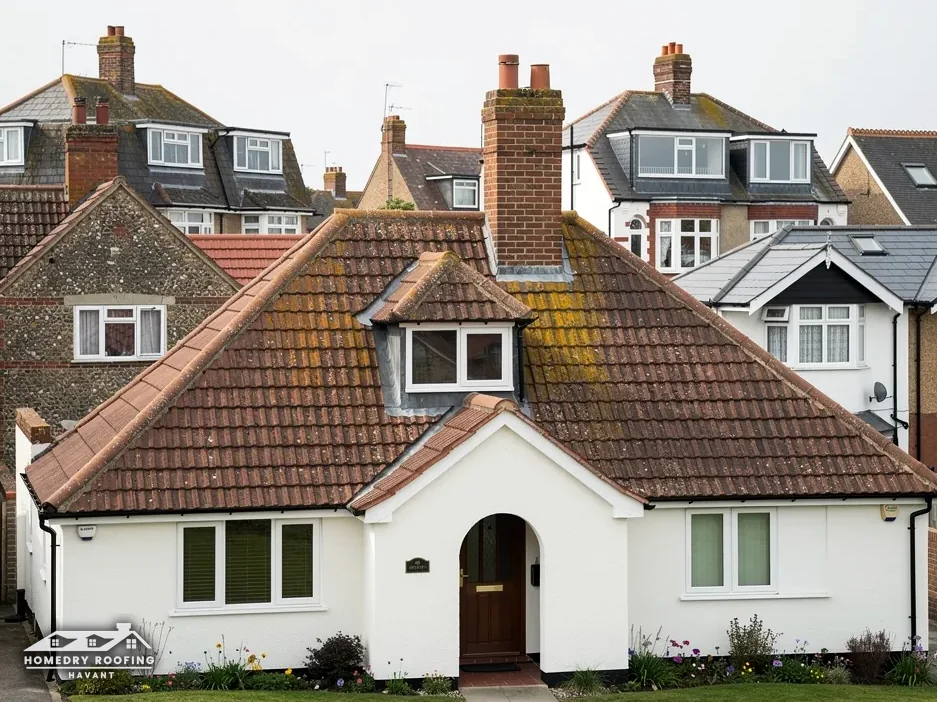
Much of it can be read from the loft and the ladder. Daylight at joints, darkened battens and stained underlay show where moisture has been, and slipped or cracked pieces show from outside. Nothing is lifted unless the findings call for it, and then only the area concerned.
A covering stays on only as well as whatever holds it down, so the survey looks beneath the surface. Outside, we note pieces that have slipped, cracked or gone missing, and the staining that marks a spot where water has stood. Inside the loft, the underlay is followed from eaves to ridge, the battens are read for darkening and softness, and nail heads and clips are checked for movement. A single cracked piece is a small job; a run of them across one slope says something about the fixings underneath, and the report records which of the two you have. Our roof inspections page describes a visit of this kind, and the roof replacement page covers the point at which patching stops being sensible and a new covering is priced.
Westhampnett House is listed Grade II, and so is the Dovecot at Westhampnett House to the South East of the House. The Parish Church of St Peter has a Grade II* entry; as a Church of England church in use, it is handled through the faculty system, and the council's listed building consent plays no part. A dwelling on the list follows the council route: consent under section 7 of the Planning (Listed Buildings and Conservation Areas) Act 1990 comes first for works "in any manner which would affect its character as a building of special architectural or historic interest", and each roof change is judged against those words.
Conservation areas around Westhampnett include Graylingwell, Chichester and Tangmere, and Chichester District Council can say whether an address sits inside any of them. Any Article 4 direction on your road falls to that council as well. The planning guide for roof work holds the rules; they are not repeated here.
What holds the covering down matters as much as the covering.
From inside the hatch, a roof tells a different story. Daylight at a joint, a darkened batten, an underlay torn at a nail and a trail of staining down a rafter each point somewhere definite. Photographs from the loft sit beside the ones from the ladder in your report, so a spot seen from below can be matched to the spot seen from above, and the cause is established, not guessed.
A patch on the ceiling that stays dry for weeks, then darkens again once a night of steady rain has fallen.
A cracked or slipped piece of covering, or a torn patch of underlay beneath it, directly over the stained spot.
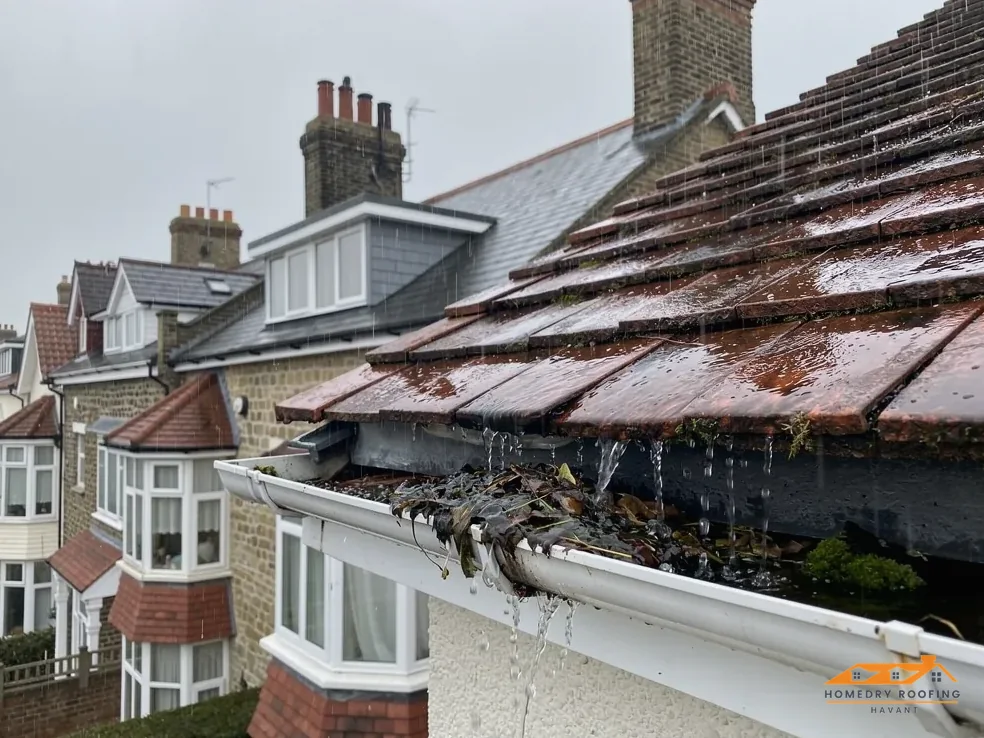
The last metre of drainage can undo a good roof.
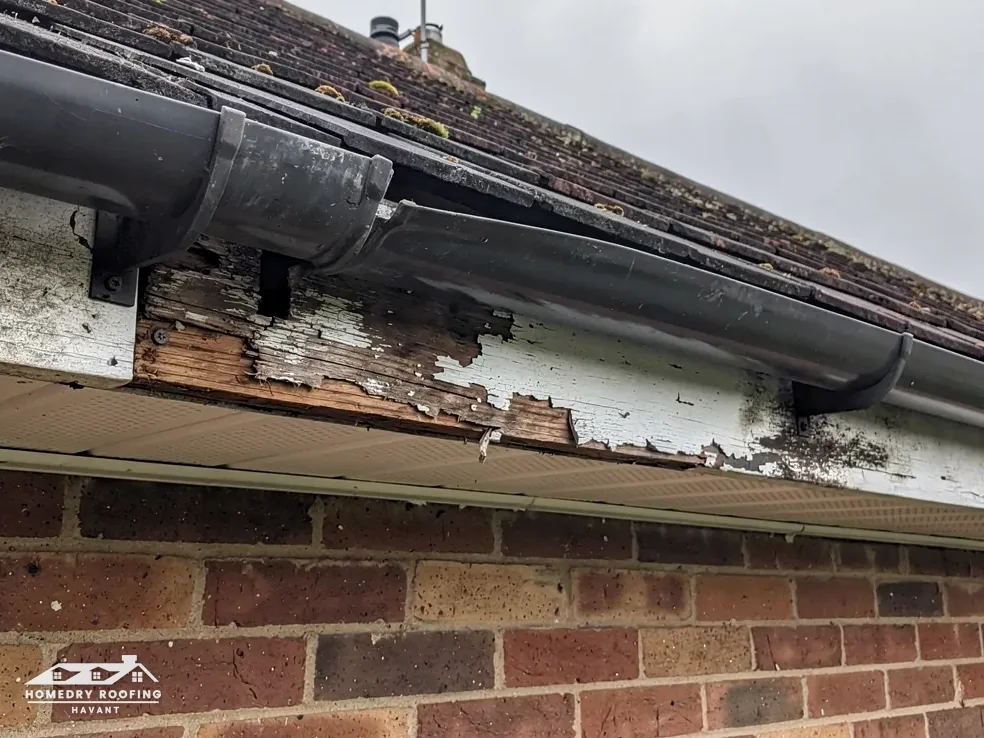
Where the roof stops, the wall begins, and the eaves are the join between the two. The fascia faces outward along the front of the overhang, the soffit is the board beneath it, and the gutter hangs from the first. We press the timber with a thumb for give, look along the soffit for brown stains and gaps, and run a hand beneath the gutter for drips at the joints. A board that has gone soft has been wet for some time, so the question becomes where the wet came from: a joint above, a gutter below, or a downpipe discharging in the wrong place. The guttering, soffits and fascias page covers the repairs.
Each downpipe finishes over a gully or feeds a soakaway, and what happens at that last point matters. We look at the shoe of the pipe, whether it sits over the gully, and the clamps that hold the run to the wall. When a run has sagged away, water splashes against the wall face and wets it, which shows later as a dark or green patch there. Gullies clogged with silt and leaf mould are reported to you because they sit exactly where the work of the roof ends, and clearing one is a short job done with a trowel, a bucket and a hose.
The visit closes the way every Westhampnett visit does: the ladder is lowered, the path is swept clear, and the paperwork says in plain terms what was found and where. If the eaves need only a clean and a refix, that is what the report states, and a larger job is not made out of it. Repair comes first wherever the timber behind is firm, and replacement is proposed only once the board will no longer hold a fixing, and the reason is shown to you on the board itself.
Rain that has run the whole way from the ridge still has to go somewhere. We follow it out of the downpipe and watch where it lands: onto a wall, across a path, or into a gully that carries it off. A sound slope may still leave a wall wet because its last metre of drainage is wrong, and that final stretch is as much a part of the survey as the slope itself.
Map of Westhampnett and the places around it, with the dashed line of our 30-mile service area from Havant. The same places are listed below the map.
From the hatch our torch runs along the battens for darkened or soft timber, because a batten that has been wet for a while shows where moisture has been reaching. Tears at the fixings and sagging between rafters are looked for in the underlay, and daylight showing through a joint marks a gap in the covering. Pieces that have slipped or cracked are logged from outside, slope by slope. Together these say whether the roof wants a local repair or whether the covering as a whole has reached the stage where patching stops being sensible, and photographs put the evidence in your hands.
It can, and the Planning Portal draws the line. Two measures decide it for building regulations: less than 25 per cent of the building envelope and less than 50 per cent of the roof, in which case no application normally follows. Approval is required for a covering 15 per cent or more heavier, regardless of area, so a change of material is raised with Chichester District Council's building control team before anything is ordered. Planning is a different matter, turning on the house and what surrounds it, and our planning guide sets the rules out with their sources so you can follow each one back.
Scaffolding put up over or on a public road requires a licence under section 169 of the Highways Act 1980. For Westhampnett that means West Sussex County Council, which licenses scaffolding on the highway at £266 for one month and asks for at least 10 working days' notice. The date is agreed with you at the survey and not after it, since the period is fixed when the licence is granted, the position of the tower is marked in the report so everyone works from one plan, and we arrange the licence with our scaffolder.
The Parish Church of St Peter holds a Grade II* listing and is a Church of England church in use, so the faculty system covers works to it; the council's listed building consent is not the route. Westhampnett House and the Dovecot at Westhampnett House to the South East of the House are each listed Grade II, and for a dwelling on the list, consent from the council is required whenever the work would change its character. To learn whether your house is listed, search under its address at Historic England, and bring any entry you find to the survey, so the roof is recorded with it in mind.
Graylingwell, Chichester and Tangmere are among those around the village. Whether your address falls within one is a question Chichester District Council can answer, and a call to it settles the matter faster than guessing, whatever the people next door were told about theirs. Article 4 directions can withdraw further permitted development rights, so raise your road directly with the council, then save the reply. Our planning guide collects the roof-work rules with the source of each, which lets you put an exact question to the council.
Land near Westhampnett lies in Flood Zone 3 according to the Environment Agency's map, and your own address needs its own look-up there before you read anything into it. The map concerns flood risk to land, a subject apart from the roof, and we do not make a roofing rule from it. The survey traces rain from the covering down through gutter, pipe and gully, and a gully that is silted or blocked is reported to you because it sits where the roof's job ends. That part of the work is about keeping rain moving away from the walls and off the path beside the house.
The code of practice, BS 6229:2025, asks for a finished fall of at least 1:80 on membrane flat roofs, so the design falls more steeply to leave a margin for tolerances on site. It does not cover lead roofs, which follow other guidance. A pool still standing a day after rain on an existing roof suggests either that the fall is lost or that the outlet is clogged, and the survey tells you which of the two it is, since a clogged outlet is simply cleared whereas a lost fall calls for the covering to be laid again, a larger undertaking that deserves a reason in writing.
Read it for what it names: the covering, the work, the extras such as scaffold and VAT, and the survey findings it rests on. A single written total is simpler to compare than several partial figures, and ours arrives after the survey, with repair put forward ahead of replacement. When another firm's figure is lower, ask it to confirm in writing that scaffold and VAT are inside; if they are not, the gap closes. Each finding in our report carries its own photograph, so the quotation can be checked against the roof by you or by anyone you ask to read it.
You'll get one written total price.
Fill in what you like. It opens WhatsApp with your message ready to send.