

Stacks
The shaft that rises through a slope to carry smoke from the room below.
A cracked joint or a lifted edge of lead at its foot sends rain down the breast indoors.

Tangmere is 15 road miles to the east of Havant; its stacks and flat extension roofs are each looked at, and one written total price follows when the survey is complete.
10-year workmanship guarantee, in writing
The shaft that rises through a slope to carry smoke from the room below.
A cracked joint or a lifted edge of lead at its foot sends rain down the breast indoors.
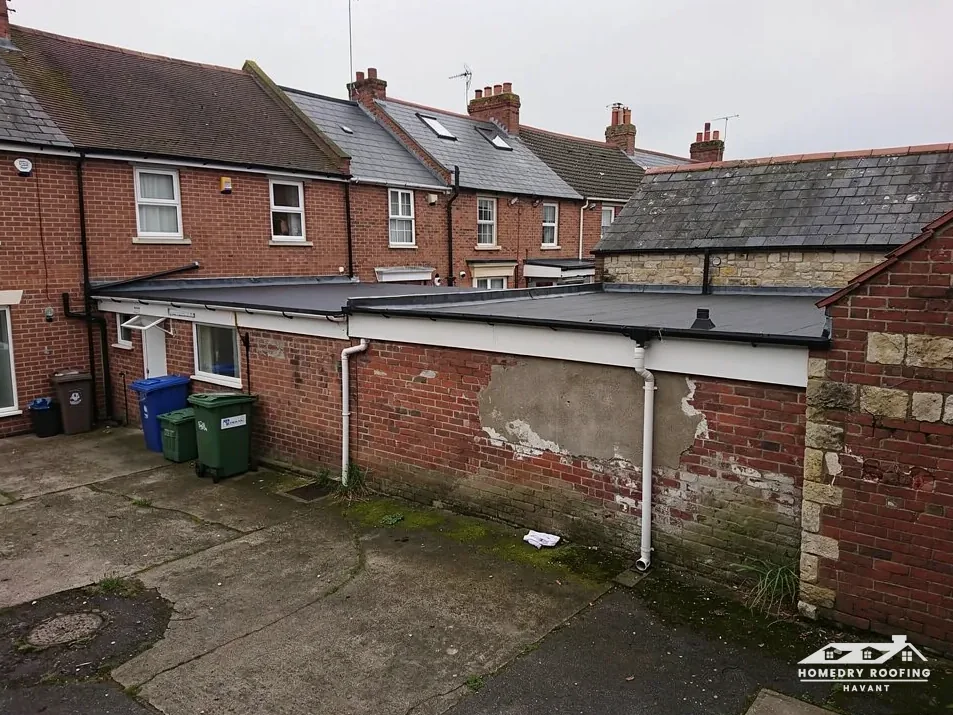
The lip of covering turned up a wall at the back edge of a flat roof.
Where that lip splits or pulls away, rain gets behind it and soaks the wall.
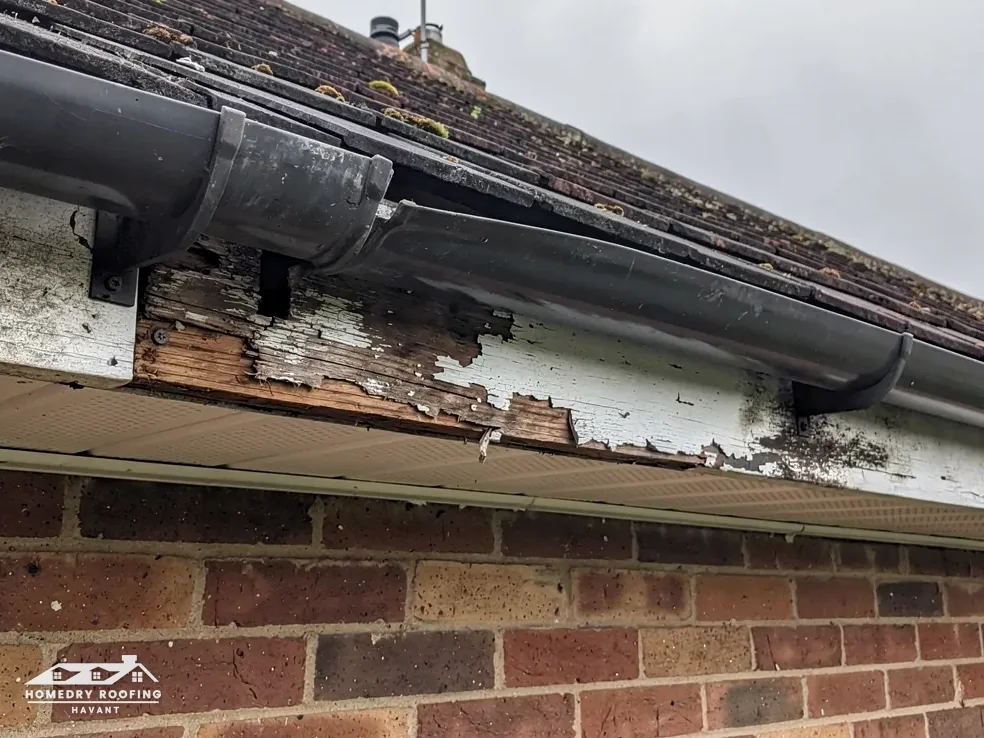
The box-shaped head of a downpipe, taking the flow from a gutter.
A cracked or clogged one spills in a downpour and stains the wall beneath it.
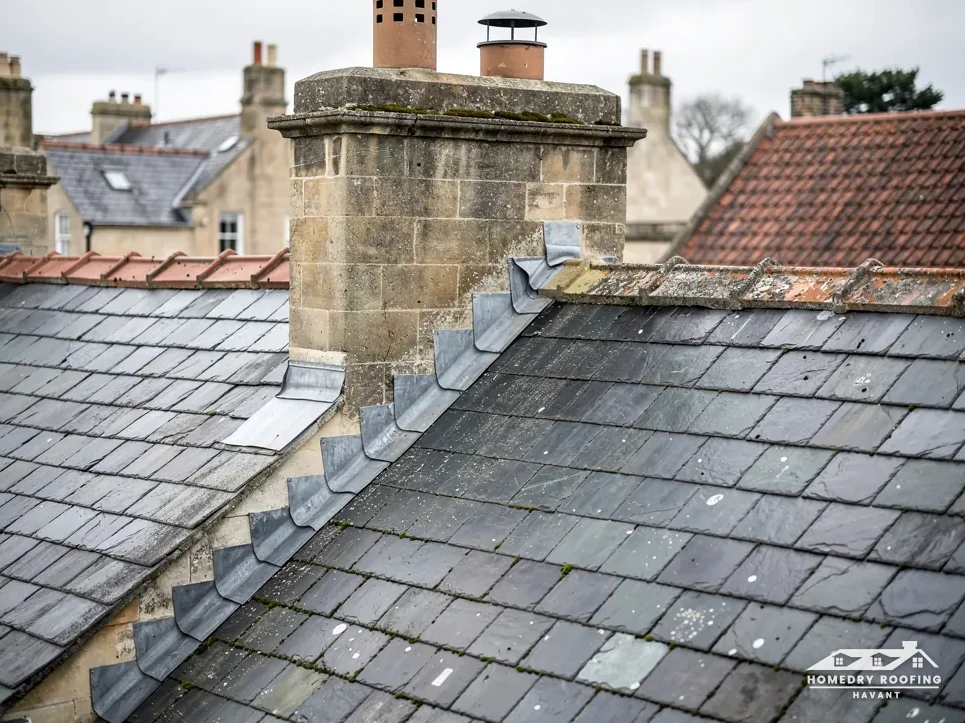
A stack stands or leaks by the lead round its foot.
Where a chimney stack leaves the slope, three layers meet: lead dressed over the tiles, a mortar fillet along the top edge of that lead, and the pointing of the stack above. We read them one at a time from the ladder, noting lead that has lifted, fillets that have cracked, open joints in the brickwork, and any movement in the cappings and pots. Inside, we put a torch round the breast in the loft and look for a dark ring on the timbers, because that ring tells us the stack has been leaking. Chimney work is described on our chimney repairs page, and the flashings are described on our leadwork page.
In Tangmere, Grade I listing is held by The Parish Church of St Andrew, while Amberley Danby and Austens each carry Grade II. Because the church is a Church of England church in use, any repair to it goes through the faculty system, so the council's listed building consent plays no part. If you own a house with a list entry, the reverse holds: listed building consent is needed whenever work would alter its character, and the entry names exactly what is protected.
The roof round a stack is examined with the same care as the stack. A tile that has slipped alongside the masonry, a gutter spilling onto it or a cracked cap can each feed a stain at the breast, so the survey follows a mark back to its source before any repair is named. A small fix at the foot of a stack is offered ahead of a rebuild higher up, and the photographs show which of the two the stack needs. Where the mortar round the stack has gone, repointing may be all it needs; where bricks have lost their faces, we say that too.
A stack can stand upright and look finished while its foot is failing. The cracked fillet or lifted lead edge only shows once we are close enough to touch it. Photographs are taken of each layer in turn, and the ring in the loft shows whether the fault has been feeding the stain, which helps separate a patch from a proper repair.
A dark ring on the loft timbers round the flue, or a brown mark on the wall beside the fireplace.
Lead lifted at the stack's foot, or a crack in the mortar fillet above it.
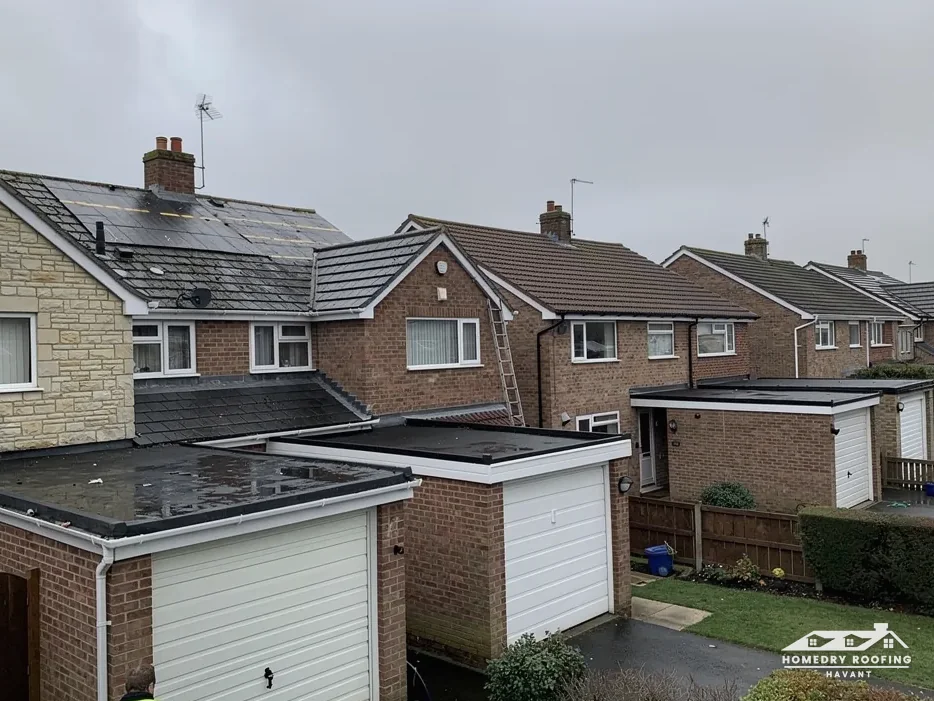
The upstand is where the covering meets the wall, and a split or lifted edge at that line lets water run behind the covering. Starting at the edge shows us the cause before the surface and outlet are examined.
Flat roofs on extensions and garages are read from the wall outward. The covering rises as an upstand against the house, then runs across to a drain. Splits and lifting at the upstand come first, then any pool left on the surface after rain, then the outlet and whatever is packed into it. A pool tells us the fall is poor or the opening is choked, and the repairs for those two differ. Our flat roofing page describes the coverings we lay; whether yours can be mended is for the survey to say. Photographs of the upstand, the surface and the outlet are taken at each step, so you can compare what we saw with what you see from the garden.
Two conservation areas, Boxgrove and Tangmere, sit near the village centre, and Chichester District Council's planning team can check your address against both. An Article 4 direction may take permitted rights from a house, so ask Chichester District Council before you plan work that alters the roof's look, and find out if one covers your road, and what it covers. The planning guide for roof work holds the rules, which keeps this page to the survey.
Gutters and hoppers close the route. A hopper that has cracked or filled with leaves spills in a downpour and runs down the wall, so each one is lifted and looked into. A scaffold standing on the highway requires a licence from West Sussex County Council; we arrange the licence with our scaffolder, and the written quote states if scaffold is part of the total. Where the poles can stand wholly on your own land, that licence does not arise, and we check the ground before we book anything.
With no slope to help, a flat roof leans on its edges and its outlet.
A flat roof has no slope to carry a fault away, so a small failure at the edge does its harm in one place. We look at the upstand first, then walk the surface for dips, then check the outlet and the pipe it feeds. Photographs of each stage go in the findings, and if the covering is sound apart from a blocked outlet, it is cleared and left, not replaced.
Map of Tangmere and the places around it, with the dashed line of our 30-mile service area from Havant. The same places are listed below the map.
Three layers are read in turn: the lead dressed over the tiles, the mortar fillet along its upper edge, and the pointing running up the shaft, with the cappings and pots last. After that comes the loft, where a dark ring round the breast records that water has come through the stack. Tiles that have slid beside the stack are looked at too, since they can feed the same patch. Photographs of every fault go into the findings, with an opinion on whether lead can be repaired or renewed, and why, so the decision rests on what was seen on the day.
An Article 4 direction may withdraw some of the permitted development rights a house normally holds. It is a reason to ask Chichester District Council, which can say whether your road is touched and what the direction covers there; hold on to the reply. The planning guide on this site gathers the roof rules every house shares, and the survey sheet flags any point worth raising with the council before a price is fixed. If the council confirms a direction applies, we adjust the plan around it and the written price reflects that. If you hold a letter or notice about one from the council, bring it to the survey.
Boxgrove and Tangmere are the two conservation areas near the village. Chichester District Council keeps the boundary maps, and from your postcode it can confirm if an address sits within one. An Article 4 direction may take further rights away inside a conservation area, which is why your own road is worth asking about, since the answer can differ between neighbours, before you order anything or agree a start with us. Tell us the answer when you have it, and the survey sheet can name the right body from its first line.
On the list as The Parish Church of St Andrew, it is Grade I, and Church of England worship goes on there, so the faculty system governs repairs and the council's listed building consent plays no part. Amberley Danby and Austens are different: each has a Grade II list entry, and listed building consent applies when work would change their character. Bring the entry for a listed house to the survey, so it can be read before any materials are chosen or a date is fixed. A copy of the entry is kept beside the photographs, and the plan allows for whatever it says about the roof.
Two measures from the Planning Portal decide it: when less than 25 per cent of the building envelope and less than 50 per cent of the roof is affected, an application can normally be skipped. A covering whose weight tops the old one by 15 per cent or more needs approval even then. Chichester District Council's building control team is given the plan before work starts, for Tangmere addresses, and it replies in terms we then pass on plainly, so heavier tiles are caught before the first pallet is delivered. Nothing about the Planning Portal's tests changes because a house stands near a church or inside a conservation area.
West Sussex County Council licenses scaffolding on the highway at £266 for one month, with at least 10 working days' notice, under section 169 of the Highways Act 1980. We arrange the licence with our scaffolder, which spares you any paperwork. Any scaffold wholly within your boundary is a separate matter, and we check where the poles will stand before booking. Ask other firms to state whether scaffold is inside their totals, so the totals can be compared fairly. A licence arises only where the scaffold sits on or over the highway, and we confirm where it will stand on the ground at the survey.
Walk the edge of the covering the morning after rain and see whether water has stayed in any hollow. Look along the upstand for splits or a lifted edge, then check the outlet is clear and see where its pipe empties. A hollow holding a pool means the covering has settled; a dry surface and an open outlet are good signs. Send photographs before the visit if you can, and we will say if a mend will serve or the roof should be relaid. Blistering on the surface, or a damp patch on the ceiling underneath, is worth a photograph too.
One total, in writing, sent once the survey is done, covering the job as found and noting which of VAT and scaffold the figure includes. A repair that would hold is put forward before any replacement, and the price is fair and good for what the roof needs. On the last day we clear tiles, offcuts and packaging. Nobody can price a roof from the road, so the quote waits for the visit; put the same questions to any other firm and the totals line up. A lower figure may simply leave something out, and the written detail shows what.
You'll get one written total price.
Fill in what you like. It opens WhatsApp with your message ready to send.