
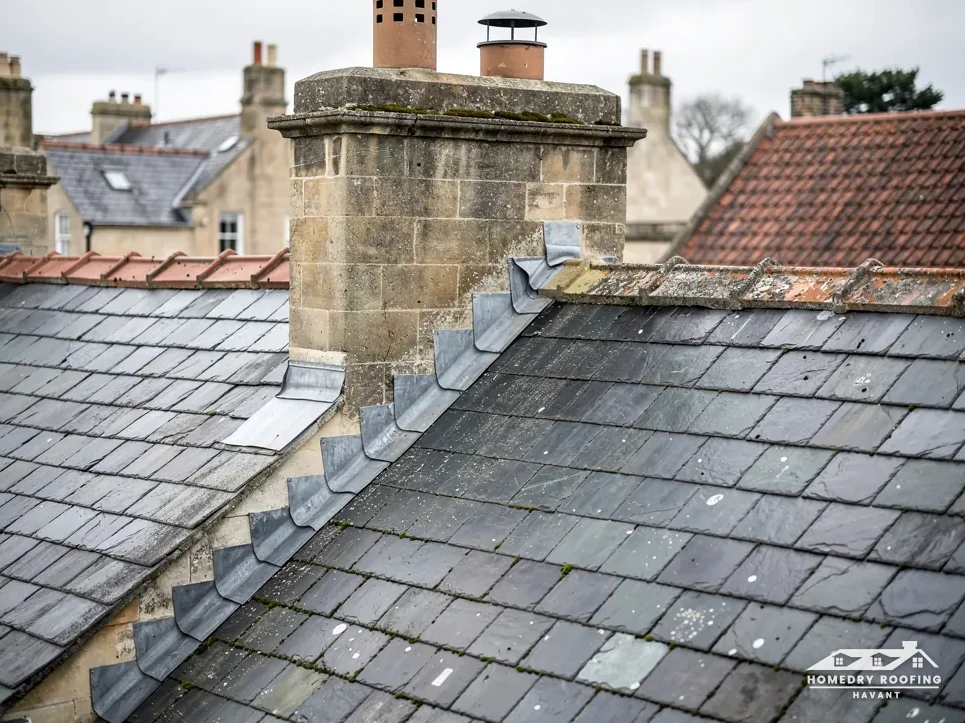
Flashings
The strip of metal that dresses a slope into a wall or around the base of a chimney.
Lifted lead, or pointing that has fallen out, leaves the seam open to rain.

Westergate is 17.3 road miles east of Havant. Its wall joins, chimney bases and gutter runs are examined at close range before any figure is put in writing.
10-year workmanship guarantee, in writing
The strip of metal that dresses a slope into a wall or around the base of a chimney.
Lifted lead, or pointing that has fallen out, leaves the seam open to rain.

The panels fixed beneath the overhang of the eaves, behind the fascia and the gutter.
A darkened or drooping panel can be the mark of a gutter that has overflowed.
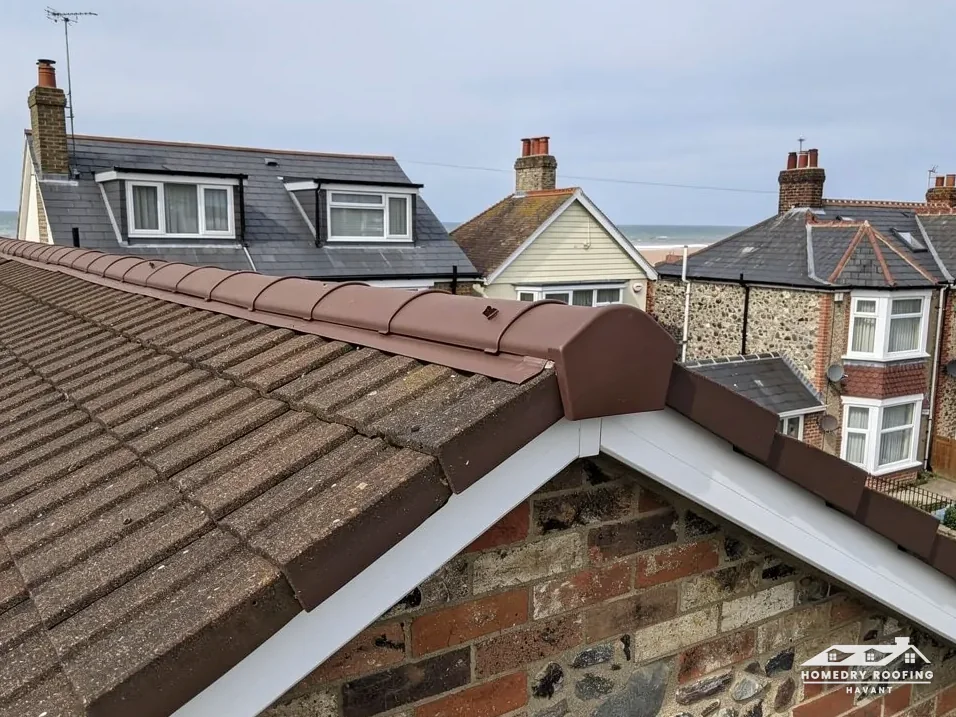
The sloping outward corner of a hipped roof, capped along its whole length.
Capping that has shifted at the lower end leaves a way in for rain at the corner.

The seam between roof and wall hangs on a narrow strip of metal.
A chimney stack or a house wall rising through a roof leaves a seam, and the seam is closed by a flashing: lead tucked into a groove cut into the brickwork (the chase) and folded down over the covering. Our check is slow and physical. We press the metal to see whether it still grips, run a finger along the pointing above it, count the clips, and note any sealant, which can mask a gap that the lead ought to be covering. MyJobQuote says correctly installed lead flashing can last for over 80 years, so a sound length is kept and only the failed section is renewed. Our leadwork page shows how the metal is shaped and fixed. After the lead, we look at the first few courses of covering beside each seam, where a slipped tile can send water towards the join.
Westergate sits in Aldingbourne parish, and the National Heritage List for England carries Grade II entries for the Old Manor House, Timbers and Hop Garden Cottage. Anything touching a listed house's character as a building needs listed building consent, under section 7 of the Planning (Listed Buildings and Conservation Areas) Act 1990. If your flashing sits on a listed house, we read the entry first and then ask Arun District Council what detail it wants.
Eastergate (Church Lane) and Eastergate (Square) form a conservation area close to Westergate. Whether the conservation area takes in your own address is settled by Arun District Council, and an Article 4 direction may withdraw rights beyond the usual, so ring Arun District Council before anything is ordered, even for a repair that looks small. Keep what it tells you in writing. The planning guide for roof work carries the rules themselves.
Lead sits in a chase, and the chase depends on pointing. When that mortar breaks down, the metal loosens and rain slides in behind it, out of sight. We tap along the line, mark any hollow sound, and photograph each gap next to a pencil for scale, so you can see the size of it. That lets the findings say whether a flashing wants re-pointing, a fresh dressing or a full replacement along its length.
A rust-coloured stain climbing the breast of an upstairs chimney, or a pale bloom on the ceiling beside it.
Lead that has parted from its chase at the stack, or pointing that has fallen out, leaving a seam for rain to enter.
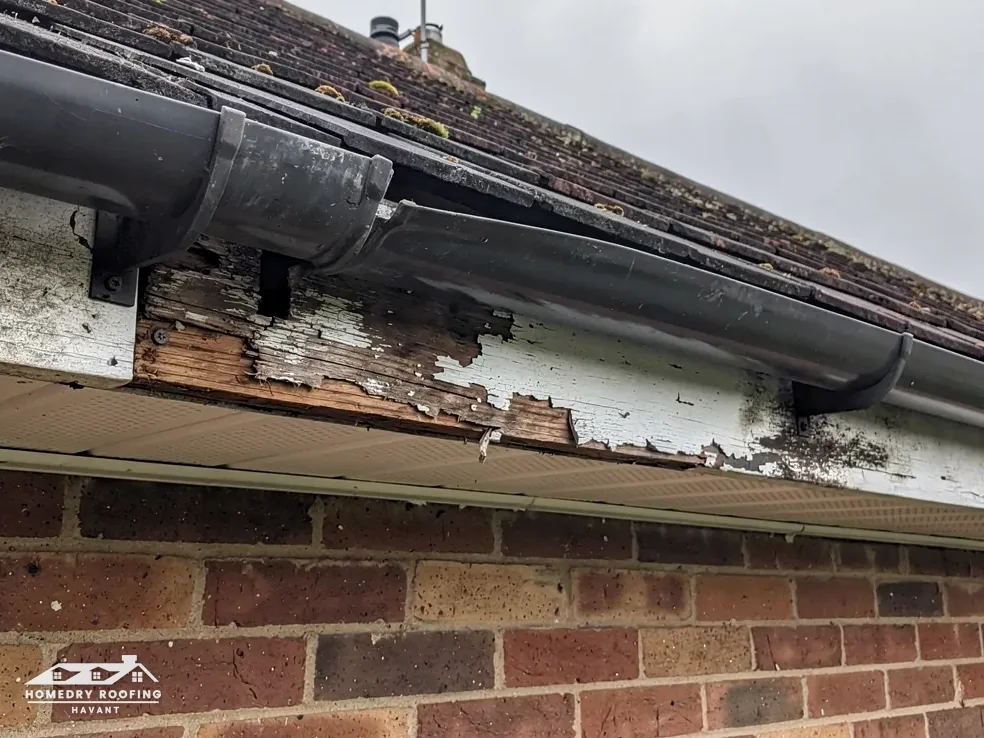
Sometimes, when the fascia behind it is sound and its fixings still bite. We press the timber first and say what we find, because a new gutter screwed into soft board comes loose again and the cost is wasted.
Down at the foot of the slope the roof hands its rain to the house. The fascia is the outward-facing plank holding the gutter up; beneath the overhang, the soffit is the panel out of sight from the street. We probe each with a screwdriver handle for give, look for stain lines, and sight along the gutter for a fall towards the outlet. Brackets get a firm pull, and the gutter is sighted from both ends, since a sag shows best along its length. Downpipes are followed from hopper to gully, with any weeping joint marked. Timber is examined before any new gutter goes up, because a run screwed to rotten board fails when the board does. Our gutters, soffits and fascias page sets out replacement runs.
On a Westergate extension with a flat roof, we trace the covering from where it climbs the wall down to the outlet. Water lying there a day after rain may mean the outlet is blocked, or that the surface has stopped sloping towards it; clearing cures the first and only relaying cures the second, and the findings say which applies. Our flat roofing page covers the coverings used, and we look at the edge trims and the joints where sheets meet before anything is priced.
The Environment Agency's map shows the mapped centre of Westergate within Flood Zone 2. That zone label says little about the roof itself; it gives a reason to keep every gully flowing and to know where each downpipe empties. An attached porch or lean-to is read in the same order, ridge to drain, and the notes mark it separately. On a re-roof, Arun District Council's building control team is asked first, and the reply is then explained to you in simple terms. When we leave, the garden and drive are swept and the site is clean.
The eaves are where the roof hands its water to the house.
Soffit boards keep a record of the gutter above them. Overflow runs back onto the underside and soaks the timber, and a board kept wet for long enough softens and sags. We press each length with the handle of a screwdriver, note exactly where it gives, and photograph the worst of it from below, so the findings can say whether a few boards want replacing or the entire run does.
A ladder, a torch and a steady hand carry the first look. The lead is pressed where it enters the brickwork and wraps the stack base, the corners are checked for splits, and the pointing above is tested for hollow sounds. Sealant gets a note of its own, because a smear can hide a gap the metal ought to cover. The flaunching, the mortar cap around the pots, is read from the ladder. Every defect gets a photograph; the findings then state whether the flashing wants re-pointing, re-dressing or replacing, and sound lengths stay as they are, so the work is the minimum that closes the seam.
Start with a call to 01903 737756, the line of Arun District Council's own building control team, whose page names "replacing roof coverings on pitched and flat roofs" among alteration projects that need approval. The Planning Portal supplies the national yardstick, two limits that together decide whether a building regulations application is normally needed: under 25 per cent of the building envelope and under 50 per cent of the roof. Whatever those limits allow, a covering that weighs 15 per cent or more extra also needs approval. We pass the answer on in plain terms, ask for it in writing when that helps, and what happens next is yours to decide.
Eastergate (Church Lane) and Eastergate (Square) is the conservation area near Westergate. Whether your own gate and roof fall inside its line is for Arun District Council to settle, and a short enquiry gets the answer. The area sits beside, not on top of, the questions about listed buildings and permitted development, which are decided separately, so the survey notes record what the council says and nothing is guessed from a neighbour's house. The roof rules sit in our planning guide, each with its source, and a house outside the boundary still gets every ordinary check.
Under Article 4 a council may remove named permitted development rights across a given area, and only Arun District Council can say whether that has happened at your address. Put the question to Arun District Council first, above all if the house stands near the Eastergate boundary. Should the council name a direction, we sit down with the wording and the written price is held back until the requirements are plain, so nothing is priced on a hunch and no job stops halfway for want of a consent. A short call now is far cheaper than a halted roof later.
The Old Manor House, Timbers and Hop Garden Cottage carry Grade II entries, kept by Historic England. Any work that touches what makes a listed house special needs listed building consent, and that consent comes from Arun District Council. If your own house is not one of the three, its list entry, or the lack of one, is the first thing to check, and the council can settle any doubt before anything is ordered. Our survey describes the roof exactly as it stands, with a photograph of every junction, so the council has facts to read. Send us its reply and it goes into the notes.
Section 169 of the Highways Act 1980 covers scaffolding that blocks the highway, and the authority for Westergate is West Sussex County Council. We arrange the licence with our scaffolder. West Sussex County Council's fee is £266 for one month of scaffolding, and at least 10 working days' notice is required. Dates are agreed with you beforehand, so the notice period is counted in, and the start you are given already allows for it. A job that may overrun the month is flagged to you in good time.
Flood Zone 2 is the Environment Agency's label for the mapped centre of Westergate, and it describes land, not roofs, so no covering, flashing or timber is treated differently because of it. Drainage is where it brings a roof into the picture: gutters, downpipes and gullies that run freely keep water away from the walls. The surveyor traces each downpipe down to its gully, and a blocked or broken one is reported with a photograph, with a note of where its water would otherwise land. A gully cleared early stays a small task.
Look for the work, the covering and any fixings described in words, and a plain note on VAT and the scaffold, saying whether either is inside the figure. Our quote is one total, in writing, issued once the survey is complete; it follows the findings, and whenever a repair can do the work, that option is quoted first, with the reason. Good and fair prices only mean something when quotes are compared like for like, so ask every contractor for the same details on paper; a figure that looks low may simply leave something out, and only the paperwork shows it.
You'll get one written total price.
Fill in what you like. It opens WhatsApp with your message ready to send.