
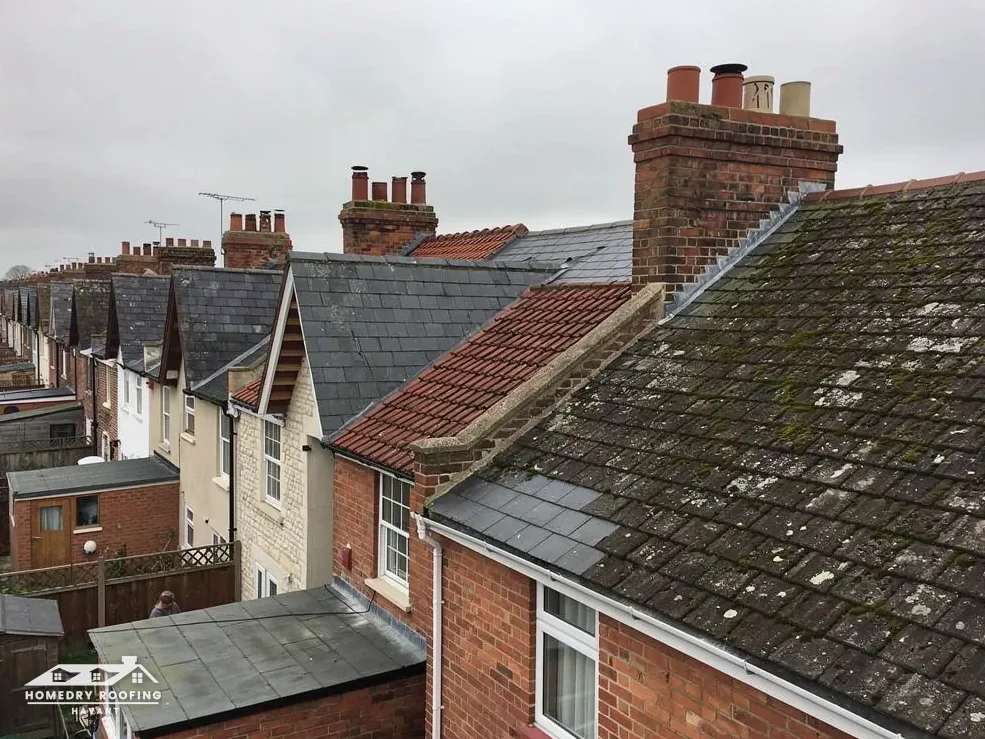
Rafters
The sloping timbers under the covering, seen from the loft, that carry the whole roof.
A tide mark on one points back up the slope towards the place the water got in, and the trace carries on from there.
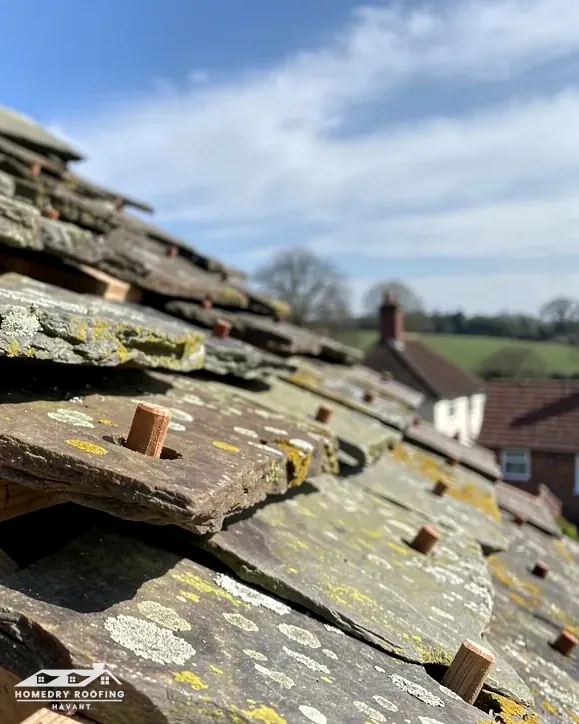
Barnham is 19.1 road miles east of Havant. A survey there goes up into the loft and out to the chimney stacks first, and the written price follows the findings.
10-year workmanship guarantee, in writing
The sloping timbers under the covering, seen from the loft, that carry the whole roof.
A tide mark on one points back up the slope towards the place the water got in, and the trace carries on from there.
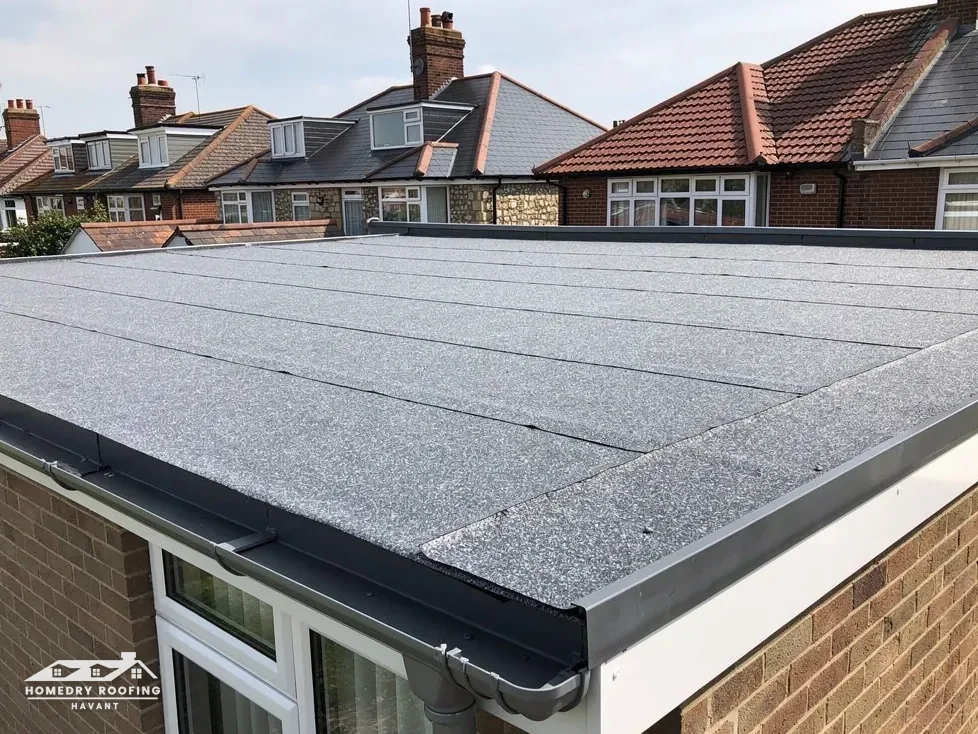
The brick column that rises through the roof, with its pot held in a sloping collar of mortar.
A cracked collar lets rain run down the inside of the stack.

The strips of lead or other metal that close the join where a roof meets a wall or a stack.
A lifted edge shows from the ground as a dark line against the brickwork.
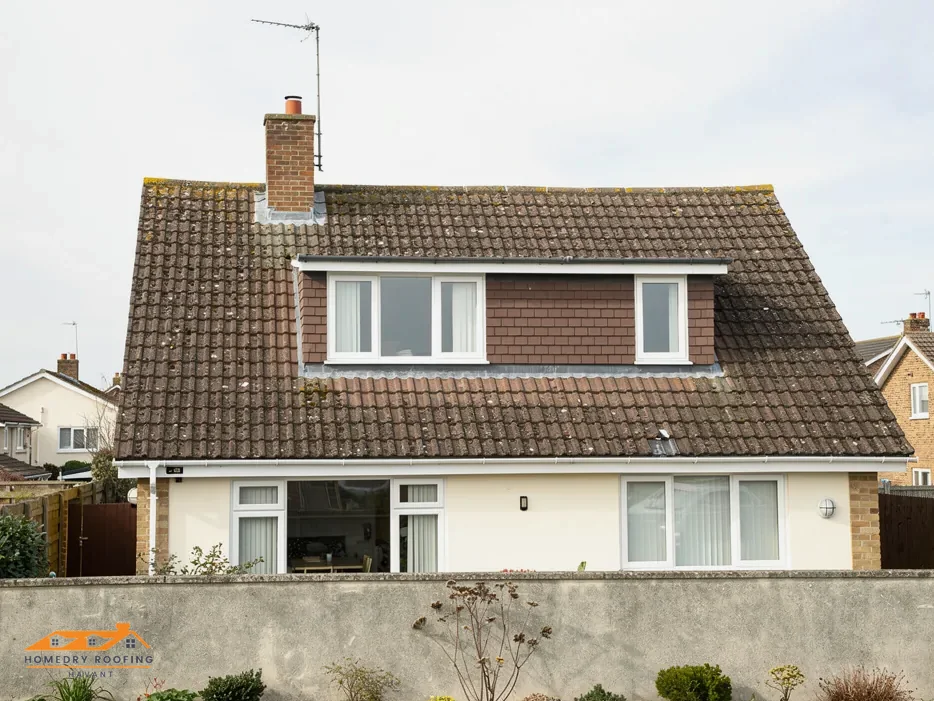
The loft shows the underside of the covering and the timber behind it, where a leak leaves tide marks and daylight shows through gaps. Starting indoors gives a path to follow outdoors, so the ladder goes where the fault is, not everywhere at once.
From the loft, a roof shows what the covering hides from outside. A Barnham loft inspection starts with a torch and a search for daylight where there should be none, then for timber that is stained or dark, underlay (the sheet beneath the covering) that has dropped or split, and battens, the thin strips of timber the covering hangs on, that have softened. Rafters, the sloping timbers that carry everything, are checked down at their feet where the roof meets the wall. A tide mark running along a rafter points back up the slope towards the entry point, which is not always straight above the stain on the ceiling. Our roof inspections page describes what a full survey records, and the findings come with photographs.
A roof space can hold wildlife too. The law protects both nesting birds and bats: it is an offence to intentionally take, damage or destroy a wild bird's nest while it is in use or being built, and damaging or destroying a bat roost is an offence whatever the intent. A nest or a roost found in the roof space therefore changes the plan, and the findings record what was seen, with a photograph and a note of where it lay, so the position is clear if anyone asks later.
Barnham Windmill and Ivy Cottage are both on the National Heritage List at Grade II, so listed building consent is required before work that alters their character as buildings of special interest. Conservation areas around Barnham include Barnham (Church Lane), Walberton Village and Walberton Green, Yapton Main Road and Church Lane, and Eastergate (Church Lane) and Eastergate (Square). Arun District Council holds the boundary maps and can say whether an Article 4 direction touches your road. The planning guide for roof work covers the rules themselves.
The ceiling shows where the water ended up, not where it came in.
A brown ring on a ceiling marks where water ended up, not where it came in. We climb into the loft, find the timber carrying the matching tide mark, and follow the trail uphill, checking underlay joins and batten ends as we go. The entry point can sit well away from the stain. The findings name the spot, with a photograph, so the repair goes where it belongs and nothing is patched at random.
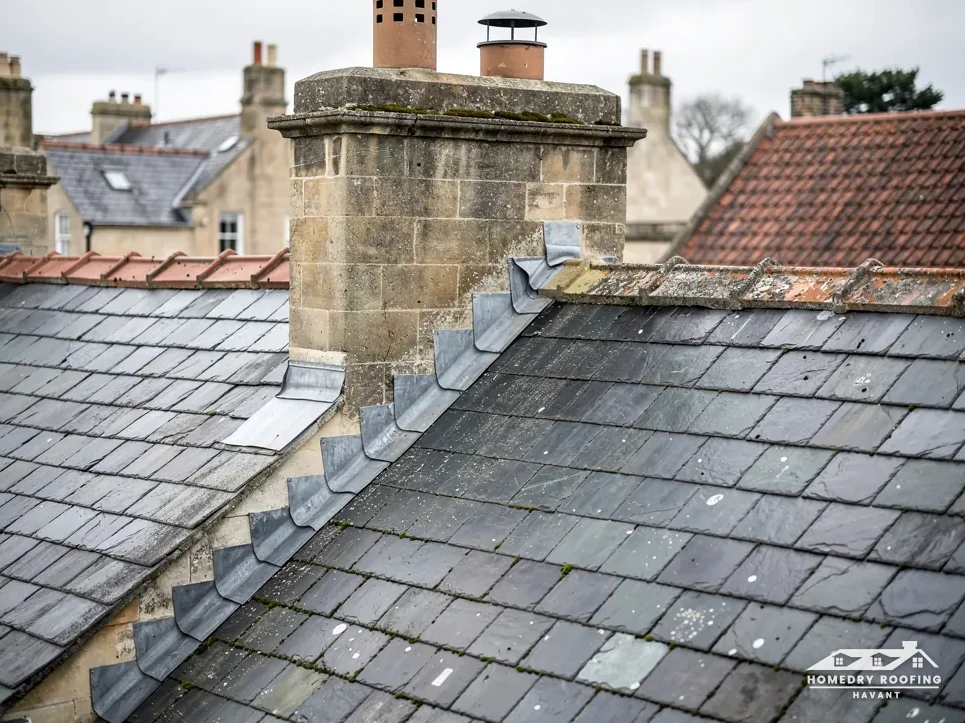
A chimney stack has to shed rain from every face, top to bottom.
A chimney stack is the brick column that rises through the roof. Its pot sits in a sloping bed of mortar called flaunching, and lead flashing, a folded metal strip, closes the join where the stack meets the slope. A Barnham survey reads the stack from the top down: whether the flaunching has cracked, whether the pot sits firm, whether the mortar between the bricks has eroded, and whether the lead around the base is still tight to the brickwork. Any flue that has been capped off or fitted with a vent is noted too, because the way a flue is finished decides where rain can get into the stack, and pots that are no longer in use get the same close look as the rest. Our chimney repairs page covers the range from repointing to rebuilding, and the lead roofing page explains how flashings are formed and fixed.
MyJobQuote says correctly installed lead flashing can last for over 80 years, so an old flashing that is still sound is repaired rather than stripped, while one that has lifted, split or pulled out of the mortar line is renewed. Taking a chimney breast out is a different kind of job. The Planning Portal says building regulations approval will always apply when removing chimney breasts, and a party wall notice is needed as well where the breast is on a party wall.
If the whole roof is coming off instead, the paperwork starts with Arun District Council. Arun District Council's building control page lists replacing roof coverings on pitched and flat roofs among alteration projects that need approval, and the route is settled with the council before any date is promised. After the survey you receive one written total price with the findings beside it, and the garden is swept before we go.
Flaunching is the sloping collar of mortar that holds a chimney pot and sheds rain away from it. Once it cracks, water can run down inside the stack, and a brown patch shows on the chimney breast in a bedroom or lounge. A cracked collar is a small repair from the roof, and a soft one left alone loosens the pot as well. We photograph the collar, the pot and the top courses, so you can see what we saw.
A brown patch spreading across a chimney breast indoors, or a smell of damp in a room where the fire is no longer lit.
A cracked collar of mortar round the pot, worn joints high in the stack, or a lifted strip of lead at its foot.
Map of Barnham and the places around it, with the dashed line of our 30-mile service area from Havant. The same places are listed below the map.
It looks for daylight where there should be none, tide marks on rafters, split or sagging underlay and battens that have gone soft, working from the eaves up towards the ridge, and along the hatch and the party walls where a neighbour's roof meets yours. The roof space is also checked for droppings, nests or signs of bats, because wildlife changes how a repair is done. Photographs of each finding go into the written notes, so a stain on a Barnham ceiling can be traced to the spot on the slope above where the water entered, which is not always the spot directly overhead.
Arun District Council's building control page lists replacing roof coverings on pitched and flat roofs among alteration projects that need approval, so we ask Arun District Council's own building control team, on 01903 737756, how it wants a Barnham re-roof handled before a date is fixed. For comparison, the Planning Portal's national guide gives two limits, under 25 per cent of the building envelope and under 50 per cent of the roof, and says a new covering 15 per cent or more heavier needs approval. Whatever the council replies is passed to you in writing.
Section 169 of the Highways Act 1980 is the law behind it, and for Barnham the licence comes from West Sussex County Council, which lists £266 for one month of scaffolding and asks for at least 10 working days' notice, a period that has to be counted before any date is promised. We arrange the licence with our scaffolder; the earliest realistic start is given to you when the survey is done, so the booking you receive is one that can actually be kept. A scaffold on a private drive is a separate question from one standing on the pavement, and the right route is explained to you.
Barnham (Church Lane) is one, with Walberton Village and Walberton Green, Yapton Main Road and Church Lane, and Eastergate (Church Lane) and Eastergate (Square) in the villages around it. Whether your own address lies inside any of them is for Arun District Council to answer. Arun District Council keeps the boundary maps, so put your address to it before roof work is planned, and file its reply with the survey notes. Our planning guide covers the roof rules and their sources, and the same survey is carried out on a house that sits outside every boundary, with the same photographs and the same written findings.
Yes, because only Arun District Council can say which directions reach a given road, so check with Arun District Council before anything is booked. An Article 4 direction withdraws specified permitted development rights across a defined area, and that can alter what a roof job needs even when ordinary re-roofing would not. If a direction applies, its text is read through together, the survey notes record it, and the price is written once the requirements are settled. A short call or email to the council comes first, and its written reply settles the point before any money is committed.
Both are protected. It is an offence to intentionally take, damage or destroy a wild bird's nest while it is in use or being built, and damaging or destroying a bat roost is an offence whatever the intent. A find in the roof space changes the plan, so it is recorded in the findings and discussed with you before work is booked. Photographs and notes taken at the survey stage protect everyone involved, and they stay with the written price in case anyone asks later what was seen. If you have noticed droppings in the loft, scratching in the eaves or bats at dusk, mention it when you book the survey.
Ivy Cottage and Barnham Windmill each carry a Grade II listing, in the national list that Historic England keeps. Any work that affects the building's character calls for listed building consent, however modest the repair looks. Read the list entry for your own address first. If it leaves any doubt, Arun District Council is the body to ask. The survey notes set out the condition of the roof junction by junction, photographed, so the council has exact material to read. A neighbour's listing does not carry over to your house: your own entry is what counts.
As one total, produced after the survey and attached to its findings, with the covering and fixings named and a clear statement on whether VAT and scaffold are included. A sound repair comes ahead of any replacement, and a replacement comes with its reasons. The prices are good and fair; the test is to ask each firm quoting for the same specification on paper, because a lower-looking figure can leave out scaffold or VAT and turn up as an extra later. Ask for the survey photographs alongside the price as well, because a figure that cannot be tied to what was found is hard to compare with another firm's.
You'll get one written total price.
Fill in what you like. It opens WhatsApp with your message ready to send.