
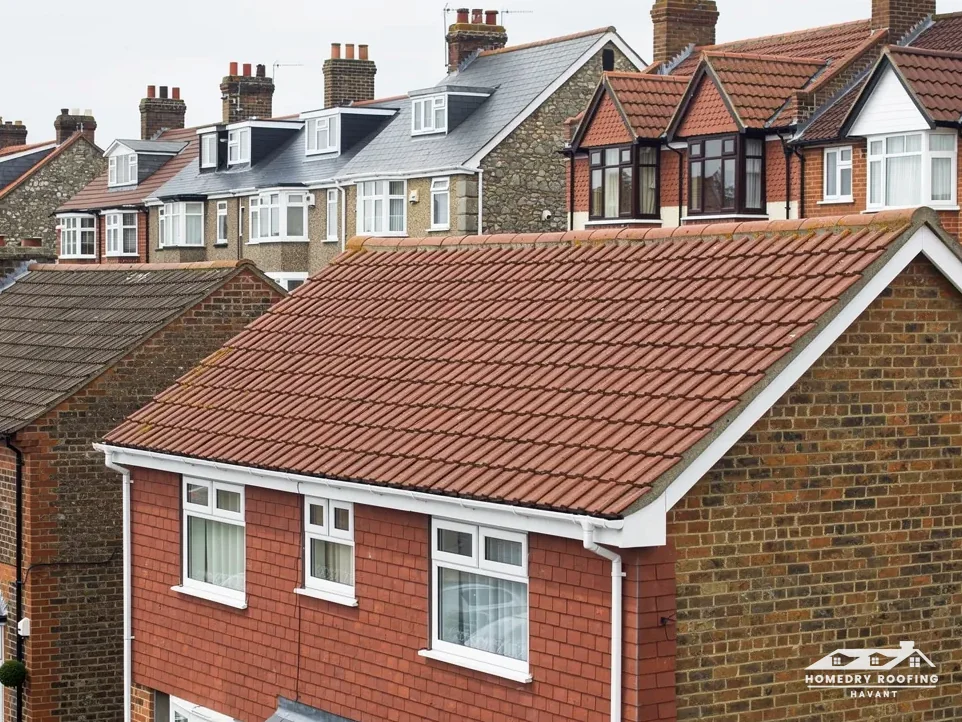
Fixings
The nails, clips and screws that keep each course of covering pinned to its batten.
One that has pulled out leaves its piece resting on its weight alone.

Climping is 22.9 road miles east of Havant. What holds each roof covering down, and how the eaves drain, is checked on the roof itself before a written total is given to the owner.
10-year workmanship guarantee, in writing
The nails, clips and screws that keep each course of covering pinned to its batten.
One that has pulled out leaves its piece resting on its weight alone.
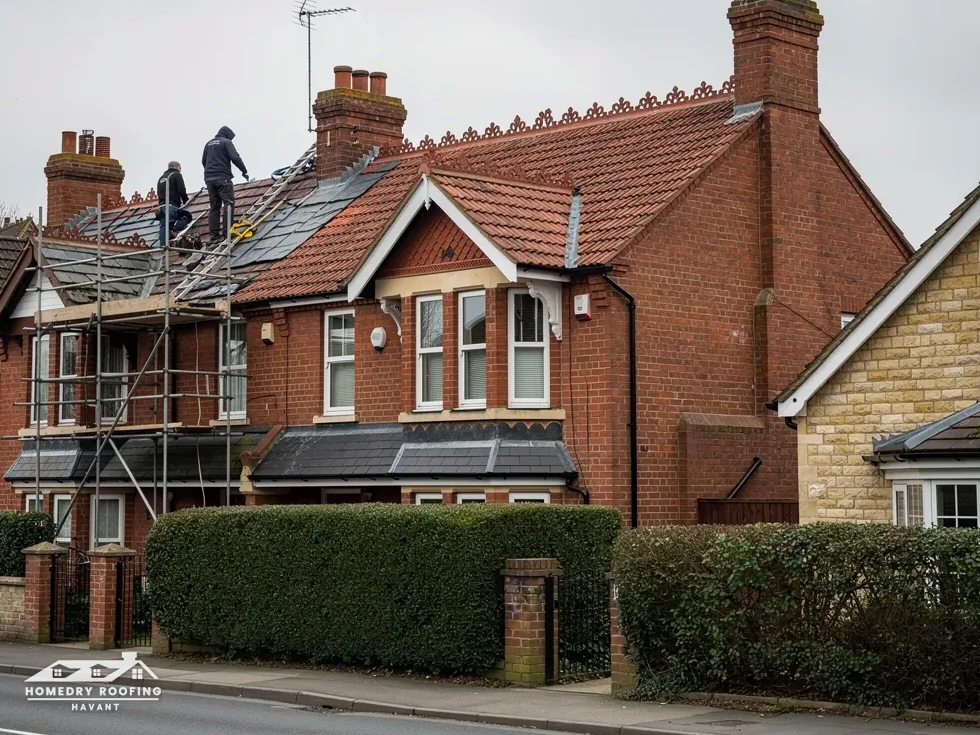
The narrow timber strips across the rafters that every tile or slate hangs from.
When one rots near a fixing, the course above it begins to slip.
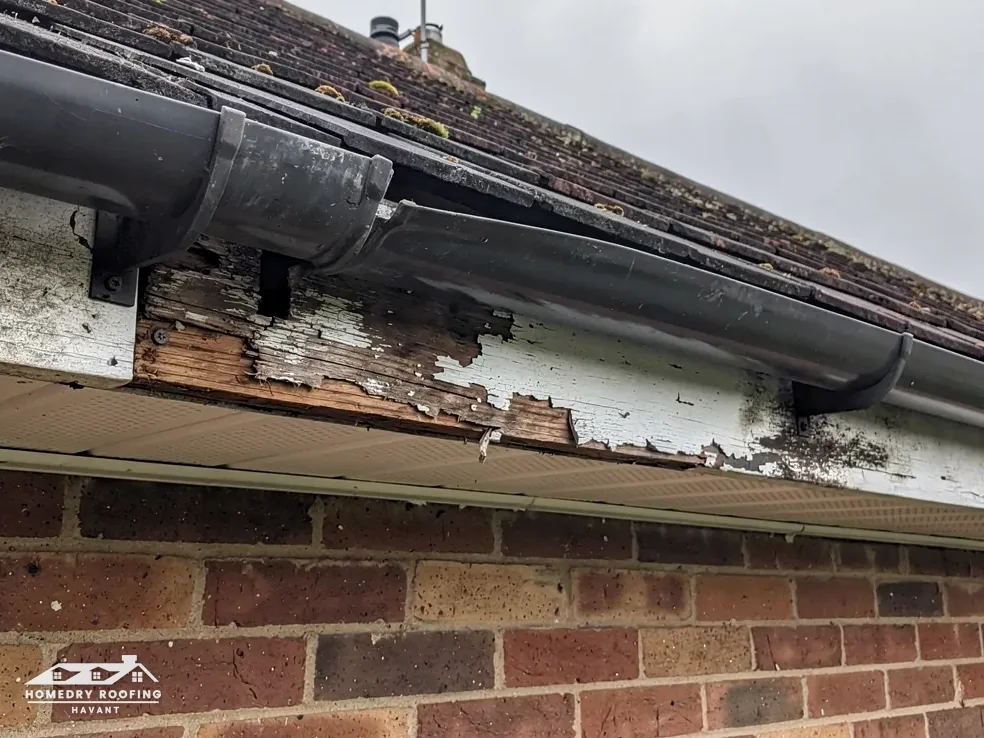
Where the roof overhangs its wall and covering, board and gutter all come together.
A gap at the eaves lets damp reach the rafter ends and the top of the wall.
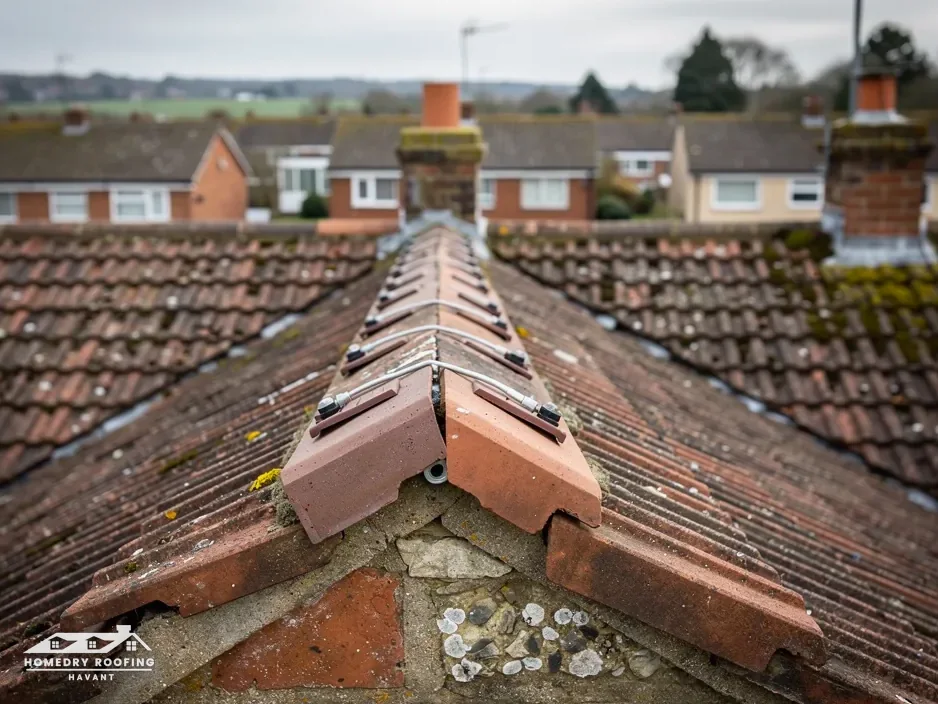
A roof stays on because of fasteners few people ever see.
Every tile or slate on a pitched roof hangs from a timber batten and is held there by a nail or a clip, and that small fastener is the thing keeping the roof on in a gale. At the survey we lift an edge course here and there to see the fixing itself: whether it is the right type, whether it has pulled, and whether the batten beside it has softened. At the gable end and along the ridge the pieces are held by other means, and our dry ridge and verge page covers the mechanically fixed systems that replace old mortar. Our pitched roofing page covers repairs to a slope as a whole.
Climping lies close to the coast. Cupa, the slate maker, writes that "coastal areas as well as tall buildings will be graded with higher exposure", and for a roof that calls for a specification worked out for the actual site under BS 5534. Marley says mortar alone "could no longer be relied upon" as the only fixing, and that BS 5534 "isn't required by law". The survey notes how each piece is held today, which lets the findings tell you if the present fixing stands up to that calculation or rests on bedding alone.
The Parish Church of St Mary is listed Grade I, and it serves as a Church of England place of worship, so roof works there go through the faculty system, not the council's listed building consent. Beside it, Medieval earthworks E and SE of St Mary's Church is a scheduled monument, and any works there must be authorised under section 2 of the AMAA 1979. Two houses on the list are Grade II: the Vicarage, and Church Farmhouse East and Church Farmhouse West.
A fixing is hard to judge from the ground, so we lift a sample course and look. A rusty nail or a clip that has sprung open says the piece above it has been held by little more than its weight. We photograph what we find where it sits, count how many pieces nearby look the same, and the findings say whether a handful need re-fixing or a whole slope needs stripping and doing again.
A tile or slate found on the lawn after a blow, or a row that sits visibly out of line.
A fixing pulled free of a softened batten, so the piece lifts and rain gets under the course above.
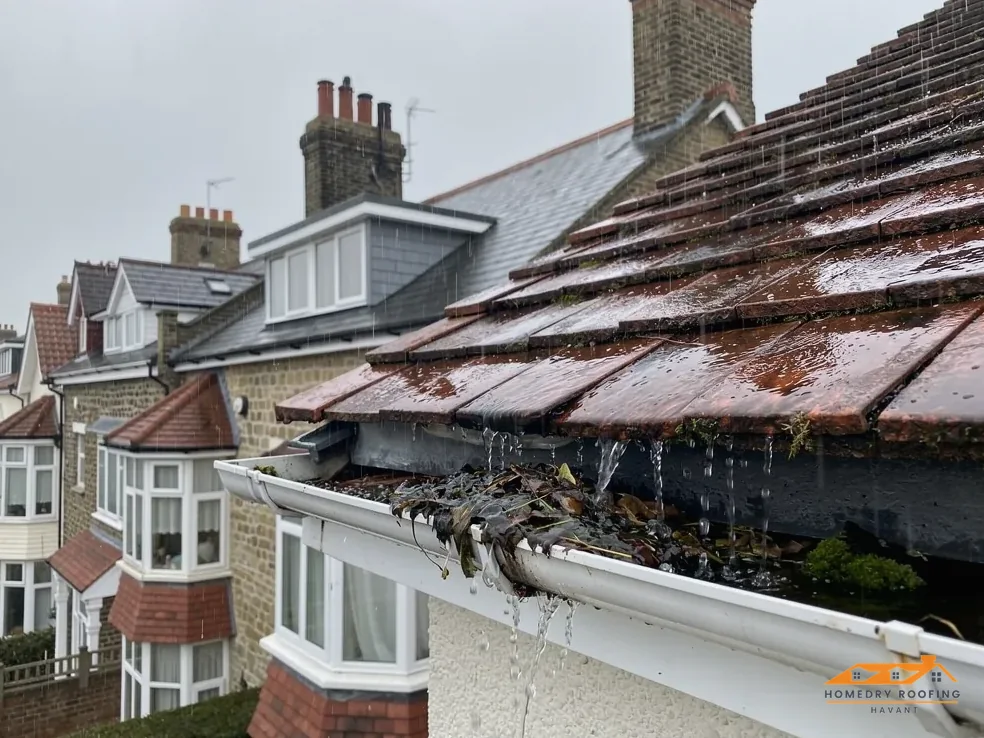
An overflowing gutter, or a joint dripping onto the board behind it, keeps that board wet for long stretches, and timber that stays damp softens. We probe the board and the rafter ends beyond it, then say how much is affected and whether a section will do.
At the eaves the covering overhangs the wall and a fascia board carries the gutter. Behind that board sit the rafter ends, and under the overhang runs the soffit. A gap or a split in any of them admits damp to timber that cannot dry easily. We examine the soffit for stains, press along the fascia for soft spots, look at the first course of covering above the gutter, and run a hand along each joint in the gutter itself. Brett Martin advises a fall of 1 mm for every 600 mm towards the outlet, so we also sight along each run for sags. Our gutters, soffits and fascias page covers replacing a run when the findings call for it, and the survey also asks where the water that wetted a failed board came from, because new timber without that answer only restarts the clock.
On the Environment Agency's map, Flood Zone 3 reaches land near Climping. That describes the ground around the village and lays down nothing for roofs, yet it is a sound prompt to see where each downpipe discharges and whether its gully can take the flow. A pipe emptying beside the wall, rather than into a gully, keeps the ground there wet whatever the roof above is doing.
Lyminster, Littlehampton (River Road) and Yapton Main Road and Church Lane are the conservation areas named near Climping. Arun District Council holds the boundaries, and it can also say whether an Article 4 direction reaches your road. Arun District Council's building control page lists replacing roof coverings on pitched and flat roofs among alteration projects that need approval, so we raise a Climping re-roof with the council first. The planning guide for roof work carries the wider rules in full.
Behind the gutter board, rafter ends sit in the wet.
The rafter ends and the fascia board sit where roof water arrives, so they are damp more often than the timber higher up. A tiny gap behind a gutter keeps one board wet through a whole winter. We probe the rafter ends where the board has failed, note the extent of any softness and say whether a section can be cut out and replaced or the whole board needs to come off.
Map of Climping and the places around it, with the dashed line of our 30-mile service area from Havant. The same places are listed below the map.
We lift a sample of coverings at the edges and along the ridge so the fixing itself can be seen. The questions are simple: is it the right type, has it pulled or rusted, and is the batten beside it still firm? Pieces that look the same are counted nearby. The findings then say whether a few need re-fixing or a whole slope needs stripping and relaying, and why. Each doubtful fixing is photographed where it sits, so what we describe is something you can look at for yourself, and the written price follows directly from those findings and from nothing else.
Climping lies close to the coast, and Cupa, the slate maker, writes that "coastal areas as well as tall buildings will be graded with higher exposure". The fixing specification for a roof is then worked out for the site under BS 5534, and the survey notes how each ridge, hip and verge piece is held now so it can be set against that calculation. The work is specified from the roof in front of us and its exposure grade, and the notes record both. If the existing fixings are sound and correctly spaced, the findings say that plainly and nothing is added.
Arun District Council lists replacing roof coverings on pitched and flat roofs among alteration projects that need approval, so for a Climping address we ask its own building control team, on 01903 737756, before a re-roof is booked. The Planning Portal's guide gives the national test beside that: a covering 15 per cent or more heavier would need approval first, and otherwise re-roofing needs no building regulations application as a rule, provided it touches less than 25 per cent of the building envelope and less than 50 per cent of the roof.
West Sussex County Council licenses scaffolding on the highway at £266 for one month, and it asks for at least 10 working days' notice before the date the scaffold is to be erected. We arrange the licence with our scaffolder. Dates are talked through with you first, so the booking is made around when you are at home, and the survey notes where on the roadside or verge the scaffold would stand. If the job could run past the month, we raise that before anything is applied for, and a late change of start is passed on to you as soon as the scaffolder tells us.
The Parish Church of St Mary is listed Grade I and is a Church of England place of worship in use. Such a church comes under the Church of England's faculty system, not listed building consent, so the district council's listed building consent is not what authorises roof works to it. The scheduled monument beside it, Medieval earthworks E and SE of St Mary's Church, is a separate matter: works there have to be authorised under section 2 of the AMAA 1979, whoever owns the land, so ask before anyone digs, props a ladder or sets scaffold near the site.
Lyminster, Littlehampton (River Road) and Yapton Main Road and Church Lane are the three named near Climping. A name on that list does not place your house inside it, so ask Arun District Council for the boundary, and ask whether an Article 4 direction covers your road before any work is fixed. We write the council's reply into the survey notes so the price and the paperwork agree. Our planning guide for roof work gives the rules in full, which is why this answer stops short of them, and the council can confirm a boundary for a single address quickly.
Two Grade II entries near the church are the Vicarage, and Church Farmhouse East and Church Farmhouse West. If yours is one of them, tell us at the first call, because listed building consent from Arun District Council is the route for any work which affects the building's character. The survey photographs the covering as it stands today, and that record is what you take to the council. It also means a quote is not drawn up around a change the council might later refuse, and the council can answer from the same photographs without a second visit.
The roof is surveyed first, and only then does one written total price reach you, accompanied by the findings so each reason can be seen. The total states whether VAT and scaffold are included, which lets you compare it with another quote fairly, and where a repair would hold we propose the repair before a replacement, so the figure never covers more roof than the survey justifies. A comparison only means something when each quote treats scaffold and VAT alike, so check that on every quote you hold, and send us anything that looks unclear and we will read it through with you.
You'll get one written total price.
Fill in what you like. It opens WhatsApp with your message ready to send.