
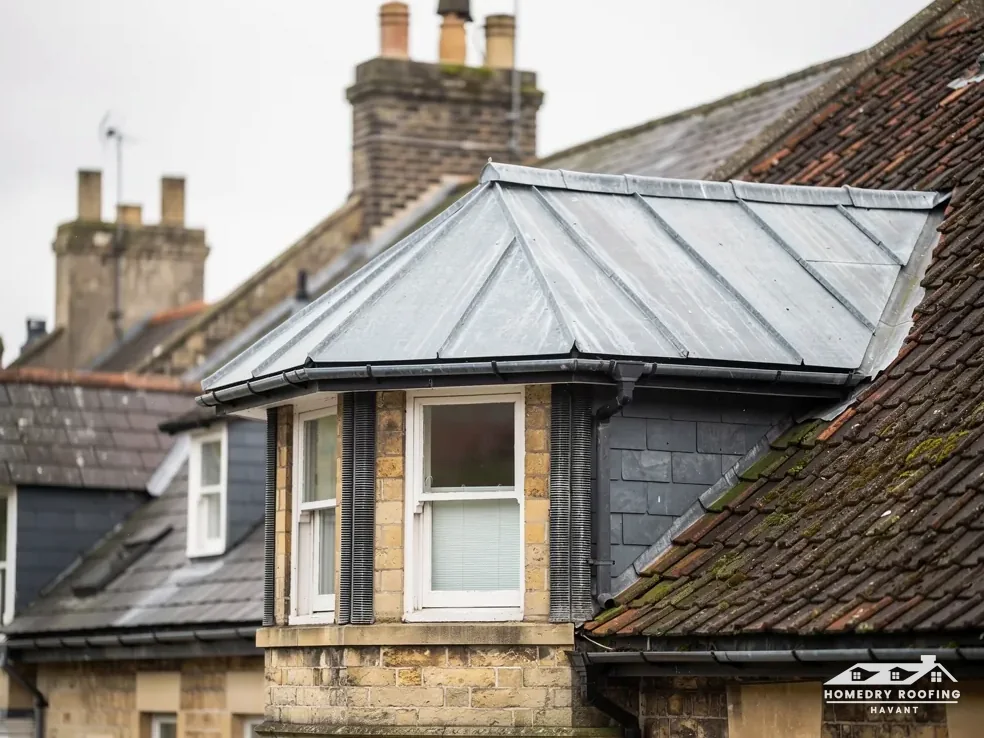
Abutments
The line where a sloping roof stops against a taller wall, closed with a strip of lead.
Lift one step of that strip and rain tracks behind it into the plaster.
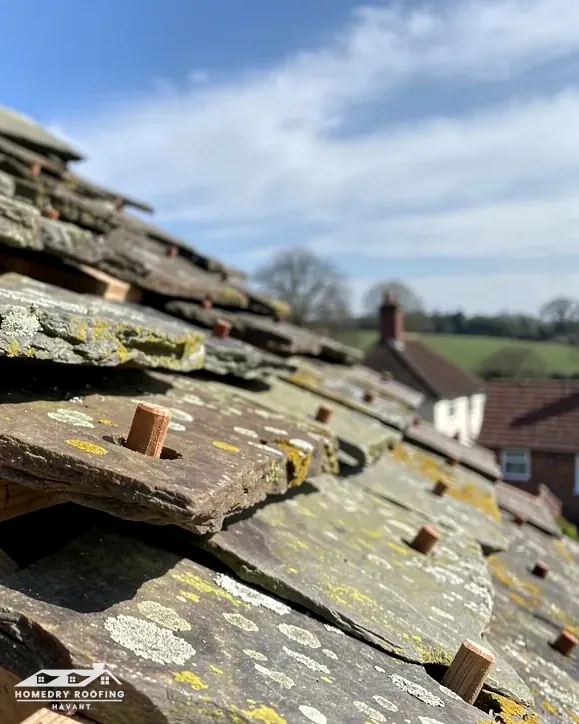
Ford is 22.1 road miles east of Havant. Where its roofs butt against walls, and where flat extensions drain, each place is read from above before any total is written.
10-year workmanship guarantee, in writing
The line where a sloping roof stops against a taller wall, closed with a strip of lead.
Lift one step of that strip and rain tracks behind it into the plaster.
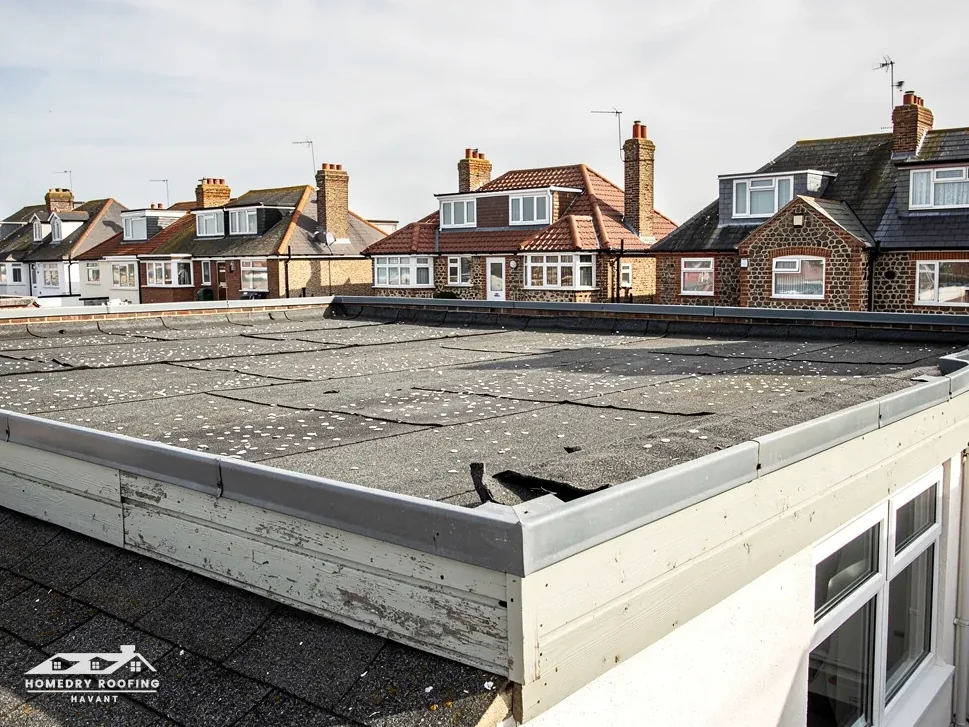
The turned edge of a flat roof covering, climbing the wall of the house behind it.
A split in that turn lets water slide down inside the masonry.
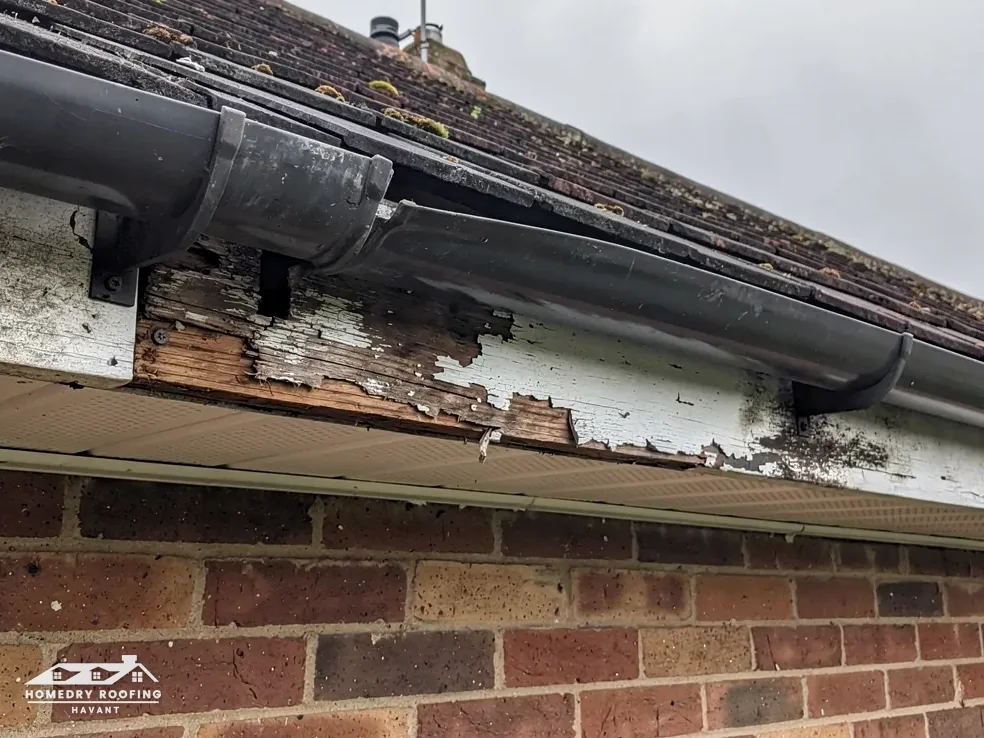
The box at the head of a downpipe, taking what a gutter or a small roof sends it.
Choked with leaf mould it overflows, and the overflow runs down one patch of wall.
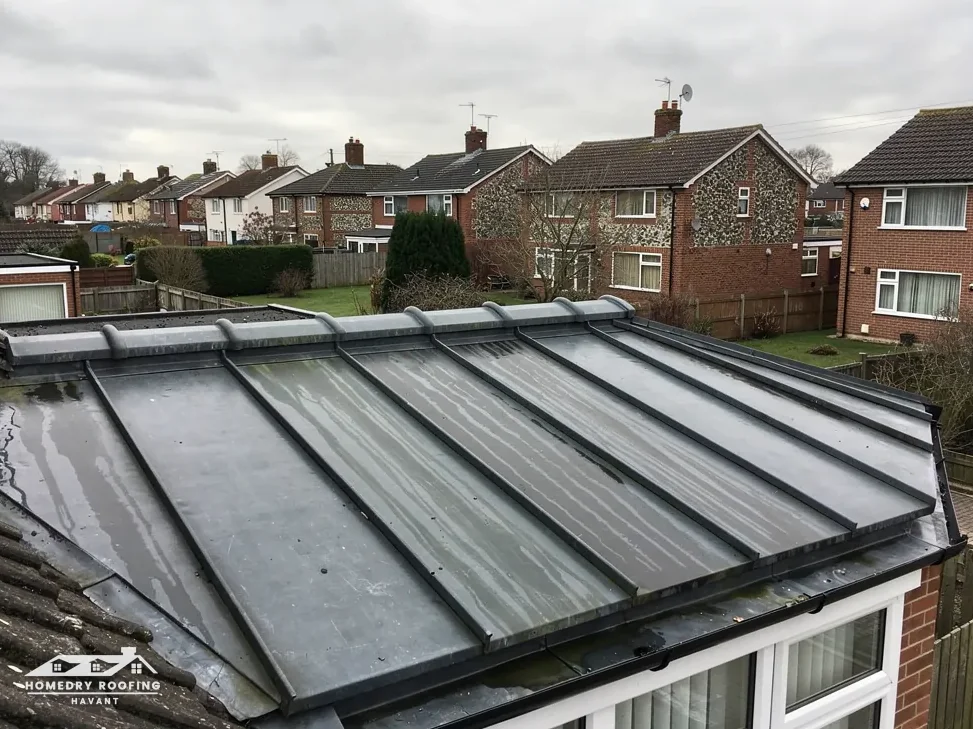
Rain behind the lead travels sideways before it shows.
Wherever a sloping roof stops against a taller wall, a strip of lead has to bridge the gap, and the meeting line is an abutment. A Ford house may have one where a rear extension joins the main wall, beside a porch, or along a shared party wall. Our survey walks each abutment end to end. We look at how the lead tucks into the mortar, how its lower edge is held, and how neatly the covering was cut to meet it. A cracked step reads as nothing from the pavement, yet it gives rain a straight run into the masonry, and a roof extension that was added later can have more than one such join to check. Our pitched roofing page covers work on a whole slope, and our roof repairs page covers the mending of one junction.
Grade I listed, The Parish Church of St Andrew is an active Church of England place of worship. Its roof work follows the faculty route that Church of England churches use, rather than listed building consent from the council. New House Farmhouse and Atherington House Ford Place Southdown House the Lodge are each listed Grade II. A house on that list sends its roof proposals to Arun District Council, because consent is required for any change that touches the building's listed character.
Near Ford the conservation areas named are Yapton Main Road and Church Lane, Littlehampton (River Road), Walberton Village and Walberton Green, and Lyminster. Arun District Council will tell you if your address touches one of them, and whether an Article 4 direction reaches your road. If it does, the answer goes into the survey notes before any date is fixed. The rules themselves sit in our planning guide for roof work, so this page leaves them there.
Rain that gets behind an abutment does not drip straight down. It travels along the back of the lead, soaks the wall and shows itself a metre or more away, perhaps as a mark on a ceiling corner. So we trace the whole junction instead of treating the mark, and the findings picture the exact joint, letting you judge the fault yourself before any repair is agreed. A torch check follows inside the loft, on that same wall.
A damp ceiling corner, or plaster that blisters on the wall beside a roof extension.
A lead step lifted from the mortar line, so weather runs behind the metal and into the wall.
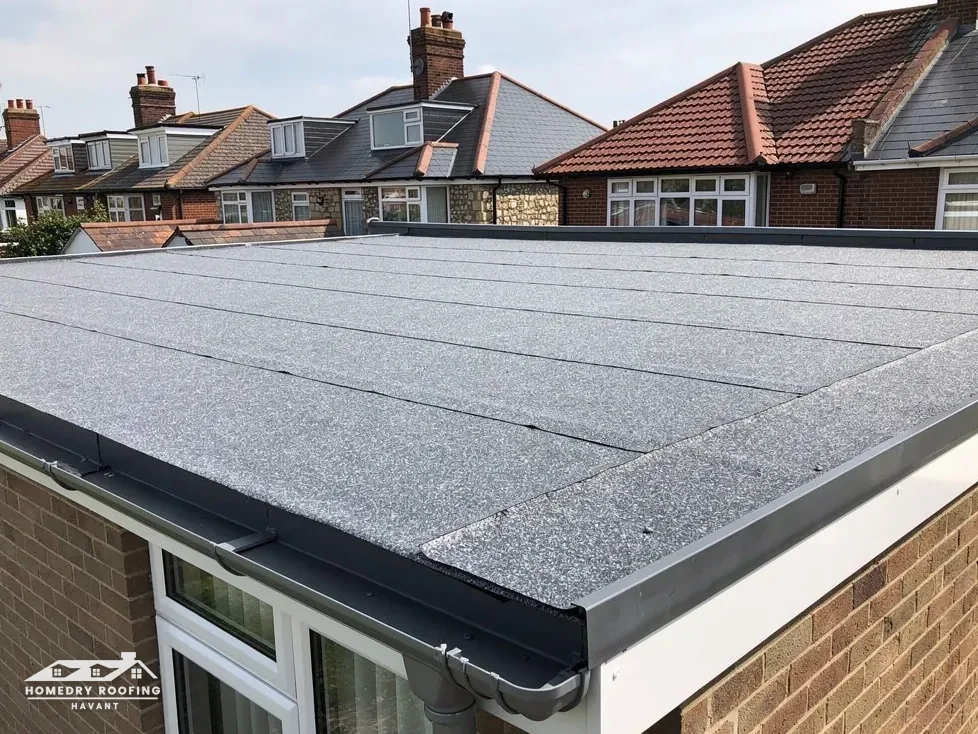
Note where the pool sits a day after rain. A small ring round the outlet means leaves or grit are holding the water back, while a wide pool in the middle suggests the roof no longer slopes as intended. Photographs of the surface help us separate the two.
Nothing called flat is level. The covering slopes gently to an outlet, rises up the wall behind it as an upstand and meets its neighbour at a seam, and every one of those places has its own way of giving up. On a Ford extension we read the upstand for splits, the surface for any pool still lying after a night of rain, and the outlet for leaf mould and grit. A pool that stays has one of two causes: the water cannot run to the outlet, or the outlet itself has clogged, and the repair differs between them, so the findings tell you which one you have. Our flat roofing page describes the covering work for the cases that end in a relay.
Flood Zone 3 covers land near Ford on the Environment Agency's map. That says something about the ground in the neighbourhood and nothing about how a roof must be built, even so it gives a sound cue to ask where each downpipe empties and whether the gully beneath it can swallow the flow. A short note on this goes into the findings alongside the photographs, with the position of every outlet marked.
Arun District Council's building control page lists "replacing roof coverings on pitched and flat roofs" among "many alteration projects that need approval", so a Ford re-roof is put to the council before it is booked. The Planning Portal's test is the national yardstick behind that, and its figures are in the questions below. Once the roof has been surveyed, a single written total comes to you, and it names what the scaffold and VAT are doing in it so that no surprise follows. If the findings turn out to be a cleared outlet and a re-sealed seam, the total is correspondingly small. Brushes and sweepers go over the drive before we leave.
A flat roof sheds its water only as well as its outlet allows.
A pool on a flat roof the day after rain tells us something, though not everything. A shallow ring round the outlet points to a blockage, while a broad sheet in the middle of the roof points to a lost fall. We measure both, photograph them and mark where the water sits. A covering with a sound fall needs only clearing and a seam check, a much smaller job than a relay.
The lead is followed from one end of the junction to the other. We check where each step is keyed into the mortar, how the lower edge is held down, and whether the covering beside it was cut tight. A gap a few millimetres wide admits plenty of water. Old mastic or patching is noted, because it shows where trouble was dealt with before and may have missed the cause. Each doubtful joint gets a photograph, and the findings state whether it wants re-bedding, re-dressing or replacing, with the pictures beside them so the reasoning is open to inspection.
For a Ford address we confirm the route with Arun District Council's own building control team, on 01903 737756, ahead of any re-roof. The Planning Portal gives the national position: re-roofing does not normally need a building regulations application if it affects less than 25 per cent of the building envelope and less than 50 per cent of the roof, but a new covering 15 per cent or more heavier does need approval. On request we hand you the council's reply in writing, so that the paperwork question is closed before work is arranged.
The highway authority here is West Sussex County Council, which licenses scaffolding on the highway at £266 for one month and asks for 10 working days' notice at the least, counted back from the date the scaffolding is erected. The survey records where the scaffold would stand relative to the pavement or verge, so the application describes your street accurately. We arrange the licence with our scaffolder. A job that might run beyond a month is flagged to you at the outset, which lets the licence be requested for the full period in one go instead of being patched afterwards.
The Parish Church of St Andrew carries a Grade I listing and is an active Church of England place of worship. Churches in that position come under the Church of England's faculty system, not listed building consent, which takes the listed building decision on roof works there away from the district council. A private house is different. Arun District Council decides listed building consent for work affecting the character of a listed home, and the Historic England entry for the property tells you whether the house itself is listed.
Four are named near Ford: Lyminster, Littlehampton (River Road), Walberton Village with Walberton Green, plus the pairing of Yapton Main Road and Church Lane. None of them describes your own address, so ask Arun District Council whether the house sits inside a boundary, and whether an Article 4 direction applies to the road. We note the council's reply in the survey papers. What the rules allow is set out in the planning guide, which covers roof work in full; this answer leaves them out deliberately rather than risk restating them wrongly, and a boundary can change.
No roofing rule turns on it. The Environment Agency maps Flood Zone 3 over land near Ford, and that is a fact about the neighbourhood and nothing more. It still argues for tidy drainage. A gutter or downpipe that sheds water against the foot of a wall, or into a gully already full, adds to the wet ground around the house. We trace each run to its discharge point during the survey and record what we find, so a small fix can be made where it is needed instead of a larger one later.
New House Farmhouse and Atherington House Ford Place Southdown House the Lodge each carry a Grade II listing. If yours is among them, tell us the list entry number if you have it, and mention it when you first get in touch, because listed building consent from Arun District Council comes into play whenever work touches the building's character. A set of survey photographs shows the covering as it is now, which gives you a solid footing for the conversation with the council well before any price is agreed or any date is fixed.
It arrives as one written total price at the close of the survey, and the findings come with it in everyday language. The total states which of VAT and scaffold it includes, so another quote can be set against it on equal terms, and a repair goes first wherever it would hold. The findings sit next to the figure, so you can see what the money addresses. Our prices are fair, yet that only shows if every quote you hold treats scaffold and VAT the same way. Ask each firm to confirm both in writing, and send us what you are shown if you would like help reading it.
You'll get one written total price.
Fill in what you like. It opens WhatsApp with your message ready to send.