
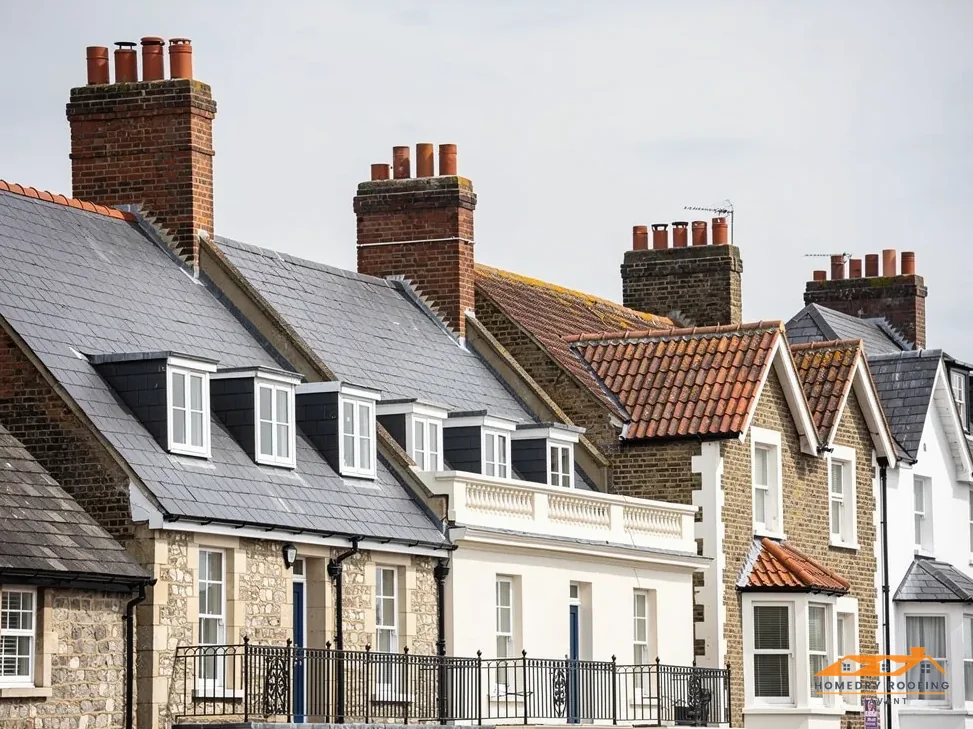
Stacks
Where a chimney leaves the roof, with flaunching round each pot and mortar on every face.
A cracked joint up there lets rain run down inside the chimney breast.

Arundel is 21.9 road miles east of Havant. Its chimney stacks, flashings and gutters are traced to the point of entry, and a survey on the roof comes before any figure is written down.
10-year workmanship guarantee, in writing
Where a chimney leaves the roof, with flaunching round each pot and mortar on every face.
A cracked joint up there lets rain run down inside the chimney breast.
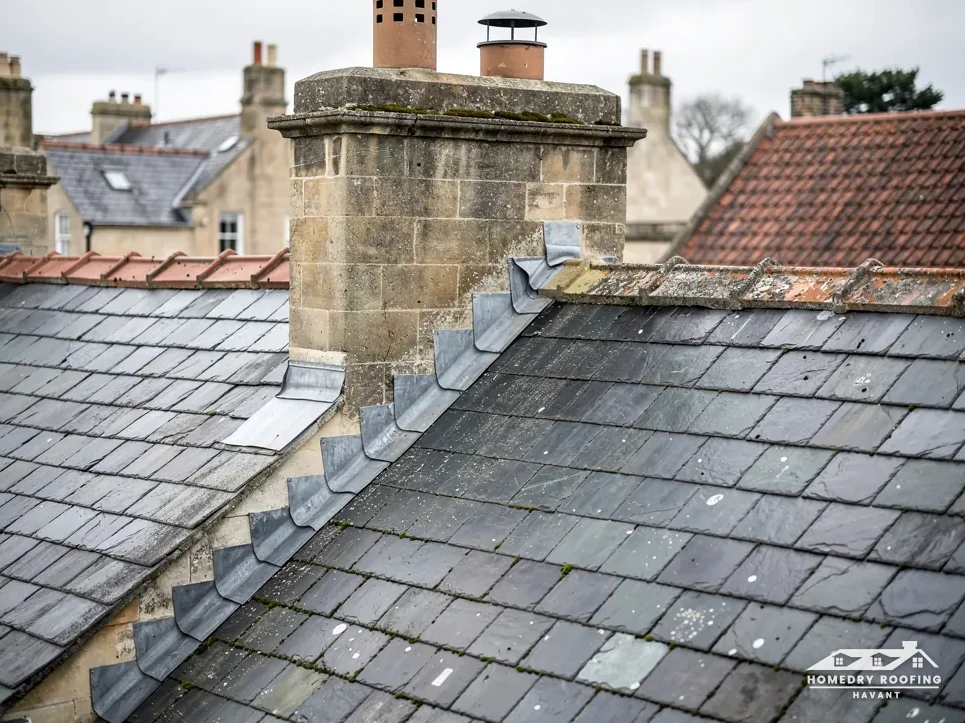
The lead strips that turn from the slope up the side of a stack or wall.
Once one pulls out of its joint, the brickwork behind it soaks through.

Where the gutter hands its load to a pipe and the pipe hands it to a gully.
A pipe that stops short of the gully stains the wall and wets the footings.
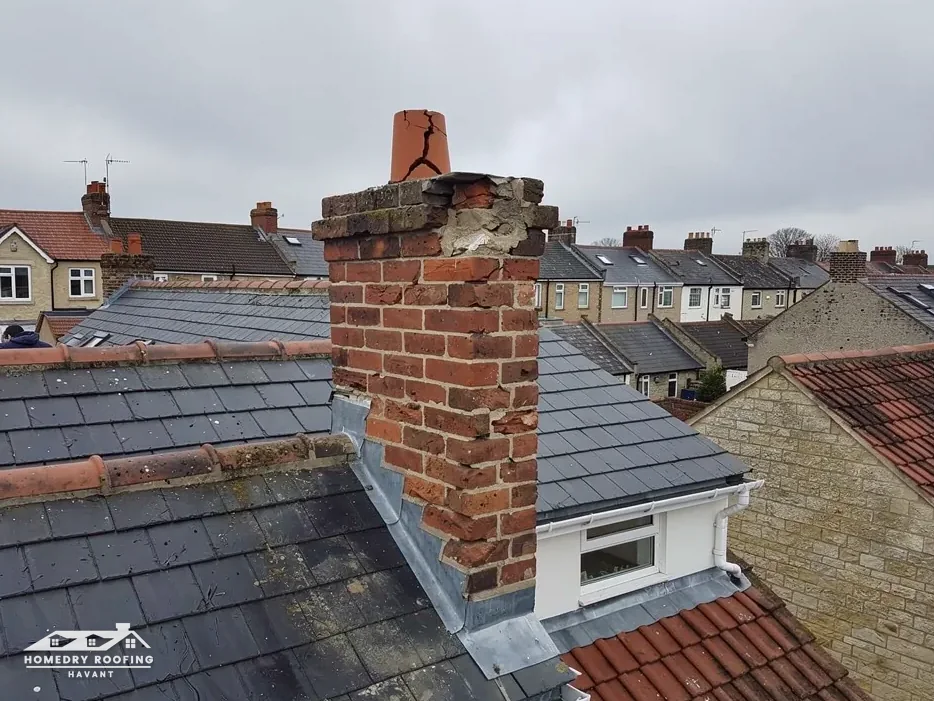
A stack has four faces, and the rain gets a chance at each one.
A chimney stack is a small tower with its own weather: the pot, the flaunching that holds it, the brickwork, and a flashing dressed into the roof around the foot. That makes four faces and four junctions, and the survey takes each in turn. We look for hairline cracks in the mortar, for flaunching that has parted from the pot and for lead that has pulled out of its joint. A brown ring on a bedroom chimney breast tells you rain is arriving somewhere above, but the stack only shows the route, so we trace upward from the stain and look at the slope on either side too. Our chimney repairs page covers repointing and rebuilds, and our leadwork page covers the flashings that dress around them.
Arundel has a good deal of recorded heritage. Fitzalan Chapel, Arundel Castle and the Church of St Nicholas are each listed Grade I, and Maison Dieu is a scheduled monument. A listed house takes its roof works to Arun District Council, since consent is required for any change to what makes the building worth listing. Fitzalan Chapel is a private chapel and burial place held for Roman Catholic worship. The exemption for that denomination turns on a building's primary use as a place of worship, so a question about works there goes to the trust that cares for the chapel. Works to a scheduled monument need consent under section 2 of the Ancient Monuments and Archaeological Areas Act 1979.
Arundel also has a conservation area, and Arun District Council holds the boundary that settles whether an address falls inside it. An Article 4 direction can take away more rights, and Arun District Council can say whether one reaches your road. Our planning guide for roof work covers the rules in full, so they are left out here.
A damp chimney breast in an upstairs room can come from the stack above it, from the flashing at its foot or from a covering that has slipped on the slope beside it. We go up beside the stack first, photograph each face and junction, and only then read the loft side of the breast. The findings name the junction that let the rain in and say whether the repair is flaunching re-set, a flashing re-dressed or a stack rebuilt.
A brown ring on a bedroom chimney breast, or a patch of wallpaper that lifts after a wet week.
A flashing lifted from the stack, or flaunching parted from the pot, so rain runs into the brickwork.
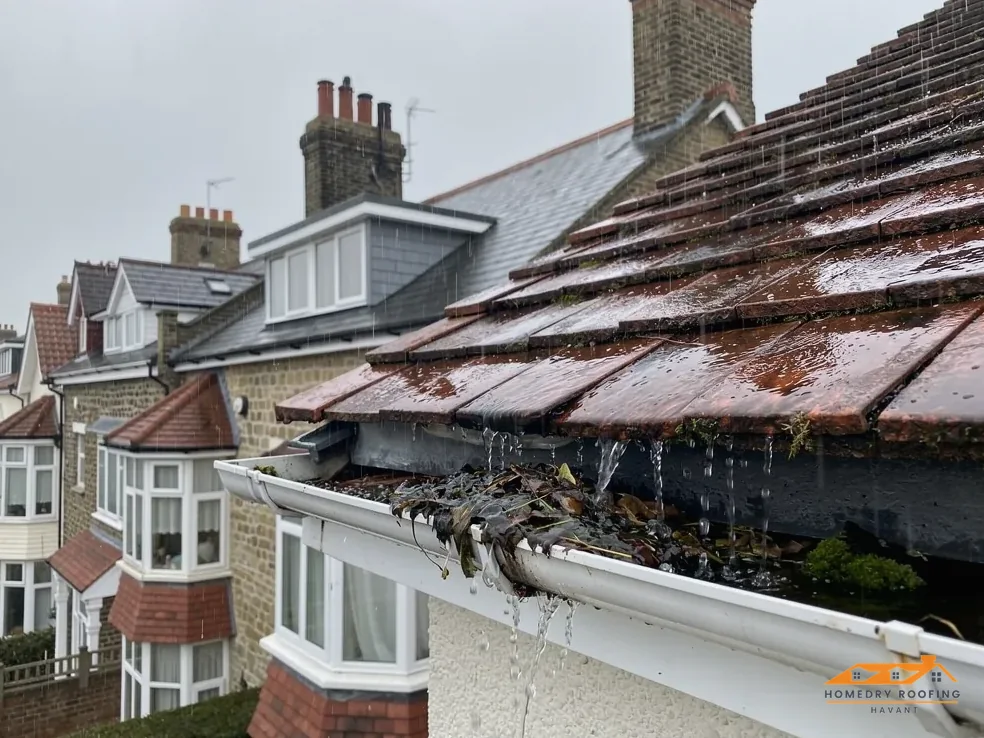
A joint that drips or a downpipe that empties against the brickwork will wet the same patch every time it rains. We read the stain lines under each joint and bracket first, because a cleared outlet or a re-made joint may be all that wall needs.
Everything the roof collects ends at the gutter, so the survey ends there too. A length that sags holds a pool, a joint that has parted drips onto the wall, and a downpipe that ends against brickwork soaks one patch of it. We press the fascia board behind the run to feel for softened timber, and we read the stain lines on the wall below each joint and bracket. Our gutters, soffits and fascias page covers renewal of a run, and the findings say whether yours needs a few joints re-made or a whole length replaced.
The Environment Agency's flood map places land near Arundel in Flood Zone 3. That describes the ground around the town rather than any roofing rule, yet it is a sound reason to ask where every downpipe discharges and to keep each gully clear. A pipe that stops above the gully, or drains into one already packed with leaves, delivers the roof's water to the foot of the wall and leaves the roof blamed for damp it did not cause. Standing water at the base of a wall also soaks into the render and the damp course, so the check is worth making even when the roof above looks sound from the ground.
If the survey points to a re-roof, Arun District Council's building control page lists replacing roof coverings on pitched and flat roofs among alteration projects that need approval, so we confirm the route with the council before work is booked. The national test is a guide that comes after it, and the FAQ below gives its figures. When the work is finished the garden and drive are swept clean, and any waste leaves with us. Where a few joints and one downpipe are all the survey finds, the written total says so, and nothing larger is suggested to fill the page.
The gutter is where a roof's last mistake turns into a stain.
The board behind a gutter has been wet each time the gutter overflowed, so its condition is a diary of past leaks. We press along it with a screwdriver handle, note any softness near a joint or a downpipe, and check the underside of the roof edge above it. A sound board and a clear gutter point to a fault further up the slope, and the survey moves there before any repair is proposed.
Yes. Rain can reach a chimney breast from the stack above it, from the flashing where the stack meets the slope, or from a covering that has slipped on the slope beside it and sent water down towards the brickwork. The survey therefore starts beside the stack, photographs every face and junction, and then reads the loft side of the breast with a torch. Whatever turns up goes into the findings with the pictures, so the repair meets the real point of entry rather than the stain. Where only the flaunching has parted, that is what we re-set, and the written price reflects that alone.
For an Arundel address we raise the route with Arun District Council's own building control team, on 01903 737756, before a re-roof is booked, and pass its answer on in plain language. The Planning Portal's national test follows as a guide: re-roofing does not normally need a building regulations application if it affects less than 25 per cent of the building envelope and less than 50 per cent of the roof, while a new covering 15 per cent or more heavier does need approval. Ask us for the council's reply in writing if you would like it for your own file.
West Sussex County Council is the highway authority, and it licenses scaffolding on the highway at £266 for one month, asking for at least 10 working days' notice before the scaffold goes up. We arrange the licence with our scaffolder, and we settle the dates with you before the application is sent, so the start you are given can be held. The survey notes where the scaffold would stand, so the application matches the street outside your house rather than a guess at it, and a change of date is passed to you as soon as it is known.
Fitzalan Chapel is listed Grade I, and its charitable trust exists to provide Roman Catholic services there. The exemption for Roman Catholic church buildings depends on primary use as a place of worship, and this is also a private burial place, so the route for roof works is for the trust to confirm with that denomination's system and the planning authority. That does not carry over to a private house on the list: for any work that changes what makes the building worth listing, listed building consent comes from Arun District Council. The Historic England list entry gives the exact description of any building, and it is worth reading before anything is booked.
Start with Arun District Council, which holds the boundary of the Arundel conservation area and can tell you whether your address is inside it. An Article 4 direction can remove permitted development rights in an area, so ask the council whether one reaches your road rather than assuming it does not. Listed status is a separate check, made against the Historic England list. What the council tells you goes into our survey notes, so the quote and the paperwork rest on the same facts. The planning guide for roof work explains the rules, and this answer does not restate them.
Parts of the ground around Arundel may fall to the South Downs National Park Authority, so the address matters. In the Arun part of the Park, the National Park Authority deals with planning applications directly, and ordinary re-roofing stays under the normal rules, so it is the body to ask about any planning question. Building control does not move: it stays with Arun District Council's own team. If you are unsure which side of a boundary your house sits, send us the address and we will put the Authority's answer in the findings.
It should say what work is covered, what covering goes on, and whether the total includes VAT and the scaffold. We give one written total price after a survey, with the findings set next to it, and a repair comes first where a repair is sound. Those prices are good and fair, but you can only judge that if every quote in your hand says the same things about scaffold and VAT, so ask each firm to put both in writing before you compare any of them, and send us the findings if you want a second reading.
Flood Zone 3 describes land near Arundel on the Environment Agency's map, which leaves the method of fixing a gutter or covering a roof untouched. What it gives you is a reason to follow the water to its end: where the downpipe discharges, whether the gully takes it, and whether the run stays clear. We check those points at the survey and write them into the findings. A gutter repaired without a look at its outlet only moves the pool somewhere else on the property.
You'll get one written total price.
Fill in what you like. It opens WhatsApp with your message ready to send.