
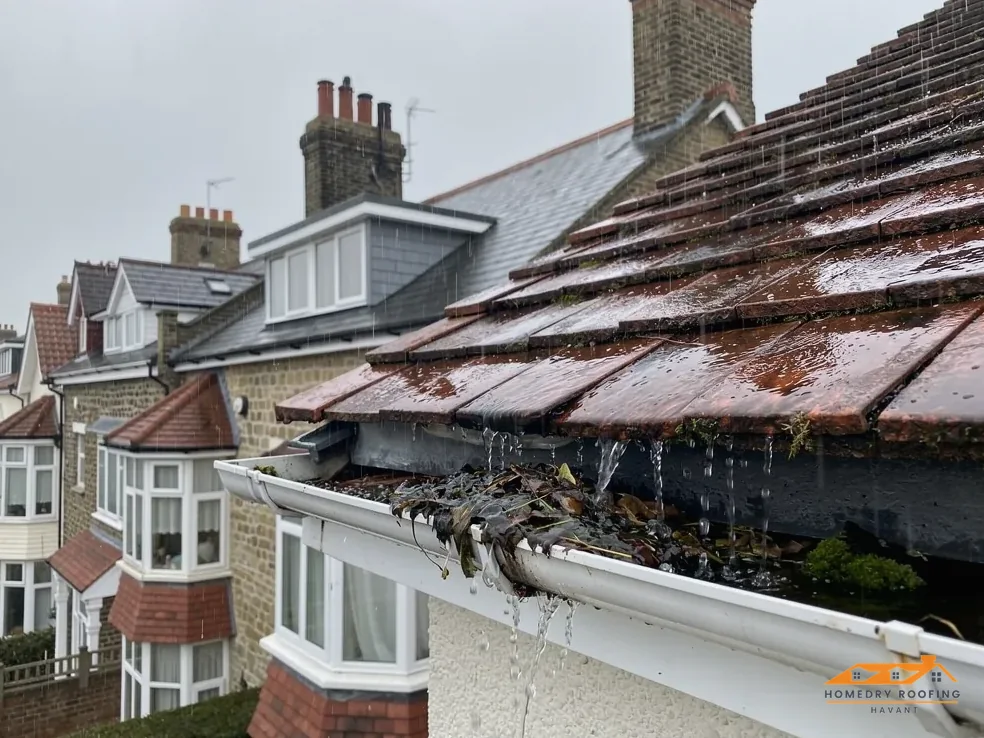
Eaves
Where the lowest row of tiles overhangs the wall and meets the gutter.
A slipped bottom row throws rain past the gutter and onto the wall.
Angmering is 28.6 road miles east of Havant, in Arun District. Eaves, gutters and downpipes are surveyed along with the roof above them, and one written total price follows the survey.
10-year workmanship guarantee, in writing
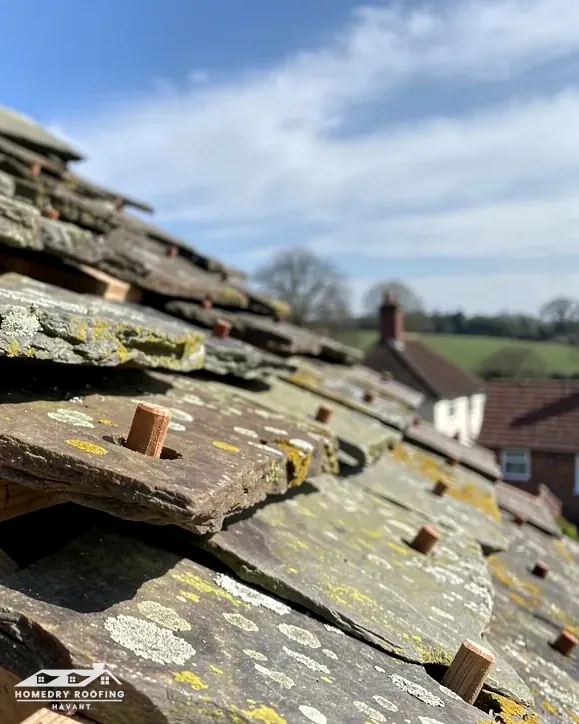
Where the lowest row of tiles overhangs the wall and meets the gutter.
A slipped bottom row throws rain past the gutter and onto the wall.
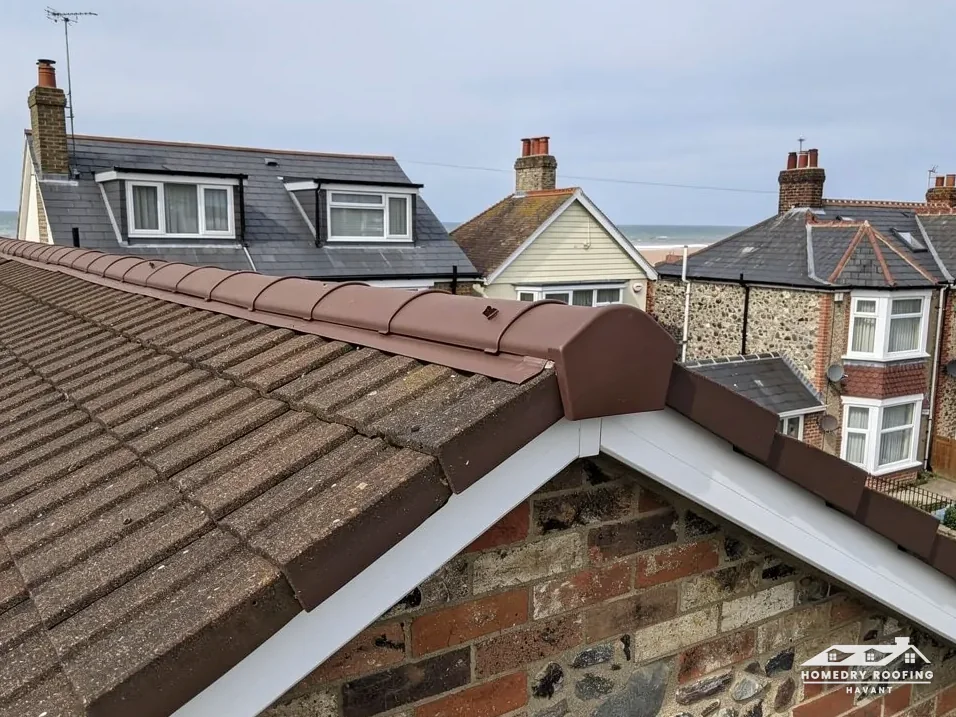
The slanting edge of a gable end, where the covering ends a little way from the wall.
Edge pieces that have come loose let rain and wind in under the covering.
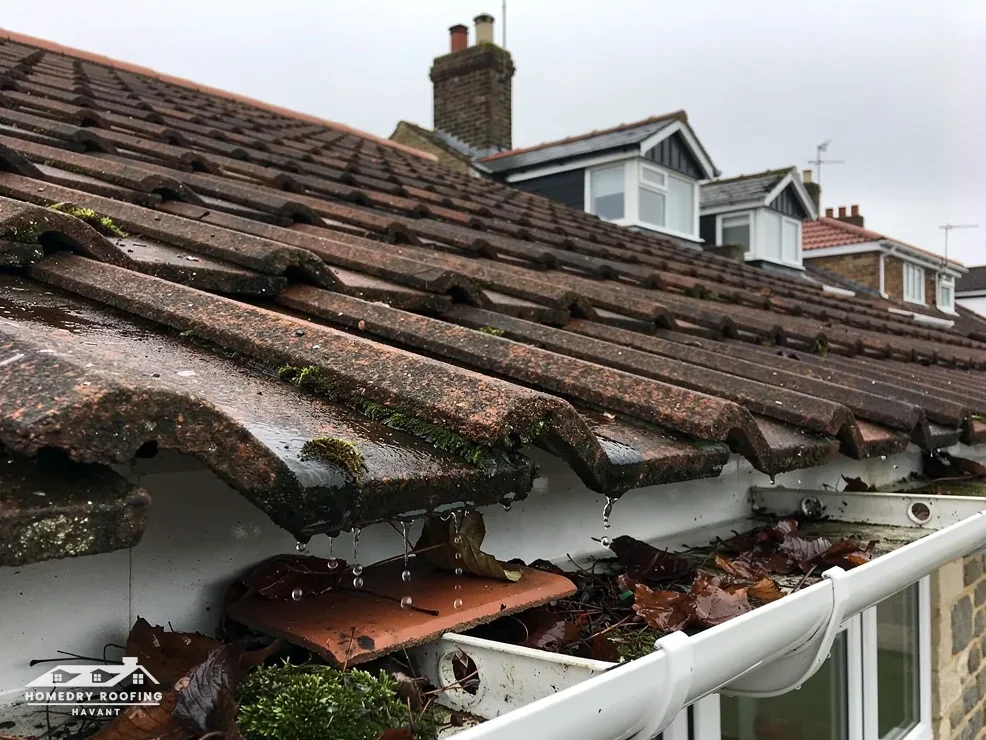
The grated drain at the foot of a downpipe, where roof water leaves the house.
Silt in it sends the water back across the paving towards the wall.

The edge of a roof is where the rain makes its exit.
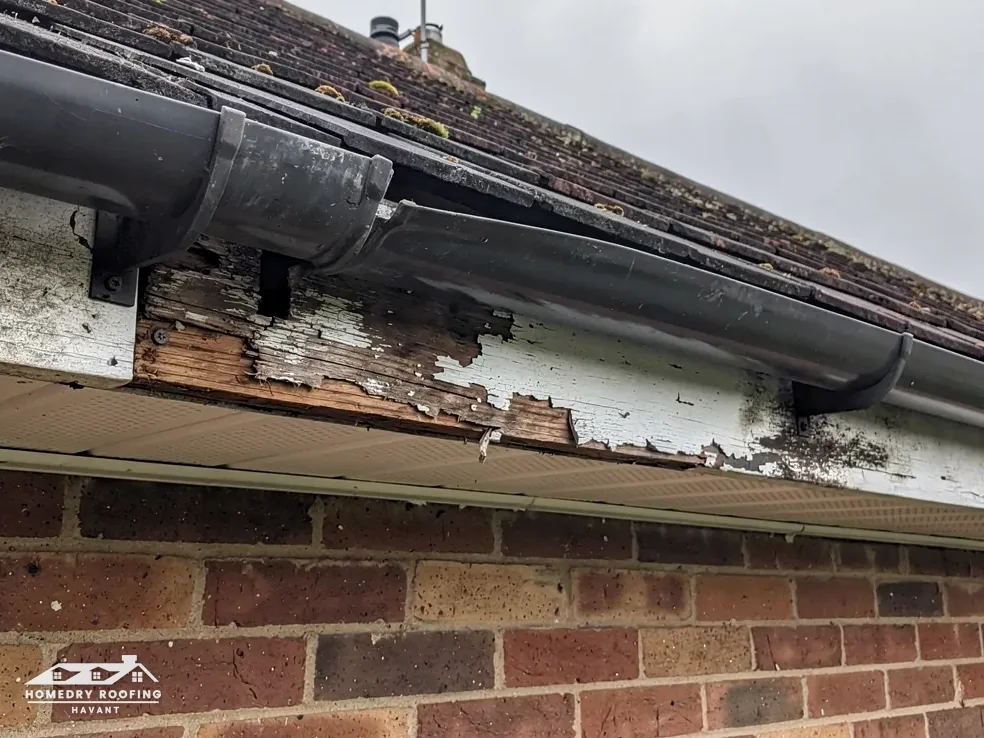
The eaves are the roof's lower edge, where three things meet: the last row of tiles, the fascia board holding the gutter, and the soffit that closes the underside of the overhang. Rain leaves the roof here, so a defect at this edge is felt on the wall and above the windows beneath as well as in the roof itself. Along an Angmering roof we check that the bottom course has not slipped or chipped, that the fascia is firm when pressed, and that the overhang delivers into the gutter and not behind it. At a gable the verge receives the same scrutiny, piece by piece. Where a fault is small and local, our roof repairs page shows how it is put right.
The Parish Church of St Margaret in Angmering is Grade II* listed and is in use as a Church of England place of worship. For a Church of England church in use, repairs go through the faculty system and not through listed building consent, so roof work there follows the church's own procedure. Byfleet House and Hazel Cottage, and Ann's Cottage Dolphin Cottage Elm Grove, are Grade II listed homes in the village. For a listed home, anything affecting its character needs listed building consent from Arun District Council, and Historic England's list entry describes what is protected.
A conservation area also carries the name Angmering and lies near the centre of the village, and Arun District Council can say whether your own address falls inside it. Whether an Article 4 direction removes further rights on your road is another question for the council, so check with Arun District Council before roof work is planned. The planning guide for roof work sets out the rules, so they are not restated here.
Trouble at the eaves leaves tracks. A bottom course that has slipped casts rain past the gutter, and the wall below shows a dark streak or a green line. A soffit that has been wet turns flaky or stained along its length. We follow those tracks upwards, photograph what we find at the edge and tell you whether the cause is one piece or the whole run.
A streak down the wall below the gutter, or a damp patch above a bedroom window frame.
A bottom-course tile that has slipped, so that rain falls beside the gutter instead of into it.
A pipe that discharges onto the wall, or into a blocked gully, keeps one patch wet all season. Rather than blame the brick, we check the pipe's end, the gully and the gutter joint above, since clearing or extending the run is a small job where that is the cause.
Roof water has one way out: down the slope, along the gutter, through the downpipe and into a gully. A survey follows that whole line. Gutters are checked for slope and for joints that weep, downpipes for splits and loose brackets, and each gully for silt, leaves and anything else that slows the flow. Brett Martin advises a fall of 1 mm for every 600 mm towards the outlet, and that is the slope a gutter run is judged against; where a length sags and holds water, the findings show exactly where. A gully choked with sediment turns the end of the route into a pond beside the wall, so the survey finishes at ground level and not at the gutter. Replacement runs and boards are described on our gutters, soffits and fascias page.
On the Environment Agency's flood map, land near Angmering falls in Flood Zone 3. That describes the ground and carries no instruction for a roof: no repair method or rule follows from it. It does give a reason to care where each downpipe discharges, so the findings record whether the gully beneath is clear and can take what the roof sends it, and whether its grating has silted over since it was last cleared.
Arun District Council's building control page lists replacing roof coverings on pitched and flat roofs among alteration projects that need approval, so before an Angmering re-roof we confirm the route with the council's own building control team, reached on 01903 737756. The Planning Portal's national test sits alongside it: under 25 per cent of the building envelope and under 50 per cent of the roof, a building regulations application is not normally needed, and a covering 15 per cent or more heavier needs approval. The reply is given to you in plain words, and the decision stays with you.
The route ends at the gully, not at the gutter.
A downpipe that ends a hand's width above a gully, or short of one altogether, drops its load against the wall or across the path. Over a wet season that leaves a green stain, a damp skirting inside, or a wall that never dries out. We follow every pipe to its end, note where it lands, and say in the findings whether a short extension, a new gully or a clear-out would put it right.
Map of Angmering and the places around it, with the dashed line of our 30-mile service area from Havant. The same places are listed below the map.
They are read twice, once from the ground and once close up. The bottom course of tiles is checked for pieces that have slipped or chipped, the fascia is pressed for soft timber, the soffit is examined for flaking or staining, and the overhang is judged for how well it delivers into the gutter. A verge at a gable end gets the same piece-by-piece look, and any gap where a bird or a draught could get in is noted too. Photographs of each doubtful spot go into the findings, noting whether a few pieces need attention or the full run does, so the quoted figure is tied to what was found.
Both are consulted, in that order. Arun District Council's building control page lists replacing roof coverings on pitched and flat roofs among alteration projects that need approval, so the first call is to the council's own building control team on 01903 737756. The Planning Portal's guide is the national yardstick: less than 25 per cent of the building envelope and less than 50 per cent of the roof, with approval needed wherever a new covering is 15 per cent or more heavier than the old one. We pass the council's answer on to you in plain words.
A conservation area named Angmering lies near the centre of the village, and Arun District Council is the body that can say whether a particular address is inside it. Put your house number and road to the council and keep its reply, which we can add to the survey notes beside the photographs. A house outside the area still gets every ordinary check before a price is written. The roof rules and their sources are in our planning guide, so they are left out here, and the survey notes can hold whatever the council says about your road for later reference.
Only Arun District Council can answer that for your road, so check with Arun District Council before roof work is planned. An Article 4 direction is how a council can withdraw chosen permitted development rights from a defined area, and where one exists we go through its wording with you before the written price is set. Asking comes first, and the answer arrives before any scaffold goes up or any covering is ordered, which is the cheaper moment to find out. This page makes no claim either way about your road, and the findings can carry the council's reply once you have it.
The Parish Church of St Margaret is Grade II* listed and is in use as a Church of England place of worship. A Church of England church in use goes through the faculty system rather than listed building consent, so the council's own listed building consent does not apply to the church itself, whatever the roof repair involves. The exemption belongs to the church while it is used for worship, and it stops there. A listed house is different: Byfleet House and Hazel Cottage, for instance, would need listed building consent from Arun District Council for work that affects its character.
Putting scaffolding on or over the highway requires a licence, under section 169 of the Highways Act 1980, and in Angmering West Sussex County Council is the licensing authority. We arrange the licence with our scaffolder. West Sussex County Council licenses scaffolding on the highway at £266 for one month and asks for at least 10 working days' notice, so you are given the start date before the application is sent, and the wait for the council is part of the schedule from the outset, not a delay discovered afterwards.
No. The Environment Agency's flood map puts land near Angmering in Flood Zone 3, which describes the ground and sets no rule for roof repairs. What it does is make the drainage worth a closer look, so every downpipe is traced to its gully, noting if the gully is clear and if the pipe lands where the water can drain away, and anything needing clearing goes into the findings, with a photograph of the gully as it was found. For flood risk at a particular property, the Environment Agency, which publishes the map, is the one to ask.
The work to be done, the covering to be used and the fixings, then whether VAT and scaffold sit within the figure. Once the survey is complete you receive one written total price, the findings come with it, and a sound repair is offered ahead of a replacement. The price is meant to be good and fair. To compare, request identical details from each contractor in writing, because a lower figure can hide an omitted item that turns up later, and ask for photographs of the roof to sit with each quote so the work described can be checked against what is actually up there.
You'll get one written total price.
Fill in what you like. It opens WhatsApp with your message ready to send.