
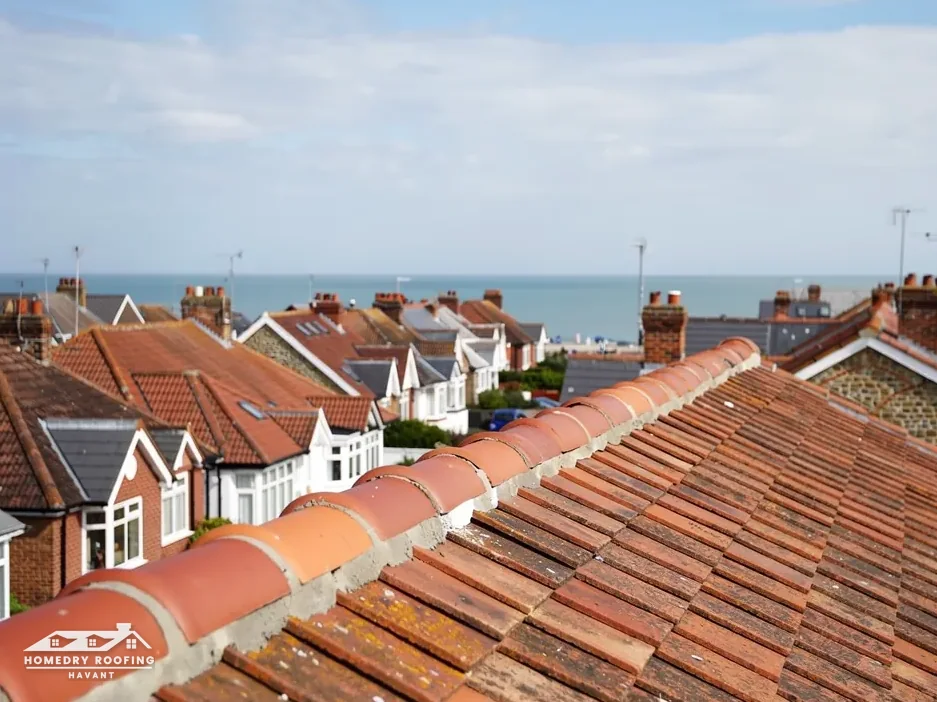
Ridges
The top line of a roof, where a row of capping pieces closes the join between two slopes.
Shifted capping or crumbled bedding there opens the roof at its highest point.
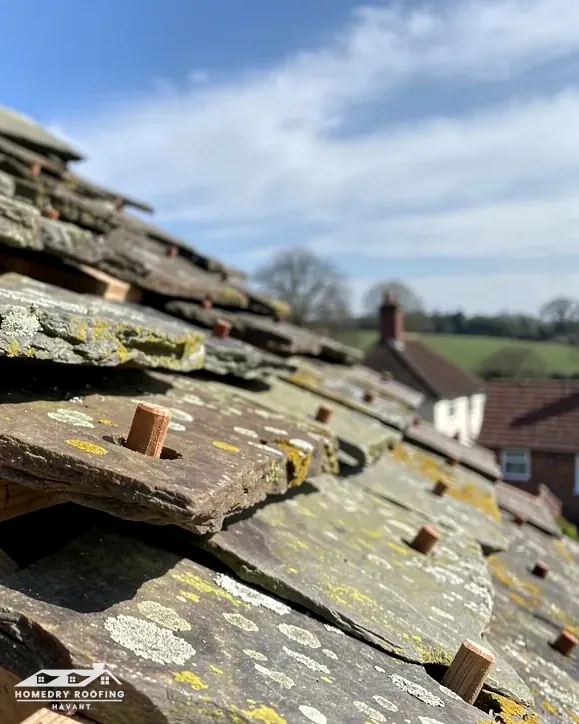
Aldwick is 16 road miles east of Havant. Its ridges, hips and flat roofs are surveyed on the roof itself before any price is written.
10-year workmanship guarantee, in writing
The top line of a roof, where a row of capping pieces closes the join between two slopes.
Shifted capping or crumbled bedding there opens the roof at its highest point.
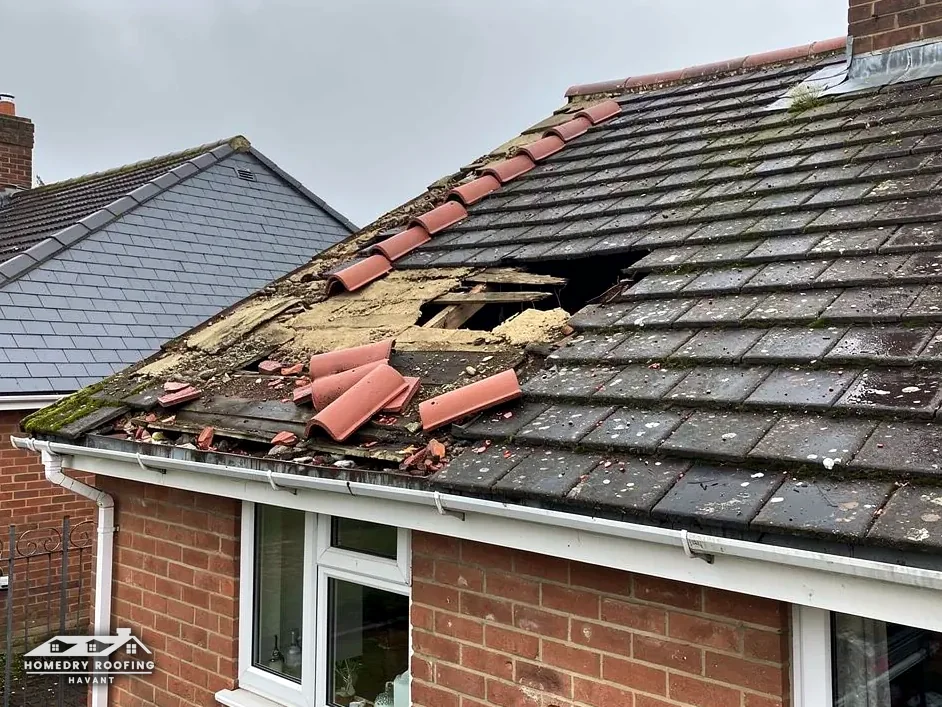
The sloping edge of a gable roof, where the covering stops just short of the end wall.
A loose edge piece gives the weather a way beneath, so each one is checked for hold.
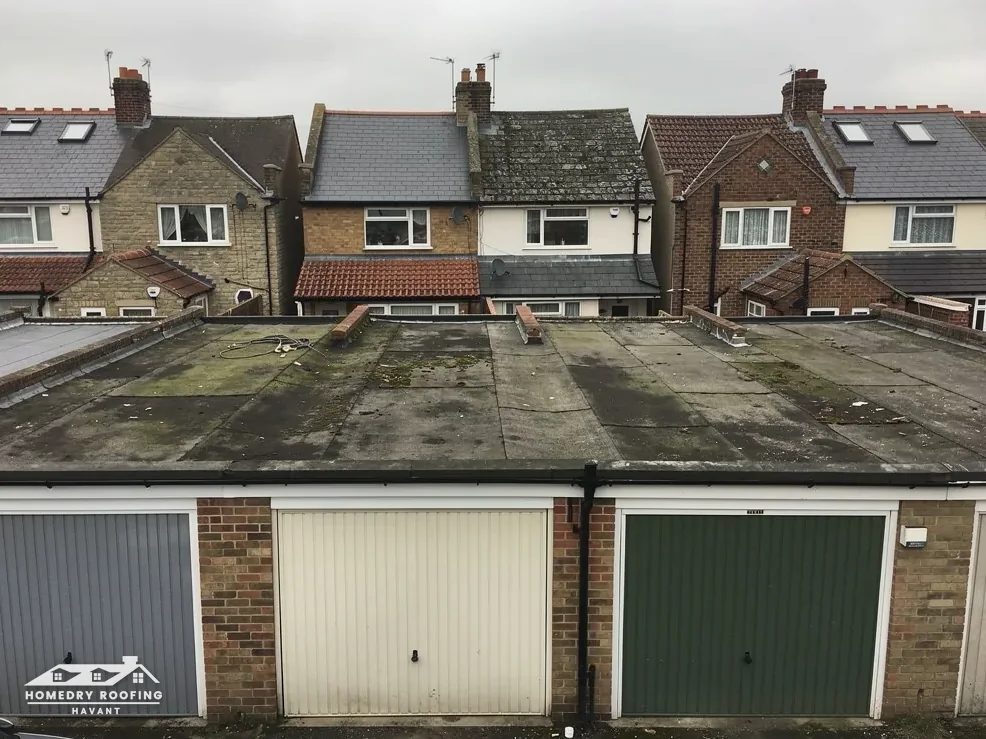
The opening that drains a flat roof into a gutter or a pipe.
Leaves and grit in it leave a pool standing, and the pool presses on the nearest seam.
Everything lower on the roof depends on the ridge holding.
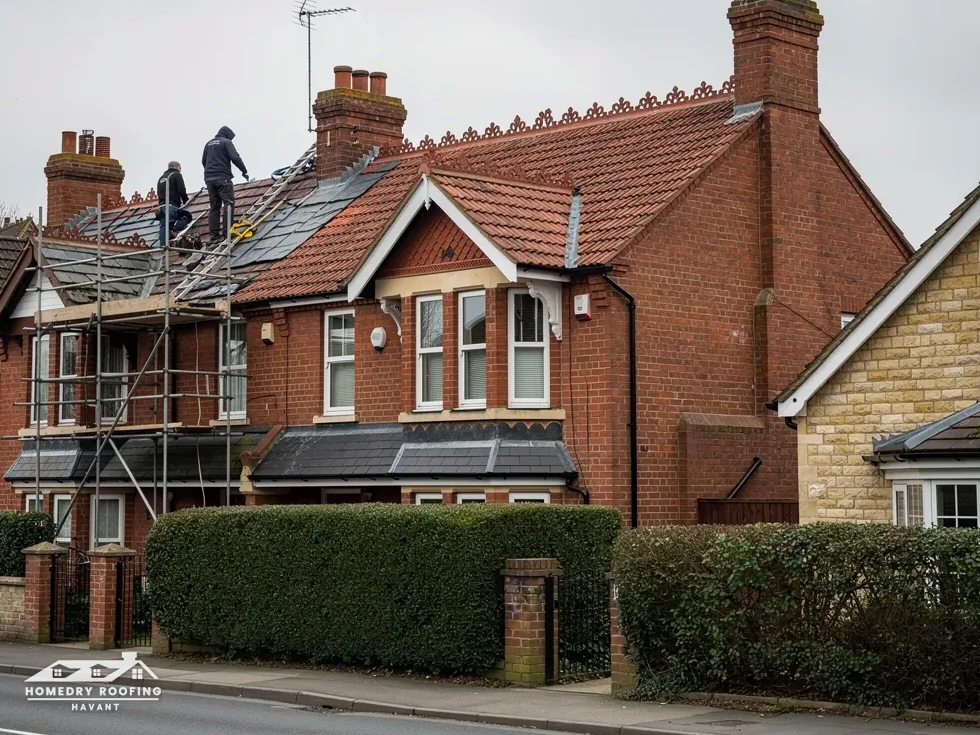
The ridge is the top line of a roof, where two slopes meet and a row of capping pieces closes the join, and a hip is the sloping edge that runs down from it on a hipped roof. A survey starts there because everything lower depends on the high point holding. We look at each capping piece, at the bedding beneath it and at the fixings, and then at the edge of the covering that meets them. Earlier patches are noted too, since a patch marks the spot where trouble was last dealt with and the cause may still be there. Our pitched roofing page covers the wider work when a whole slope needs attention.
Aldwick is a coastal village, and Cupa, the slate maker, says buildings in coastal areas are graded with higher exposure. For a roof that means the fixing specification is calculated for the site under BS 5534, which Marley describes as a code of practice, not law. Marley also says mortar alone can no longer be relied on as the only means of securing a roof covering, so the survey notes how each ridge piece is held and states plainly whether it needs more than bedding.
Hurst Cottages, Woodstock and Old Place are Grade II listed buildings in Aldwick. Work that would affect a listed building's character as a building of special architectural or historic interest needs listed building consent from Arun District Council. Conservation areas lie close by: Bognor Regis (Railway Station), Bognor Regis (The Steyne and Waterloo Square), Bognor Regis (Aldwick Road) and Aldwick Bay. Arun District Council's list tells you whether an address sits inside one, and an Article 4 direction can remove further rights, so check with Arun District Council. The planning guide for roof work sets out the rules, and this page does not repeat them.
A ridge piece that has shifted may show nothing indoors at all. From the ground it can read as a line that is no longer straight, or as a gap where the bedding has crumbled and left the piece sitting loose. We look along the whole run, mark each doubtful piece and photograph it, so the findings can say whether the repair is a few pieces re-bedded and fixed or a longer length taken up and relaid.
A stain at the very top of an upstairs wall, or a damp patch beneath the loft hatch after a wet spell.
A shifted capping piece, or a gap in crumbled bedding along the ridge, where rain runs under the covering.
A gutter that overflows or a joint that drips keeps the same stretch of wall wet. Before blaming the brickwork, we check the gutter's fall, its joints and the downpipe above that patch, because clearing a blocked outlet may be all the wall needs.
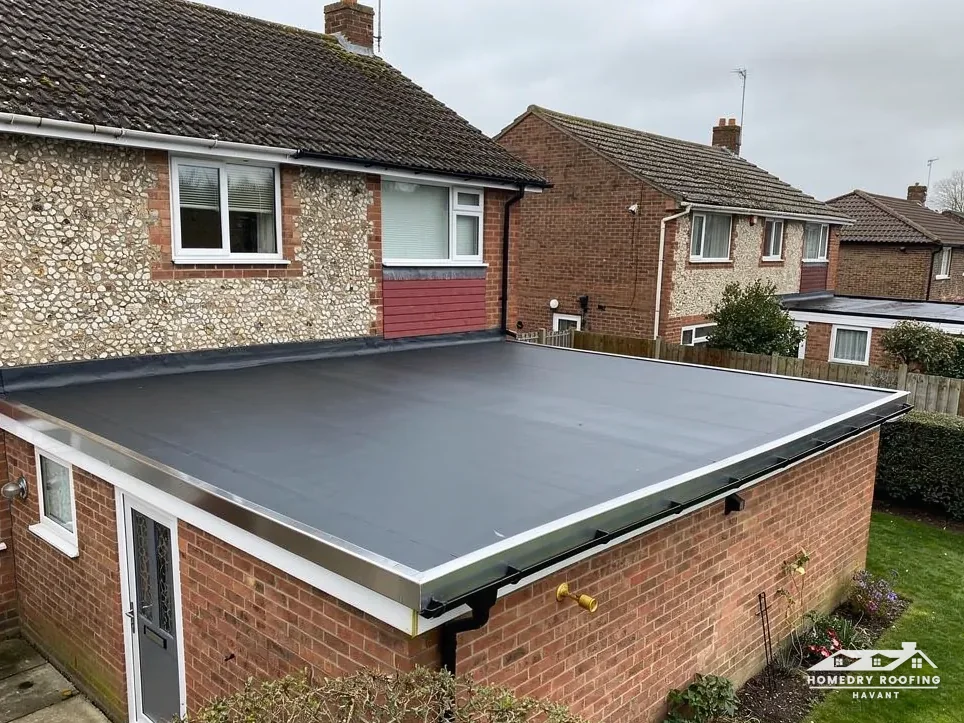
A flat roof sheds rain in a different way. The covering runs up the house wall as an upstand, falls gently across the roof and drains through an outlet into a gutter or a pipe. We read all three on an Aldwick extension: the edge of the upstand, any pool still lying on the surface a day after rain, and the outlet itself. The surface is photographed so that any pooling is on record. A pool means either a fall that has been lost or an outlet that is blocked, and the two need different repairs, so the findings say which one the roof has. Our flat roofing page describes the covering work, and the gutters, soffits and fascias page covers the last metre.
That last metre is the gutter, the boards behind it and the downpipe. A joint that drips, a length that sags and a pipe that empties against a wall can all be read from a ladder, and the board behind the gutter is pressed to see whether the timber has softened. Land near Aldwick sits in Flood Zone 2 on the Environment Agency's map. That is a fact about the ground around the village, not a roofing rule, but it is a good reason to keep downpipes and gullies clear and to ask where each one discharges.
For the paperwork on a re-roof, Arun District Council's building control page lists replacing roof coverings on pitched and flat roofs among alteration projects that need approval, so we confirm the route with the council before a re-roof begins. The Planning Portal's guide is the national test and comes after it. When the survey is done you receive one written total price, with the findings set beside it in plain language, and the garden and drive are swept before we leave.
A flat roof has to empty, and we watch how it does.
Water that misses the gutter lands on the wall beneath, and the stain it leaves is easily mistaken for damp coming through the brickwork. We look for stain lines under each joint and each bracket, and for a downpipe that discharges at the wall instead of into a gully. A short run of wall that stays wet after rain tells us where the gutter has been overflowing, and the findings name the joint or the outlet responsible.
Map of Aldwick and the places around it, with the dashed line of our 30-mile service area from Havant. The same places are listed below the map.
It starts at the capping pieces along the top: whether each one sits firmly, whether the bedding beneath has crumbled and how the fixings hold. The hips and the edge of the covering beside the ridge follow. Because Aldwick is a coastal village, the fixing specification is calculated for the site under BS 5534, and the survey notes how the present ridge is held against that. Photographs of each doubtful piece go with the findings, so you can see the cause for yourself. Where only a few pieces have moved, we re-bed and fix those, and the findings state that before any price is written.
Arun District Council's building control page lists replacing roof coverings on pitched and flat roofs among alteration projects that need approval, so an Aldwick re-roof is checked first with Arun District Council's own building control team, on 01903 737756. As the national guide, the Planning Portal says a building regulations application is not normally needed if less than 25 per cent of the building envelope and less than 50 per cent of the roof is affected, while a new covering 15 per cent or more heavier does need approval. We pass the council's reply on in plain language, ask for it in writing where that helps, and leave the choice with you.
These lie close to the village: Bognor Regis (Railway Station), Bognor Regis (The Steyne and Waterloo Square), Bognor Regis (Aldwick Road) and Aldwick Bay. Whether your own house sits inside one is a question for Arun District Council, which holds the boundary maps, so ask before any work is planned. The survey notes can record what the council tells you. Our planning guide sets out the roof rules and their sources, which is why this page does not restate them, and a house outside every boundary still gets the same ordinary checks before a price is given. A short enquiry to Arun District Council settles the question for your address.
Arun District Council's page on conservation areas mentions two Article 4 directions in the Craigweil House conservation area. An Article 4 direction lets a council withdraw specified permitted development rights across a defined area, so check with Arun District Council whether any direction reaches your road before roof work is planned. If the council confirms one, we read its wording with you, and the written price is set once the requirements are clear. Asking costs nothing and avoids a surprise halfway through a job, when a halted roof is both untidy and exposed.
Hurst Cottages, Woodstock and Old Place are each Grade II on the National Heritage List for England, which Historic England keeps. Listed building consent is needed for anything that affects the building's character, under section 7 of the Planning (Listed Buildings and Conservation Areas) Act 1990. Read your own list entry before anything is bought or booked, and ask Arun District Council if the entry leaves any doubt. Our survey describes the roof as it stands, with photographs of each junction, so the council has something exact to read and nothing is left to memory.
Scaffolding that stands on the public highway needs a licence under section 169 of the Highways Act 1980, and for Aldwick the licensing body is West Sussex County Council. West Sussex County Council licenses scaffolding on the highway at £266 for one month and asks for at least 10 working days' notice. We arrange the licence with our scaffolder, and the start date is agreed with you before the application goes in, so the notice period is part of the plan from the first day rather than a delay discovered later, and you are told the date in good time.
The Environment Agency's flood map gives land near Aldwick as Flood Zone 2. That describes the ground, not the roof, and it sets no rule for repairs. It does bring the water leaving the roof into focus: gutters, downpipes and gullies need to be clear and to discharge where the water can drain away. During the survey we follow each downpipe to its gully, note anything blocked or discharging against a wall, and put it in the findings. Questions about flood risk to your own property go to the Environment Agency, which publishes the map.
A written price should name the work, the covering and the fixings, then show whether VAT and scaffold form part of the total. We give one written total price once the survey is done, with the findings attached, and where a repair is sound we put the repair forward first. Our prices are good and fair, and the way to judge them is to ask any other contractor for the same details in writing so two quotes can be read side by side, because a lower figure may simply leave a cost out. An Aldwick roof is surveyed the same way whatever the price turns out to be.
You'll get one written total price.
Fill in what you like. It opens WhatsApp with your message ready to send.