
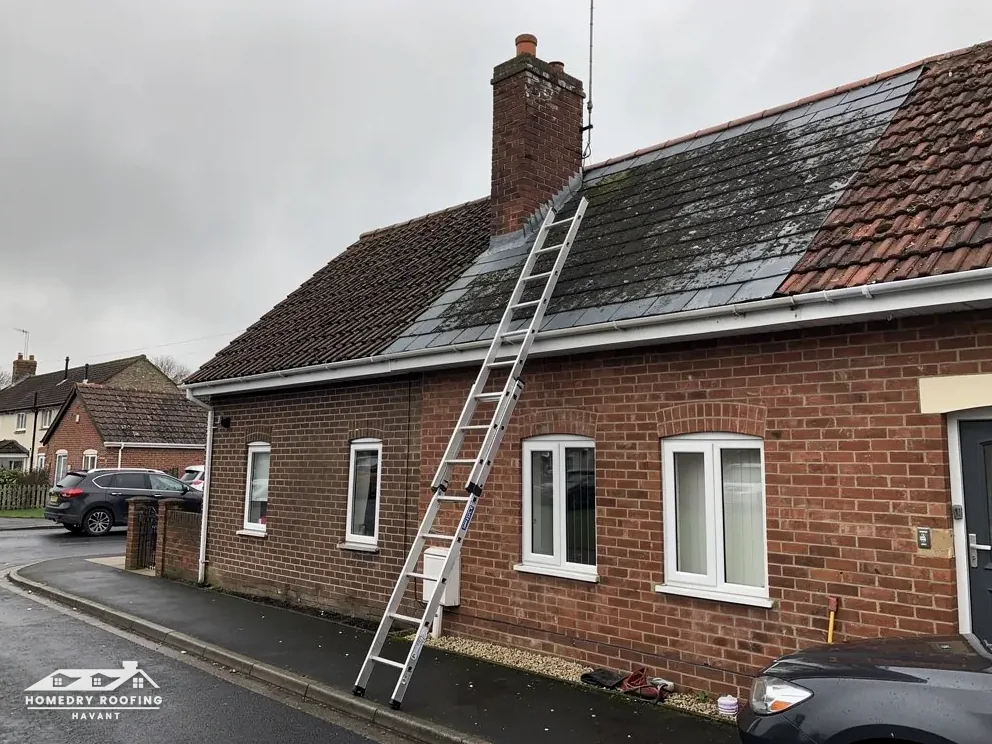
What counts as a storm
People differ on where an ordinary wet and windy night ends and a storm begins, and the Financial Ombudsman Service has written down how it approaches the question. It says: "We say that a storm usually involves violent winds, usually with rain, hail or snow." It also says: "Rain, hail or snowfall by itself can constitute a storm."
The Ombudsman also says: "We take into account the Beaufort Scale." And: "Some insurers say that only winds above a certain point on this scale count as storm-force winds." Read your own policy to see what your insurer means by it. Which label applies is for your insurer to say and, in a dispute, for the Ombudsman, never for the roofer.
For the roof, the label matters less than the result. A heavy fall of rain, a gust that lifted a few tiles or a night of hail can all leave the roof in a different state from the one it was in the day before, and each is worth a look. A tile can be shifted on a day that no forecast called a storm, so judge the roof by what you can see.
What to check from the ground and the loft
Check once the wind has dropped and the light is good. Stay on the ground, and take binoculars or a phone with a zoom lens.
- Tiles or slates that are missing, cracked or lying in the garden.
- Ridge or hip pieces that have moved, or mortar lying below them.
- The chimney stack, for a lean or loose pieces.
- Flashings, which can lift or peel back at a wall or a chimney.
- Gutters, downpipes and fascias that have sagged, parted or filled with debris.
Then take a torch to the loft hatch and check under the slope for daylight and fresh wet marks. Check the ceilings below for new stains. Write down what you saw and when, even if it seems minor, because a single slipped tile can matter when the roof is looked at properly.
Do not climb onto the roof. HSE says "all roofs should be treated as fragile until a competent person has confirmed they are not." A roof that has just taken a battering is the last one to test. Our post on what to check after storm damage adds more to look for.
Photographs, reports and your insurer
If the roof is damaged, the order matters. Contact your insurer before anything else. Next comes a temporary repair that makes the roof safe, with photographs and receipts kept throughout. That order means the insurer hears about it before any work.
On evidence, the Financial Ombudsman Service says: "To do this we'll usually look at expert reports and photos. Your insurer will normally ask a surveyor to write a report." It adds that "the insurer has to prove that the exclusion applies", and gives an inspection report as one example of how.
So the pictures you take at once matter, and an inspection report adds an expert view. Take wide shots that show where the damage sits on the house, then close-ups, with the date on each. Clearing up comes after the pictures, never before them, since a fallen tile in the garden is part of the evidence.
A report after the storm can say what condition the roof is in now. It cannot say what the roof was like before, which is where earlier dated photographs earn their place. Our page on a roofer's report for an insurer goes through what the report should hold.
When to book an inspection, and the price to expect
Book an inspection after a storm when any of these is true:
- You can see damage from the ground.
- A new ceiling stain has appeared, or an old one has grown.
- Debris has fallen from the roof, or something has fallen onto it.
- You cannot tell whether the roof is sound and need to know.
Where nothing shows from the ground or in the loft, a closer look can still be worth having, since some damage sits where only a ladder or a camera on a pole reaches. A written report then records either damage found, or a roof that came through in good order.
On cost, MyJobQuote's emergency roofer page (updated October 2026) says that "extensive storm damage repairs can cost £1,200 or more". That figure belongs to extensive damage only, and it says nothing about the price of a small repair. A repair is quoted in writing after the survey. Our roof inspections page explains how the visit runs, and our page on what you can tell from the ground covers the checks you can make first.