
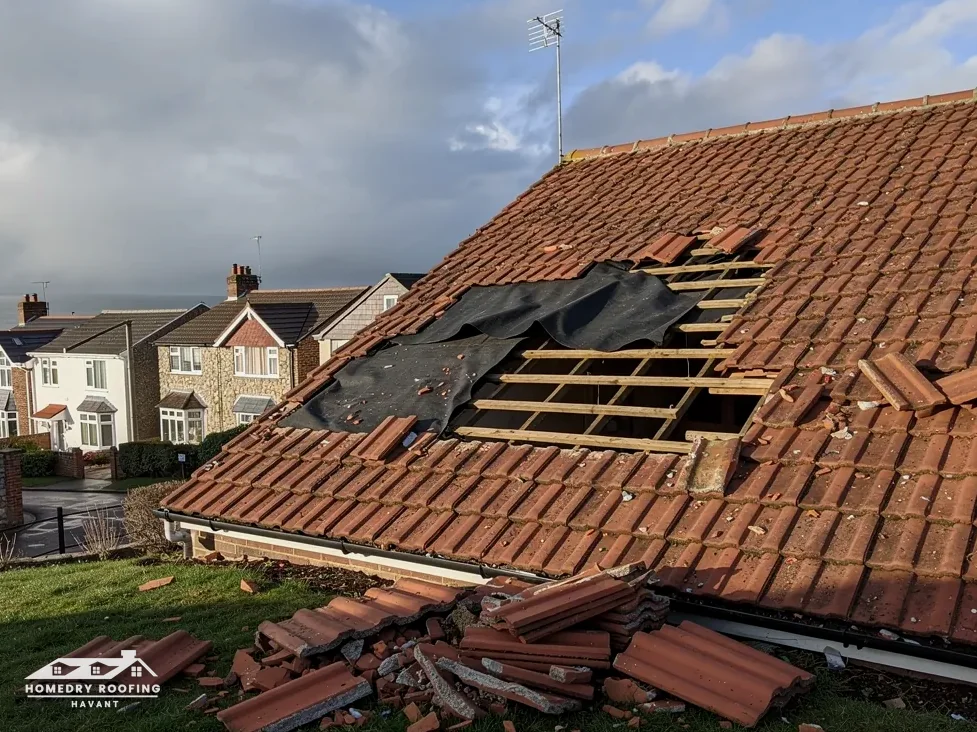
The weather has gone and the house is still standing, but you would like to know whether the roof came through it. A storm can shift a tile, lift a ridge, loosen a chimney pot or drop a branch on a gutter, and none of that is guaranteed to show as a leak the same night.
You do not need to climb anything to find out most of it. This post follows the order a careful check takes: the ground first, then the loft and ceilings, then the photographs that protect an insurance claim, then the decision about when to call a roofer. It ends with a note on what to do if a stranger knocks and offers to look at the roof.
The Ombudsman looks at weather reports for where you live and when the damage happened, so note the date and what you saw. The advice works whatever the weather was, and it keeps you on the ground, where it is safe to be.
What counts as a storm, and why it matters
Before you check anything, it helps to know how a dispute over storm damage is judged. The Financial Ombudsman Service, which settles complaints between consumers and insurers, puts it this way: "We say that a storm usually involves violent winds, usually with rain, hail or snow." It goes on: "Rain, hail or snowfall by itself can constitute a storm." A downpour on its own is therefore not automatically ruled out.
The Ombudsman also writes "We take into account the Beaufort Scale", the scale used to describe wind strength, and then adds: "Some insurers say that only winds above a certain point on this scale count as storm-force winds." That threshold is an insurer's own rule, not a law. If a claim is turned down on that basis, you can complain to the insurer first and take it to the Ombudsman afterwards.
The reason to care before you start is simple: a storm claim rests on evidence of what the weather did to your roof. The Ombudsman weighs weather reports too, but the part you can gather is photographs and a roofer's or surveyor's report. The order of the checks below is arranged to protect it:
- Look first, touch nothing, and photograph what you see.
- Leave damaged tiles, slates and debris where they fell until they are recorded.
- Write down the date and what the weather did, in your own words.
- Keep any receipt for a temporary repair or a call-out.
Nothing in this list needs a ladder, and nothing in it is rushed. A day's delay in checking costs you very little, and a rushed climb can cost a great deal.
Check from the ground, with your feet on it
Walk round the house and look up at each side in turn. A phone camera with the zoom turned up shows more than the naked eye, and the photographs it takes are a record you can show a roofer or an insurer. Stand clear of the building while you look, especially below a chimney, a tall gable or an overhanging branch, because anything loose can come down without warning.
These are the places worth a careful look:
- Tiles or slates that have shifted, tipped or vanished, leaving a dark gap.
- The ridge line along the top, for tiles out of line.
- Chimney stacks and pots, for leaning, cracks or fallen pieces.
- Gutters and downpipes, for sagging, gaps or a section hanging loose.
- Fascias and soffits, the boards under the roof edge, for lifted or missing sections.
- Anything fixed to the roof, such as a flue, an aerial or a satellite dish.
Look at the ground too. Pieces of tile, mortar or cement in the garden tell you something has come off, even where you cannot yet see what. Check the neighbours' side too: a tile that landed next door is still your tile, and a photograph of it helps.
HSE, the Health and Safety Executive, says "all roofs should be treated as fragile until a competent person has confirmed they are not." That is the reason this check stays on the ground. If something looks wrong, you note it and leave it for someone with the right access, rather than going up to find out.
Check inside, from the hatch and the ceilings
Damage on the roof shows itself inside before it shows itself outside, so the second look is indoors. Go through the upstairs rooms first and look at the ceilings, the tops of the walls and the corners where walls meet the roof line, since a stain can begin there and be easy to miss. Then open the loft hatch and look in with a torch, standing on the ladder or steps below the hatch rather than climbing into the loft.
| What you see | Where | Next step |
|---|---|---|
| A new stain or drip | Ceiling or wall | Photograph, catch the water, call a roofer |
| Daylight through the roof | Loft | Photograph and note where it is |
| Wet insulation or timber | Loft | Photograph from the hatch |
| A bulging ceiling | Room below | Keep clear and call urgently |
Stay on the steps and do not put weight on the ceiling boards. If you cannot see into every corner of the loft from the hatch, say so in your notes and leave the rest for a roofer. Plasterboard is not made to carry a person, and one step off a joist can put a foot through the ceiling below. Look in, photograph what you can see, and come down.
If you see nothing, that is useful to know, but it is not a clean bill of health. A small displacement can let water in before a stain appears, so note the date you checked and what you saw. If anything changes later, your note shows when it began. Check again after the next spell of rain, since that is when a hidden fault shows itself.
Photographs, your insurer and the next steps
To decide whether a storm caused the damage, the Ombudsman writes: "we'll usually look at expert reports and photos." It adds that "Your insurer will normally ask a surveyor to write a report", and that "The insurer has to prove that the exclusion applies". So the photographs you take on the day sit alongside a professional's findings, and both count.
Photograph before anything moves, and take more than you think you need, because a spare picture costs nothing and a missing one cannot be replaced: wide shots of each side of the house, close shots of damage, the debris on the ground and any wet rooms. Then work through the steps in order, noting the date and time of each so that the sequence of events is clear later:
- Tell your insurer what has happened, before you commit to any large repair.
- If water is coming in, put a temporary repair over it to make the roof safe.
- Keep photos, receipts and any written report together in one folder, on paper or on the phone.
- Ask for a written quote as one total for the permanent repair.
- Check your policy wording for what is covered and for any excess you will have to pay.
Whether a claim succeeds is for your insurer to decide and, in a dispute, the Ombudsman, so nobody can promise the outcome. Our guide to roof storm damage and insurance claims goes through the steps in more detail.
Deciding when a roofer needs to come
Not every sign needs the same response. It helps to sort what you have seen into two groups, and to act on the first one straight away.
- Ring a roofer without delay if water is coming in, if a ceiling is bulging, if a chimney or ridge looks loose, or if tiles are hanging at the edge of the roof.
- Arrange a survey, without the same urgency, if you can see a cracked or slipped tile from the ground, a sagging gutter, or a flashing that has lifted.
- Arrange an inspection if you simply want to be sure, because a check from the ground cannot see everything, and a roofer with access can look at flashings, valleys and the ridge close up.
When you ring, say what you saw and where, and send the photographs. Ask for a written quote as one total, and ask what is included.
Published guides give some idea of the cost. MyJobQuote (October 2026) writes: "Emergency roofer call-out costs typically range from £150 to £300, while extensive storm damage repairs can cost £1,200 or more." The upper sum is for extensive storm damage, so it is no guide to a few slipped tiles. That call-out sum is for attendance, not a make-safe or a repair, and the repair itself gets its own written price after the roof has been surveyed.
Our guide to loose tiles and chimneys after a storm covers what a roofer does at each of those points, and our emergency roof repairs page explains how we make a roof safe and then repair it.
If someone knocks and offers to look at your roof
A storm can bring people to the door offering to inspect or fix the roof. Some may be genuine local roofers and some may not, and you cannot tell which from the doorstep, so the habits below apply to everyone. A few plain habits protect you either way.
- Do not agree to work, or hand over money, at the door.
- Ask for a written quote as one total price, and take time to read it.
- Treat a claim that the roof needs work with suspicion if the person will not let you see photographs of it.
- Do not let anyone onto the roof before you have decided who is doing the job.
Your rights depend on how the contract came about. A contract you sign at home once the survey is done carries 14 days to cancel, and the work can start earlier only on your written request. The exception for urgent repairs is written around a consumer who has specifically requested a visit from the trader, so a stranger who arrives uninvited is a different case. For advice on your position, the Citizens Advice consumer helpline is 0808 223 1133.
The simplest protection is to decide who you want before the storm, so you are not choosing in a hurry. Photographs, a written quote and a clear scope of work are what a straightforward job looks like, and we leave the site clean when we finish.
Filed under Emergency repairs