
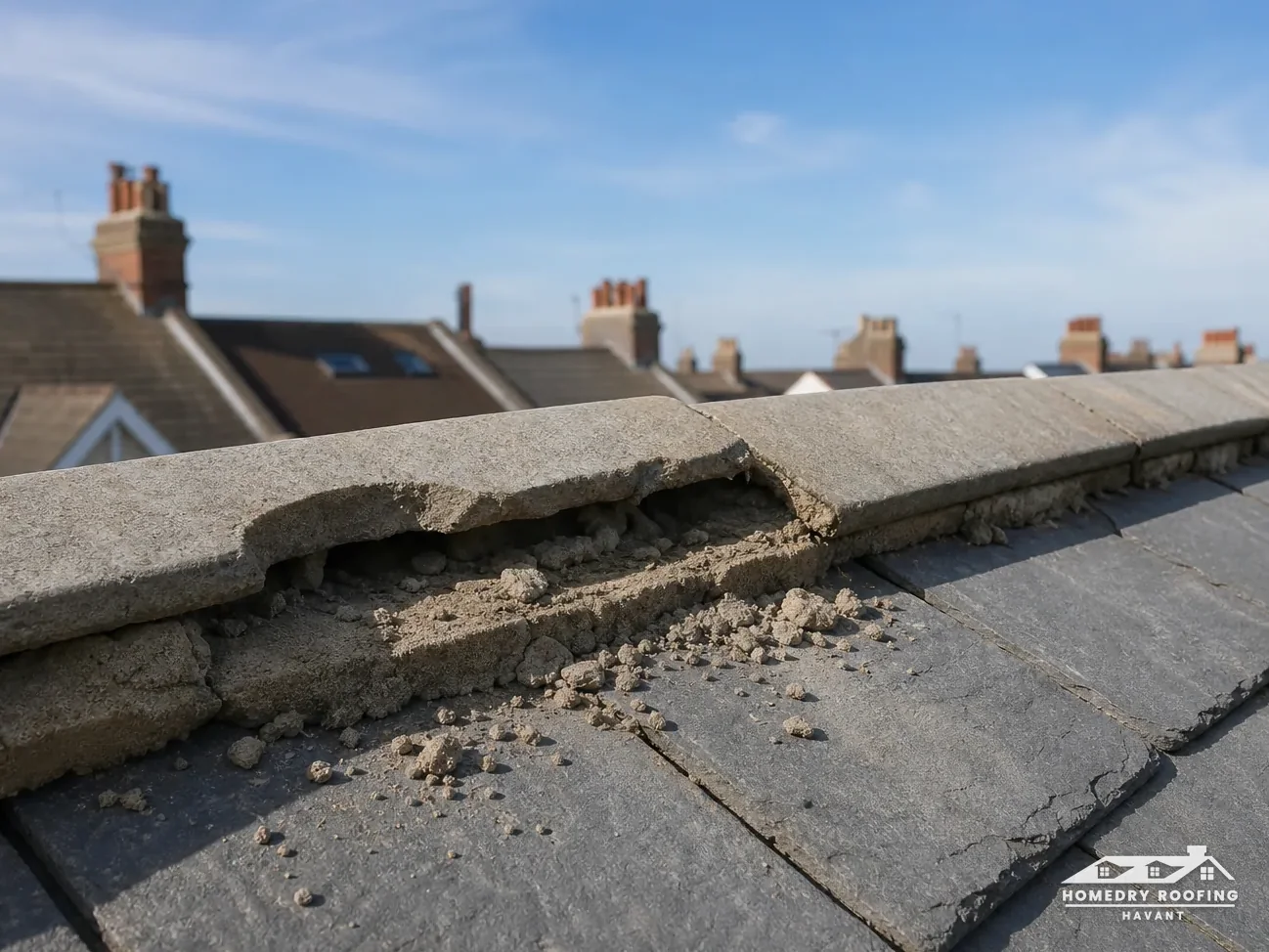
Signs that make the visit urgent
Three tests separate an emergency from an ordinary repair. Ask whether anyone could be hurt, whether the house is taking in water now and whether the water is nearing electrics or a ceiling that is giving way.
If any answer is yes, ring us. Typical examples are:
- A chimney stack that has cracked, leans or has dropped bricks or a pot.
- Ridge tiles, slates or a length of gutter hanging loose over a footpath, a doorway or a driveway.
- A gap in the roof covering where tiles have blown off, leaving the layer beneath open to the sky.
- Water running or dripping indoors, particularly if it grows during rain.
- A bulging or sagging ceiling, or water reaching a light fitting or socket.
Each of these puts either a person or the contents of the house at risk, and each gets worse with the next shower. Where water has reached wiring, switch the circuit off only if you can get to the consumer unit without standing in water, and call an electrician too.
Our guide to what counts as a roofing emergency goes into each of these in more detail.
Problems that can wait for a planned visit
Plenty of roof faults are worth fixing without being urgent. Booking them in calmly tends to give you a better look at the roof and a clearer price than a rushed visit would.
These can generally wait, provided nothing is falling and no water is coming in:
- A single slipped tile or a small gap over a loft that is dry.
- An old stain on a ceiling that has stopped growing and stays dry in rain.
- A gutter that spills only occasionally, with no water reaching the walls.
- Moss, lichen or weathered pointing with no sign of leaks.
Putting a job off is different from forgetting it. A small fault can grow larger over a winter, so book a survey, and check the loft after the next heavy downpour. Our roof repairs service deals with these jobs, and each is priced as a single written total once it has been surveyed.
If a small problem changes, such as a stain that spreads or a drip that appears, it has moved to the other list. Ring us, and say what has changed since you last looked.
When you cannot tell which it is
A roof is hard to judge from below, and a roofer does not expect you to. If you are not sure, send what you can see and let someone read it.
- Take a photo of the outside from the ground, zoomed in on the area you are worried about.
- Take a photo of the wet room, the stain or the drip.
- Note where the water shows, and which rooms lie beneath the nearest wall or chimney.
- Send the pictures by WhatsApp to 07880 284133, or ring 023 9396 0313, and describe what you can see.
Two pictures, one taken outdoors and one of the damp room, give us plenty to work with before anyone sets foot on the roof. We tell you whether it can wait, and what to watch for if it can.
Do not go up to look for yourself. Our answer on checking the roof yourself after a storm explains the danger.
If the situation changes while you are deciding, with more water or a new noise from the ceiling, treat it as urgent.
What to do before anyone arrives
The steps below are for the owner or tenant, and none of them involves the roof itself.
- Keep everyone clear of the area under any loose chimney, ridge or gutter, and use another door.
- Move belongings out of the wet room, and catch drips with buckets.
- Photograph whatever fell or broke, from the pavement, before anyone sweeps or lifts it.
- Tell your insurer, your landlord or your freeholder, and keep your receipts.
Be aware that you lose the right to cancel a visit you request for an urgent repair, so ask what it will involve and what it will cost before it goes ahead. Our answer on cancelling an urgent roof repair explains the rule.
The first visit makes the roof safe. The lasting repair follows after a survey in dry weather, and its price comes as one written total. The emergency roof repairs page explains how both stages work.
Write down what you notice in the meantime, such as how often the drip falls and which rooms it reaches, because that helps whoever arrives and shows how the problem is developing.