
What the safety guidance says
The Health and Safety Executive publishes guidance on roof work, and its wording is blunt. It says: "all roofs should be treated as fragile until a competent person has confirmed they are not." It adds: "Do not trust any sheeted roof, whatever the material, to bear a the weight of a person."
On the scale of the danger, it says: "almost one in five deaths in construction work involve roof work. Some are specialist roofers, but many are just repairing and cleaning roofs."
It is not describing careless people. It is describing people who set out to fix or clean a roof and were hurt doing it. Knowing your own roof well does not make the surface safe to stand on, and a storm has just changed it in ways you cannot see from the foot of a ladder. A careful person can still be caught out. A step that held yesterday can give way today, because a fixing has let go underneath, and nothing about the surface warns you. The guidance therefore begins by assuming a roof will not carry you, and asks for proof before anyone relies on it.
HSE's page on roof work has the full text. Our advice follows from it: leave the climbing to someone with the means to work safely at height.
Why a storm makes a roof worse to stand on
A roof that was fine last week can behave differently after a blow. The covering may have slipped without falling, a fixing may have let go and a slate may be resting on nothing. You cannot tell which tile will hold your weight from the way it looks.
Several things stack up at once:
- Wet tiles, slates and moss are slippery, and the surface can stay damp long after the rain stops.
- Gusts can arrive without warning, and a ladder on soft or wet ground can shift.
- A loose piece can slide as soon as it is touched, taking your footing with it.
- Flat and sheeted roofs, and glazed panels, can give way under a step. HSE treats them as fragile too.
None of that depends on your fitness or your experience. It is the condition of the roof and the weather that make the climb dangerous, and neither can be judged before you are already on it.
If a neighbour or a passing builder offers to go up and have a look, the same advice applies to them.
What a careful look from the ground tells you
You can learn a great deal without leaving the floor. The aim is to see enough to describe the damage, not to diagnose it.
- Walk the garden and the pavement for fallen tiles, slates, ridge pieces, bricks or lengths of gutter. Photograph them where they lie.
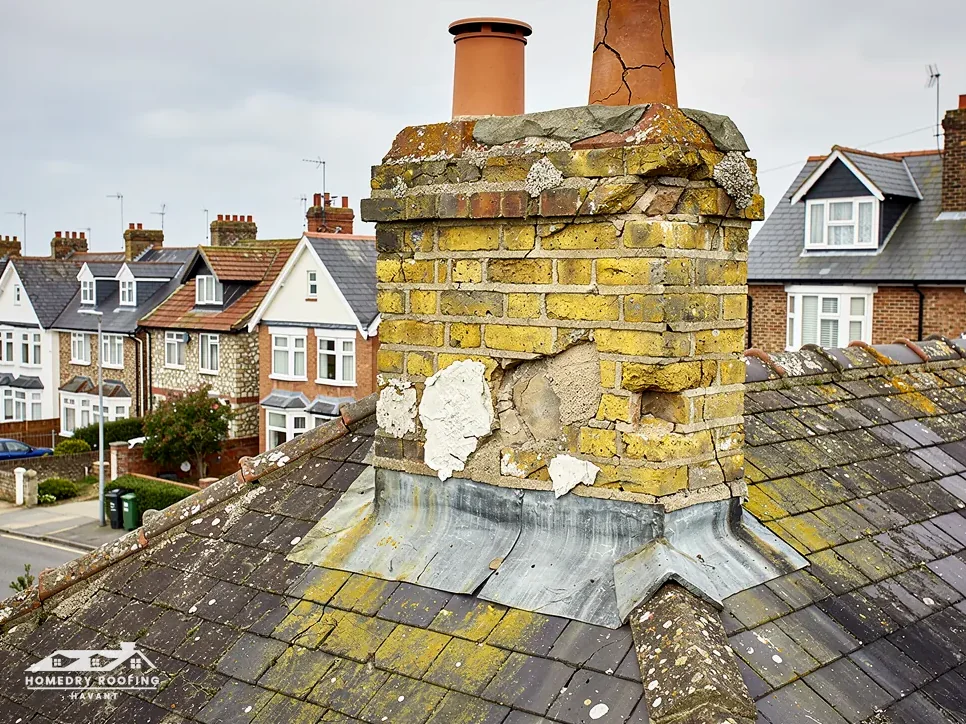
- From the opposite pavement, use your phone camera's zoom and follow the top line and the lower edge of the roof, looking for gaps, steps or anything hanging.
- Look from an upstairs window, or ask a neighbour whether you can look from theirs, to see the slope from a different angle.
- Check ceilings and the tops of walls for new stains, bubbling or drips.
- If the loft hatch is easy to reach, put your head through it, and keep to the joists, or to boards laid across them, if you must go further.
Keep children, pets and passers-by clear of the spot beneath anything loose, and use another door if you need to. Do not stand under a leaning chimney to take a better photograph. A zoomed picture from the far side of the road shows more than a close one from beneath the damage, and it keeps you out of the way of anything that falls while you are looking.
What to do with what you saw
Photographs are the most useful thing you can produce, and they cost nothing. Take each from a distance and from close up, and include something that shows the scale. Note where each one was taken, so that the pictures can be matched to the roof, and keep them together in a single album on your phone.
Then do three things, in this order:
- Tell your insurer what you have found, and ask what they need before any work.
- Send your photos to us by WhatsApp on 07880 284133, or ring 023 9396 0313, and say what has come loose and what lies beneath it.
- Hold on to the receipt for every item bought to shield the house.
We then look at the roof from a safe point of access, and tell you what we found and what the first visit would involve. Our guide to loose tiles or a chimney after a storm covers what to do about falling material, and the emergency roof repairs page explains the next steps.
Photos taken before anything is cleared up show both your insurer and us what the storm did.