
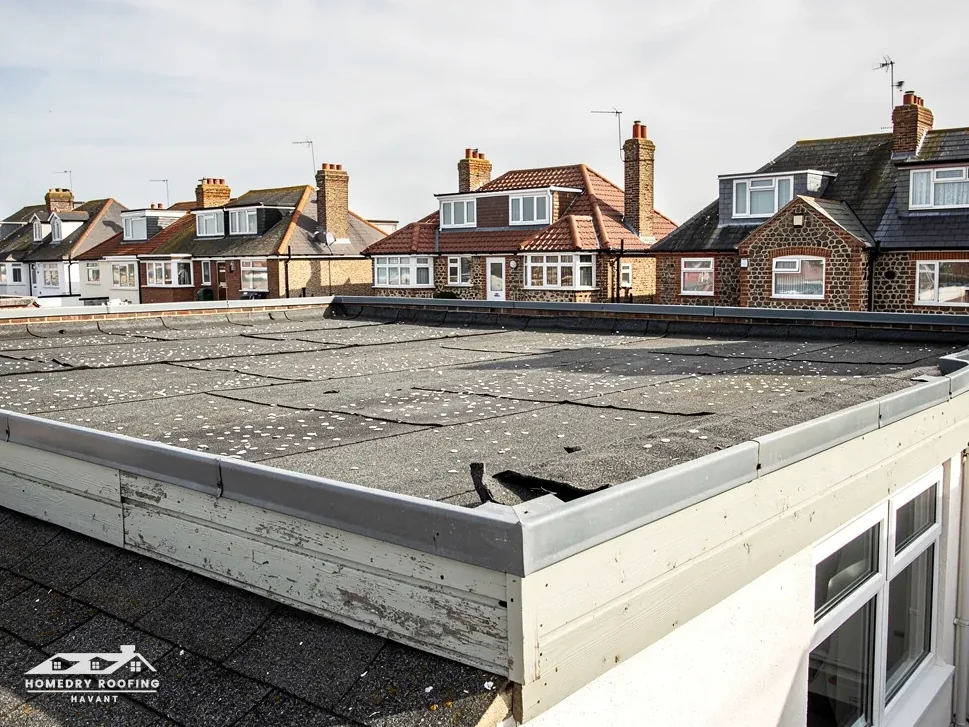
A roof problem feels urgent the moment you find it. A drip in the night, a tile on the lawn or a brown ring spreading across a bedroom ceiling all make for a bad evening, but they are not all the same kind of problem, and the difference decides who you ring and how soon.
In roofing terms, an emergency is a problem where waiting does damage that cannot be undone, or where somebody could be hurt. Water reaching wiring, masonry that could fall and an opening that lets the weather straight into the house all qualify. A stain that has stopped growing, a slipped tile in dry weather or a gutter that spills only in a downpour belong to a planned repair instead.
Below, each emergency is taken in turn, followed by the list of things that can wait, the steps to take before anyone arrives and what a call-out and your rights look like. The repair work itself is covered on our emergency roof repairs page.
Water near lights, sockets and wiring
Water and electrics come first on the list, whatever the roof looks like from outside. A wet ceiling light, a socket on a damp wall or a stain spreading beneath a loft hatch where cables run should all be treated as dangerous until someone has checked them.
While you wait for help, the steps are common sense rather than roofing:
- Keep everyone away from the wet area, including children and pets.
- Do not touch a wet light fitting, switch or socket.
- Switch the power off at the consumer unit only if you can reach it without crossing a wet floor or touching anything wet.
- If the consumer unit sits in the wet area, or water is dripping near it, stay clear and ring an electrician.
- Shift rugs and furniture clear of the drip and set a bowl or bucket under it.
Electrical checks belong to an electrician. Our part is the roof: tracing where the rain is entering and closing that route, so the wiring is not exposed to it again. A ceiling that has swollen or is sagging with water behind it needs the same caution. Do not stand beneath it, because trapped water is heavy and plaster can come down without warning.
A leak that arrives through a light fitting has its own answer in our note on a roof leak near lights. Once the danger is dealt with, photographs of the stain taken from a safe spot help whoever surveys the roof.
Where water reaches wiring, the electrics come first and the roof second.
Anything loose that could land on a person
The second emergency is anything loose that could drop. Wind and rain do not make a chimney or a ridge unsafe by themselves; they show that something was already weakened, and the next gust may finish it.
Look from the ground, at a distance, for signs like these:
- A leaning chimney pot, or a stack showing a gap in the brickwork or at the cap.
- Ridge tiles that have shifted or hang over the edge.
- Slates or tiles that have slid part-way down and are held by one nail.
- A gutter or fascia board pulled away and hanging over a doorway.
- A coping stone or a piece of parapet that has moved.
If any of these sits above a door, a path, a car or a neighbour's garden, treat it as urgent. Keep people away from the fall zone, which is wider than it looks because a tile can slide or be carried by the wind. A line of garden furniture or a few cones across the path is enough to keep people off it until help arrives, and a word with the neighbour is a courtesy that may prevent an injury. Check again after the next gust, since a tile that held yesterday may not hold today.
Do not climb up to take the loose piece off, and do not lean a ladder against a damaged gutter. Our guide on loose tiles and chimneys after a storm covers what a survey looks for once the area is safe.
An open roof or a hole to the weather
The third emergency is an opening. That means a patch where tiles or slates have gone and the underlay or battens show, a roof window that has smashed, a flat roof covering lifted and folded back, or a hole made by a fallen branch. Rain that enters through an opening wets the insulation, the ceiling and anything beneath, and each wet night adds to the repair.
The test is simple. If you can see daylight from the loft, or you can see the layers of the roof from the ground where the covering should be, the house is open to the weather. That is a job for cover first and a proper repair afterwards.
What temporary cover is
A make-safe is a stop-gap that keeps the weather out until the roof can be repaired. Typically that means a sheet fixed over the opening and held with battens rather than weights, because an unsecured sheet in wind can lift and become a hazard of its own. It is a temporary step, not a repair, and it is fixed over the roof rather than beneath it.
Inside the house
Move belongings away from the wet area, lift the corners of carpets that are soaking and keep a bucket under any drip. If the loft hatch is above the leak, open it only from a safe spot and do not stand beneath it, since water collects above the ceiling and drops all at once when the plaster gives way. Write down when the opening appeared and what the weather was doing, as your insurer may ask. Note which rooms are affected, too, because a leak at the front of the house can travel along the rafters and drip somewhere quite different.
What can wait for a planned repair
Plenty of roof faults are real but are not emergencies. They still deserve a survey, because each is a route for rain, but the repair can be arranged and quoted in the ordinary way.
| What you see | Treat it as | What to do |
|---|---|---|
| Water at a light, a socket or wiring | Emergency | Keep clear and ring an electrician |
| A chimney, ridge or gutter that could fall | Emergency | Keep people away and ask for help |
| An opening to the weather | Emergency | Cover and make safe |
| A stain that has dried and stopped growing | Planned repair | Mark its edge and book a survey |
| A slipped tile with dry weather forecast | Planned repair | Photograph it from the ground |
| A gutter that spills only in heavy rain | Planned repair | Check the outlet and the fall |
Waiting is not the same as ignoring. Mark the edge of a stain in pencil and write the date beside it. If the ring has grown by the next rain, the leak is live and the roof moves up the list. A slipped tile with a dry week ahead is a sensible candidate to wait, but the same tile before a storm may not be.
A bulging or stained ceiling needs one more check before you place it in either column. If the ceiling has begun to sag, or drips as you watch, move it to the urgent list. If it is dry to the touch and the stain has an edge that has not shifted, it can join the planned repairs. If you are unsure which column a problem belongs in, send us a photograph. We will say what the photograph shows and whether it needs attention now or on a survey visit.
Photos, insurers and staying off the roof
Before anything is moved, take photographs. The Financial Ombudsman Service says it will usually look at expert reports and photos of a property's condition, so shots of the damage as you found it, taken from the ground and from inside, are worth more than a description afterwards. Include the date on at least one frame, and keep the bills for any temporary work.
Tell your insurer first, then make the house safe with a stop-gap repair and save what you spend. The Ombudsman also says that "Rain, hail or snowfall by itself can constitute a storm", so do not rule out a claim only because the wind was light, and read your policy's own wording. A claim's outcome rests between you and the insurer.
Why you should not go up
HSE says all roofs should be treated as fragile until a competent person has confirmed they are not. The same HSE page reports that "almost one in five deaths in construction work involve roof work. Some are specialist roofers, but many are just repairing and cleaning roofs." The wet surface, the wind and the pull to do something quickly add to that risk, so the answer for a householder is the ground.
If you can see the problem from a window, photograph it from there. If you cannot, say so when you phone, and describe where the water appears indoors. Our note on loose tiles after a storm is a reminder to keep your feet on the ground.
A tile on the lawn can wait for a ladder-free photo; a person on a wet roof cannot.
Calling a roofer: call-out figures and cancelling
When you ring, give the facts in the order that matters:
- Where the water is entering, and which room it reaches.
- Whether it is anywhere near a light, a socket or the consumer unit.
- What is visible from the garden or the street.
- Whether anyone is at risk from something that could fall.
A good answer from a roofer is a clear description of what the first visit involves, and a plain statement of what it leaves for later.
A call-out buys attendance and is not a repair. MyJobQuote (October 2026) says "Emergency roofer call-out costs typically range from £150 to £300, while extensive storm damage repairs can cost £1,200 or more." The second figure is for extensive storm damage, not for a single tile or a patch of flashing, so do not read it as a price for an ordinary repair.
Your cancellation position
A contract signed at home following a survey carries a 14-day cancellation period, and work begins sooner only if you ask for that in writing. An urgent repair is different: Regulation 28(1)(e) of the Consumer Contracts Regulations removes the cancellation right where you have specifically requested a visit from the trader to carry out urgent repairs or maintenance. Citizens Advice puts it as inviting the business in for urgent repairs. Our note on cancelling an urgent roof repair goes through it. If you need advice, the Citizens Advice consumer helpline is 0808 223 1133.
Where a repair goes beyond making safe, we give you a single written total once the survey is done.