
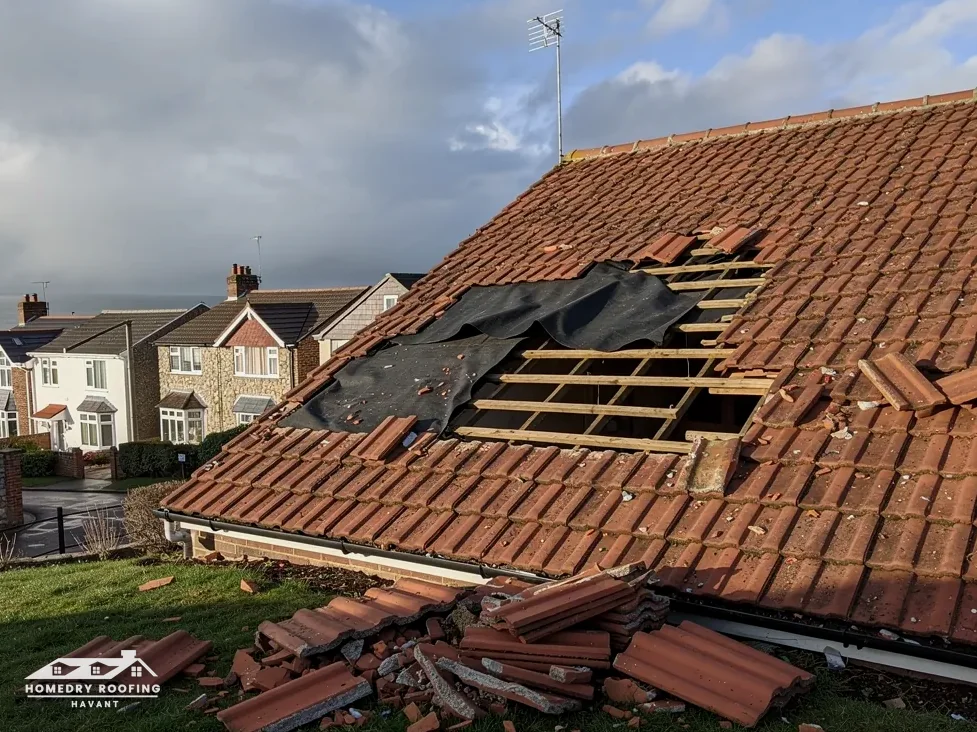
A storm that lifts tiles or brings down part of a chimney leaves two jobs: making the house safe and dealing with the insurer. They overlap, and the way the first is done can help or hurt the second. A few sensible habits in the first day or two, kept up through the claim, matter more than any special knowledge.
This guide sets out those habits as plain steps. It covers what to do before you ring anyone, what the Financial Ombudsman Service says counts as a storm, the sequence of a claim, how reports and photographs are used, how the cost of a call-out and a repair fits in, and what to do if the insurer says no.
It is general guidance and not a promise about any claim. Whether a claim is paid is the insurer's decision, and it depends on your policy. Our emergency roof repairs page covers the repair side.
Before you ring anyone: safety and evidence
Two things come before the phone call, and neither costs anything. The first is safety. Keep everyone clear of whatever could fall, stay off the roof and do not climb a ladder to look. Our guide to loose tiles or a damaged chimney after a storm covers how to do that.
The second is evidence. The Financial Ombudsman Service, the body that looks at complaints about financial firms, says it will usually look at expert reports and photos. That is the reason to record the damage before anything is picked up or covered over.
- Photograph each damaged area from the ground, with the full slope in at least one picture.
- Photograph fallen tiles, pots or masonry where they landed.
- Photograph any water inside, such as a stained ceiling or a wet wall.
- Write down the date and time, and what the weather was doing.
Write down, as you go, anything you cannot photograph, such as a noise in the night or a damp odour in one room. Small details tend to be forgotten by the time a form is filled in.
Do not throw away what has fallen. A broken tile or a piece of pot may be asked for as evidence, and it is easier to keep a bag of it in the garage than to explain later where it went. Label the bag with the date.
These records take a few minutes to make. A repair, once done, makes the damage invisible, and a photograph taken before it is the only way to show what was there.
What the Ombudsman says counts as a storm
A home insurance policy that covers storm damage will say somewhere what it counts as a storm. The Financial Ombudsman Service has its own view of the word, published on its storm damage page. In its words: "We say that a storm usually involves violent winds, usually with rain, hail or snow." It then adds that "Rain, hail or snowfall by itself can constitute a storm." So a storm does not need extreme wind to count, and rain alone can be enough.
It says it also takes account of the Beaufort Scale, a scale of wind force. It notes that some insurers say only winds above a certain point on that scale count as storm-force winds. A policy may say so, and the wording of yours is what the insurer will read first.
Two practical points follow. Note what the weather was doing when the damage happened, because that is the first thing an insurer is likely to ask about, and read the storm clause in your policy, keeping a copy beside your photographs.
What to note about the day
- The date, and roughly when the worst of the weather arrived.
- Whether it was wind, rain, hail or snow, or a mixture of them.
- Whether neighbouring houses or fences were damaged, which can show how widespread the weather was.
- When you first noticed the damage, and what you saw.
The date and the weather you saw are what count for your claim.
Rain, hail or snow alone can count as a storm, so note what the weather was doing on the day.
The plain steps of a claim
Insurers differ, so check your own policy, but the sequence below is plain general practice. It is advice rather than a rule of law.
- Tell your insurer first, before arranging repairs beyond a temporary one. Ask what they need from you and write down who you spoke to and when.
- Make the roof safe with a temporary repair, so that the damage does not grow while the claim is dealt with.
- Keep photographs and receipts for everything you spend, including a roofer's visit to secure the roof.
- Follow any instructions the insurer gives about reports, surveys or approved repairers, and keep their answers in writing.
- Agree the repair in writing before it starts, so that what is to be done and who is paying are clear.
If the house is rented, or the roof belongs to a landlord or freeholder, tell them too, since the policy may be theirs and not yours.
A temporary repair is a make-safe job, not a permanent fix. Our answer on what a make-safe roof repair is explains the difference, and why the permanent repair is planned afterwards, from a survey.
It is wise to ask the insurer one more thing at the start: what they want kept. Some will ask for damaged parts, some for a report from their own surveyor before repair, and some for neither. Asking costs nothing, and the answer can save an argument.
If a roofer is asked to describe the damage, ask for it in writing: where it is, what it looks like and what has been done to make it safe. You can pass that note on to the insurer.
Reports, surveyors and why the photographs matter
When a claim is disputed, the question is usually what caused the damage. The Ombudsman says of this: "To do this we'll usually look at expert reports and photos. Your insurer will normally ask a surveyor to write a report."
That sentence tells you what carries weight. The report and the photographs are the evidence, and the photographs may be the only record of the roof before it was repaired.
The Ombudsman also says "The insurer has to prove that the exclusion applies - for example, with an inspection report." This concerns policy exclusions, the list of things a policy does not cover. If an insurer relies on one, it is for the insurer to show that the exclusion applies, with an inspection report for example.
What helps your side of the file
- Dated photographs of the damage, taken before anything was moved.
- The fallen pieces, kept in case they are asked for.
- A note of the weather on the day.
- Any roofer's written description of what was found and what was done.
- Your policy documents, with the storm clause marked.
A roofer can tell you what the roof shows. The decision on cause is made by the insurer, using its own report, and a roofer's note is one more piece of information for the file, not a verdict. If the insurer sends a surveyor, let them see the damage as it is, and ask for a copy of the report when it is written.
Paying for a make-safe visit and the repair
The cost of securing the roof can be the first bill, and it arrives before the claim is settled. MyJobQuote, in a guide updated on 22 October 2026, says "Emergency roofer call-out costs typically range from £150 to £300, while extensive storm damage repairs can cost £1,200 or more."
Read the two figures separately. The call-out range is for attendance. The larger figure belongs to extensive storm damage alone, and a few slipped tiles are a different order of job.
Ask the insurer whether it will pay the repairer directly or reimburse you, and ask when. The answer decides who carries the cost in the meantime.
None of this predicts the insurer's decision. Policies carry excesses, which is the first part of a claim that you pay yourself, and limits, and whether a claim succeeds is for the insurer to decide. Keep every receipt, and do not assume that a visit you paid for will be refunded.
One rule on urgent visits
Consumer law treats a visit for urgent repairs differently from a contract signed after a survey. Under regulation 28(1)(e) of the Consumer Contracts Regulations 2013, there is no cancellation right where the consumer has specifically requested a visit from the trader for the purpose of carrying out urgent repairs. Our answer on cancelling an urgent roof repair sets out the detail.
The permanent repair is quoted as a single written total once a survey is done, with scaffold included, so you can set that figure beside any estimate from the insurer.
If the insurer says no
A refusal is not always the end. If you think the decision is wrong, there is a route, and it starts with the insurer itself.
- Complain to the insurer first. The Ombudsman says that for most complaints a business has up to 8 weeks to consider a complaint.
- Ask for its final response in writing, and read the reasons it gives.
- If you are still unhappy, take the complaint to the Financial Ombudsman Service. The deadline is 6 months, counted from the date printed on the insurer's final response.
The Financial Ombudsman Service helpline is 0800 023 4567. It looks at the evidence that both sides provide, which is why the photographs, the dates and the receipts you have been keeping are worth the trouble.
Where the refusal rests on an exclusion, remember what the Ombudsman says about it: the insurer has to prove that the exclusion applies. Ask the insurer to show you the report, the policy wording and the reasoning it relies on.
While the dispute runs, the roof still needs to be kept safe. A temporary repair should stay in place, and any further damage should be photographed and reported to the insurer as it happens. Keep every letter, email and note of a call in one folder, so that the history of the claim can be followed by someone who was not there. When the claim is settled, or the roof is repaired at your own cost, the permanent work can then be priced from a survey and agreed in writing.