
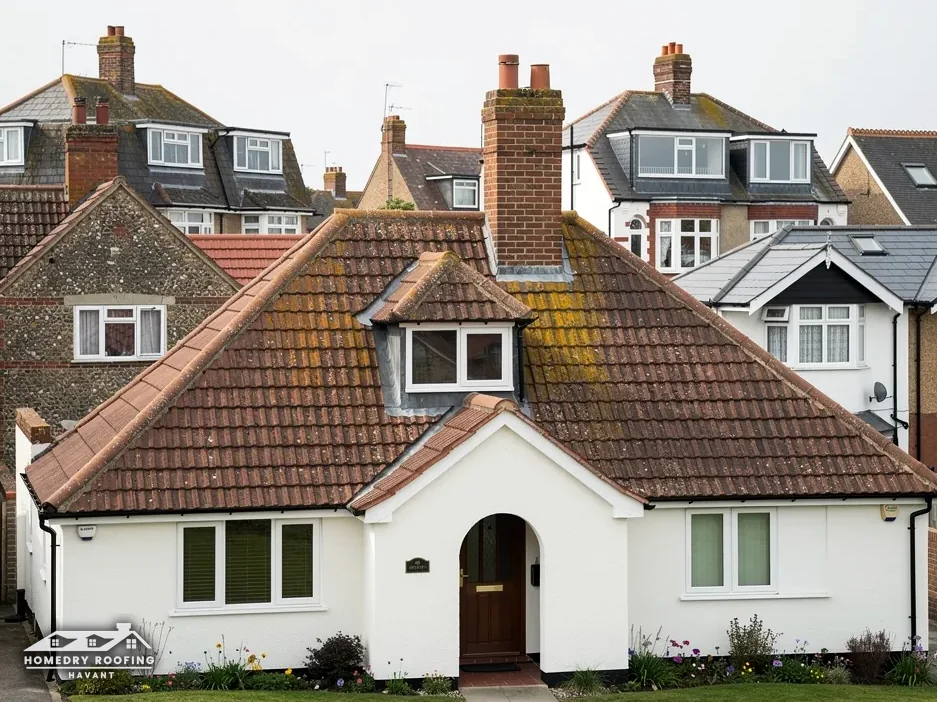
Two tiles that look alike from the pavement can have very different limits. One can be laid on a gentle slope and the other needs a steep one, and a roof covered with the wrong one can let water in. The slope of a roof, its pitch, is therefore part of the choice of covering, and not a detail to be settled afterwards.
This guide takes the figures that makers publish and sets them against the question that comes up on a quote: will this tile suit this roof? It covers what pitch is, the minimum pitches Marley lists for its clay and concrete tiles, the figures Cupa gives for natural slate, what can be done when a slope is too shallow, and what a good quote should name.
Our pitched roofing page covers the service as a whole, and our answer on interlocking or plain roof tiles looks at the two main tile shapes.
What pitch is and why a tile cares
Pitch is the angle a roof slope makes with the horizontal, usually given in degrees. Tiles and slates are laid in overlapping courses, and the slope carries rain down and off each course. On a shallower slope water moves across each course more slowly, which is why makers publish a minimum pitch for each product.
A house can carry more than one pitch. The main slopes may sit at one angle while a lean-to extension, a porch or a bay sits at another, and a covering that suits the main roof can fall below its limit on the lower one. Each slope is therefore checked on its own.
Pitch also sets a floor on the whole exercise. Marley's lowest listed figure is 12.5°, so a slope below that sits outside its tile lists altogether, and a different kind of covering has to be considered for it.
Three things decide what a slope can be covered with.
- The measured pitch of that slope, taken in degrees.
- The minimum pitch for the product, taken from the maker's data sheet.
- The exposure of the site, which affects the fixing specification and, for slate, the figure that applies.
The minimum is the maker's figure for a named product, not one number for all tiles. Marley lists each of its clay and concrete tiles separately, and Cupa gives a figure for natural slate. The next three chapters set those out, and the last two cover what to do about a shallow roof and what a quote should say.
A minimum pitch belongs to a named product. It is never a figure for tiles in general.
Marley clay tiles and their minimum pitches
Marley's page on minimum pitch gives a figure for each of its tiles, and the clay ones are in this table.
| Marley clay tile | Minimum pitch |
|---|---|
| Canterbury | 40° |
| Ashdowne | 35° |
| Hawkins | 30° |
| Acme Single Camber | 30° |
| Lincoln pantile | 15° |
Canterbury is a Marley tile product, not the city, and it carries the highest figure in the clay list. Reading it as a rule for roofs in a place of that name, or for clay tiles in general, would be a mistake. It is one product with one data sheet.
The spread is the useful part. Two clay tiles from the same maker differ by 25 degrees between the first and last rows, so a tile cannot be chosen by material alone. A roof at 30° is at the limit for Hawkins and Acme Single Camber, above it for the Lincoln pantile, and below it for Canterbury and Ashdowne.
A repair does not raise the question in the same way as a re-cover, because the existing tiles stay where they are. Where a slope keeps leaking after sound repairs, though, the pitch is worth measuring, and the survey records it for every slope whether or not the job is a re-cover.
The table gives Marley's published figures, and the data sheet for the tile you are quoted is the document that governs. If a quote names a clay tile, ask for its name and its minimum pitch, so that the figure can be set against the measured slope.
Marley concrete tiles and their minimum pitches
Marley's concrete tiles span a wider range, from some of the shallowest figures on its page to one of the steepest.
| Marley concrete tile | Minimum pitch |
|---|---|
| Plain | 35° |
| Edgemere | 17.5° |
| Modern-Duo | 17.5° |
| Double Roman | 22.5° |
| Mendip | 15° |
| Mendip 12.5 | 12.5° |
| Ludlow Major | 22.5° |
| Ludlow Plus | 22.5° |
| Wessex | 15° |
| Anglia | 25° |
| Ashmore | 22.5° |
The lowest figure listed is 12.5°, for Mendip 12.5, and the highest is 35°, for the plain tile. A concrete tile is therefore not one answer either, and the shape of a tile does not settle its limit by itself. The data sheet does.
On these figures the plain tile has the highest minimum on the list, so it is the product that limits the slopes it can cover most. Several others share a figure, with three at 22.5° (Double Roman, Ludlow Major and Ludlow Plus) and two at 17.5° (Edgemere and Modern-Duo), so the pitch narrows the choice without picking one tile.
This is where like-for-like replacement can mislead. If a roof was covered with a tile below its own minimum pitch, replacing it with the same tile repeats the fault, and the leaks that follow are a design problem, not a workmanship problem. The survey compares the measured slope with the data sheet for the tile named in the quote, and you are told if they do not agree, with the reason.
Natural slate, exposure and hook fixings
Natural slate has no single minimum pitch for every case, and Cupa, a slate maker, says so by tying its figure to conditions. It says BS 5534:2014+A2:2018 "also indicates that the minimum roof pitch for natural slate is 20 degrees in the case of a project situated in an area with moderate exposure and with a slate 500mm long and a 115mm overlap".
Read it closely. The figure is 20 degrees for moderate exposure, a slate 500mm long and a 115mm overlap. It is not a figure for every slate or for every site, so another slate length, a different overlap or a more exposed position needs its own check.
Cupa also says "hook fixings should not be used on any pitch below 25º". Hook fixings are a method of holding a slate, so the pitch decides whether that method is available at all.
Exposure
The survey notes the slope, the height and the position of the house when it works out which exposure applies, and it records the slate length and overlap that the figure assumes.
Cupa says "Most significant is the environment, with the two main factors being exposure to wind and rain." It adds that "Buildings positioned on slopes, hills or coastal areas as well as tall buildings will be graded with higher exposure." On a coastal house the exposure grade is higher, and BS 5534 is the basis for calculating the fixings for that site.
Marley says "Installing to BS 5534 isn't required by law". It is a code of practice, but it is where the fixing calculation comes from, so we use it to set the fixings for a slope.
When the pitch is too shallow for the tile
When the measured pitch is below the minimum for the tile that was asked for, the covering has to change or the roof does. These are the options.
- A different tile from the same range or another maker, with a lower minimum pitch, where its data sheet allows the measured slope.
- A different kind of covering made for a shallow slope. BS 6229:2025 is the standard for flat roofs, and for curved roofs no steeper than 10 degrees, finished with continuously supported flexible waterproof coverings, which are membranes.
- A change to the roof structure that raises the pitch. That is a larger job, and it is checked with the council before it is priced.
Where only a lean-to or a porch is too shallow for the main roof's tile, the main roof can keep its covering and the low roof can take a different one. The join between them is then a flashing, and it is surveyed with the rest.
Pitch also touches ventilation. Where an HR underlay sits in a cold roof, Marley gives "25mm along the length of the eaves for pitches of 15° or less; 10mm along the length of the eaves for pitches of more than 15°." So a shallow slope asks for more eaves ventilation than a steeper one.
The covering also changes the load. The Planning Portal's guide brings in approval where the weight of the new covering is 15 per cent or more above the old, and Approved Document A calls an increase of more than 15% a significant change in loading. Neither names a material that is heavier, so each product is weighed against what it replaces.
What a quote should name
A quote for a re-cover should show that the tile has been matched to the roof. These are the points to look for.
- The make and name of the tile, not only its material, and which slopes it is meant for if the roof has more than one pitch.
- The minimum pitch from the maker's data sheet and the pitch measured on each slope.
- How the tiles are fixed, and that the fixing specification has been calculated for the site's exposure.
- The underlay, and the eaves ventilation where the pitch is shallow.
- Whether scaffold and VAT are in the total.
After a survey you receive a written quote with one total price, and it names the tile so that you can check it against the data sheet yourself. Where the slope is below the figure for the tile first asked about, you are told and a suitable tile is suggested, and we do not price a covering that would not. A tile that suits the slope is a better start than a cheaper one that does not, and the written price is for the tile named.
For a house in England, the Planning Portal's guide draws the line at under 25 per cent of the building envelope and under 50 per cent of the roof, below which re-roofing does not normally need a building regulations application. Our answer on matching old roof tiles covers how a new tile is chosen to sit beside an old one, and our answer on the cost to retile a roof covers what moves the price.