
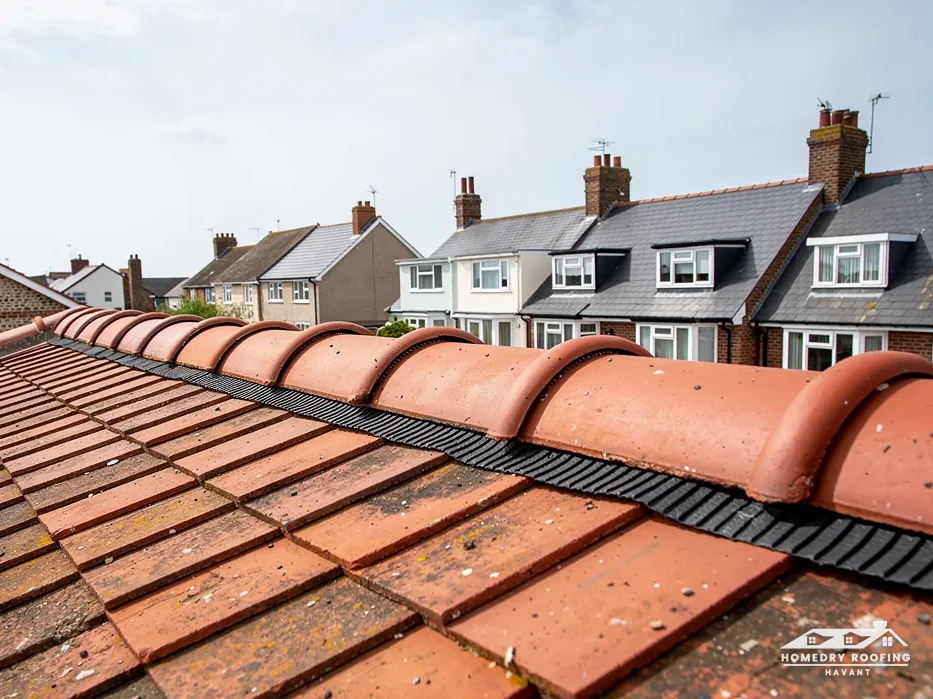
How plain and interlocking tiles are laid
A plain tile is small and relatively flat, and it keeps water out by lapping: each row overlaps the one below, and the joints between neighbours are covered by the row above. A roof of plain tiles has many small pieces, and every one is a separate fixing and a separate lap.
An interlocking tile is bigger, and its sides are shaped so that one tile keys into the next. The side joint is closed by the profile of the tile, not only by overlap above and below. Double Roman, one of Marley's concrete profiles, is a familiar example of the shape.
The practical differences follow from that. Larger tiles mean fewer pieces to fix and a roof covered quickly, while small plain tiles give a finer texture and cope better with tight shapes, curves and small roof areas. The look matters, and on a listed home or in a conservation area it can also shape what the council will accept, which our answer on matching old tiles covers.
Neither type is better in general. The right choice depends on the roof pitch, the house and the budget.
Minimum pitch is set tile by tile
Pitch is the steepness of the slope, and every tile has a lowest angle it can be laid at. Go too shallow and wind can push rain back up under the laps. Marley publishes minimum pitches product by product, and the figures below are for those tiles alone.
| Tile | Material | Minimum pitch |
|---|---|---|
| Plain | Concrete | 35 degrees |
| Double Roman | Concrete | 22.5 degrees |
| Mendip | Concrete | 15 degrees |
| Mendip 12.5 | Concrete | 12.5 degrees |
| Lincoln pantile | Clay | 15 degrees |
Read the table as a reminder that the type of tile and the angle of the roof travel together. The plain tile needs the steepest slope of these concrete products, and the Mendip 12.5 the shallowest. The clay Lincoln pantile, at 15 degrees, shows that clay is not always the steeper choice, since each product has its own figure.
The product data sheet always has the last word, so we check the sheet for the exact tile on your roof. Our guide to roof pitch and tile choice goes through how pitch limits the options.
Changing from one tile type to another
Swapping a roof from plain tiles to interlocking ones, or back, is a bigger step than it looks. The new tile has its own minimum pitch, its own batten spacing and its own fixing method, and each of those has to suit the roof you have.
Weight is the other check. Under the Planning Portal's test, a new covering 15 per cent or more heavier needs Building Regulations approval, and the portal advises you to "check with a structural engineer or surveyor before commencing with works". Approved Document A puts it as "A significant change in roof loading is when the loading upon the roof is increased by more than 15%." We name the document when we quote it, because the two wordings differ slightly, one saying 15 per cent or more and the other more than 15%.
We therefore never assume that a new covering can go on in place of the old. The survey records the covering now on the roof, says whether it can be matched or whether a change of type is the better course, and checks the route with your building control body before any extra weight goes on.
Where a tile type is changed, battens and fixings are specified for the new tile, not carried over from the old one.
Which type suits a repair, and which a re-roof
On a repair, the question is how closely a new tile can match the ones beside it. A single tile of the wrong profile will not lap or lock properly with its neighbours, even if the colour is close. We look at the existing tile, find a match where one exists, and tell you if none is available.
On a re-roof you have more freedom, and more to check. The pitch must suit the tile, the structure must carry the weight, and the fixings must be specified for the site, which for coastal places means grading for higher exposure under BS 5534.
Cost depends on more than the tile. Our answer on the cost to retile a roof sets out the published ranges, and your own figure comes in writing once the roof has been surveyed. If you want the whole subject in one place, our pitched roofing page is the starting point.
Choosing between the two types is a survey decision, made roof by roof with the pitch and the look of the street in mind, and with an eye on whether a repair will do.