
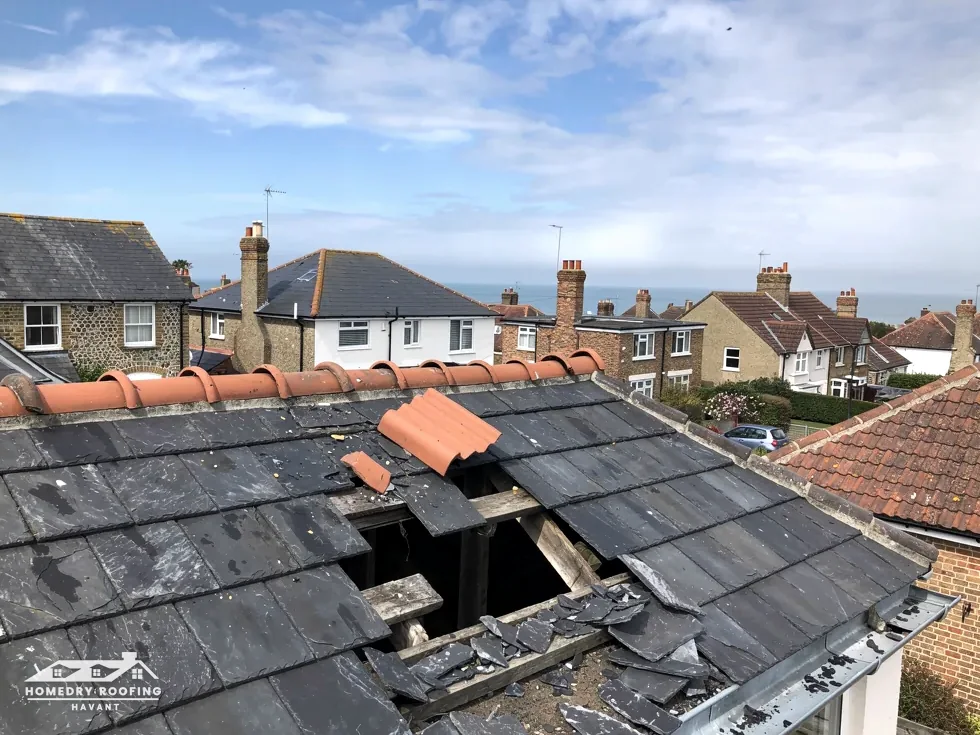
Water that gets into a tiled roof does not simply drop. It can run along a batten, down the face of the underlay and along a rafter before it reaches the plasterboard, so a ceiling stain reports where the water finished, not where it started.
This guide is about finding the start. It sets out the steps of a trace and the places on a pitched roof where rain gets in. It then takes three places that need a closer look on a tiled roof: valleys, abutments where the slope meets a wall, and the underlay beneath the tiles. It closes, in the last chapter, with how a repair is matched to a cause, and the cost and consent points that can arise along the way.
The wider picture of surveys on tiled roofs is on our pitched roofing page, and our guide to common pitched roof problems sets out the signs of each fault.
Following a stain back up the slope
A trace works against the flow of the water, from the stain towards the opening.
- Note where the stain is and how it behaves: a ring that grows after a shower, a patch that stays damp, or a mark that appears only in driven rain.
- Place the stain against the layout of the roof, since a mark below a valley or a wall points to different places than one below the ridge.
- In the loft, find the wet timber, the stained underlay or a dark line down a rafter, and follow it up the slope.
- Outside, look at the spot the loft trail leads to: a valley, a flashing, a tile or an eaves course.
- Rule out other routes before settling on one, since two openings can feed a single stain.
Timing carries information. A stain that grows only after wind-driven rain suggests an opening on the side of the roof facing the weather, while one that follows any wet spell suggests something plainer, such as a split or a missing tile. Write down dates and conditions, because the survey can use them.
A dated photograph of each stain, of the timbers in the loft and of the roof from the pavement lets us plan the visit. Photos also matter if the leak follows a storm. Contact your insurer before anything else, arrange a temporary repair if the roof needs making safe, and keep every receipt. The Financial Ombudsman Service says it will usually look at expert reports and photos of a property's condition, and that "Rain, hail or snowfall by itself can constitute a storm." Climbing up to check is not worth the risk, so leave the roof itself to the survey.
Where a tiled roof lets rain in
Each of these places has a different cause and a different remedy. The table pairs them, so you can see why a repair has to go to the opening and not to the stain.
| Place | How rain gets past | What closes it |
|---|---|---|
| Valley | The channel narrows, cracks or loses its edge tiles | Clearing, relaying the edges, renewing lead |
| Abutment | Lead lifts or joint mortar fails where slope meets wall | Dressing or renewing the lead, repointing |
| Chimney | A flashing or the back gutter fails on one side | Renewing the part that failed |
| Ridge or hip | The mortar bed cracks and a tile loosens | Re-bedding, refixing or dry-fixing |
| Underlay | The sheet beneath the tiles tears, slips or perishes | Relaying a section with sound battens |
| Eaves | The last course or the underlay lap into the gutter has moved | Reworking the eaves course |
A repair that deals with the stain and not the row it came from leaves the route open. A bead of mastic over a gap in lead, or a patch of new mortar on a joint that has moved, is of that kind, and the same stain can return the next time the weather turns.
Which row applies decides the kind of work needed, and the survey looks at every row in a single visit, so a second opening is not found only after the first has been closed.
The three places that follow need more than a table, because each one is hidden or hard to judge from the ground.
A repair that treats the stain and not the opening has only moved the problem indoors.
Valleys on a tiled roof
A valley sits in the inside corner formed by two slopes, and the channel in it carries the rain from both. Our answer on what a roof valley is describes the parts. In a trace, the points to settle are whether the valley is the route and, if it is, which part of it failed.
A valley is the likely route where the stain lies on a diagonal line from the eaves to the ridge, or where the loft trail meets the valley timber. At the roof the survey looks for four things.
- Debris, moss or silt that has narrowed the channel so rain climbs its edge.
- A crack or an open lap in the lead along the channel.
- A slipped tile or slate at the edge, which can close the channel or leave a gap beside it.
- An earlier patch, such as a bead of sealant or a screw driven through the lead.
Where lead lines the valley, Royston Lead's brochure lists code 4 and heavier codes for a pitched valley gutter, and each roof's specification decides which code is used. Valleys are also formed without lead, and the survey notes which kind yours is before choosing the repair. Lead is checked along its whole length, since one sound stretch says nothing about the next, and the covering at each edge is checked in the same visit.
Because two slopes drain into one line, a fault in a valley is tested at every shower. That makes a small crack more significant than it looks from the ground.
Abutments, walls and chimneys
An abutment is the edge where the tiles end at a wall standing taller than the roof, such as the side wall of an extension or the wall between two terraced houses. The covering cannot lap onto brick, so metal flashing and soakers do the job at that edge.
The survey reads an abutment from the covering outwards.
- Soakers beneath the tiles, which cannot be seen from the ground.
- Step flashings along the wall, and the joints they are tucked into.
- The brickwork above, since a joint that has opened can feed water behind the lead from higher up.
- Any mortar, mastic or tape standing in for lead, which suggests an earlier fault.
The wall matters as much as the metal. Water can enter through cracked pointing or a failed joint above a sound flashing and appear to come from the roof, so a trace checks both. Where the flashing has failed, our guide to lead flashing repairs explains when it is patched, refixed or renewed. If the wall needs work too, the wall joint is made good first and the lead is dressed over sound brick afterwards.
A chimney stack is an abutment on four sides. It also has a back gutter behind it on the high side, and each part can fail on its own. A stain beside a chimney breast should therefore be traced to the particular side or part, not to the stack as a whole.
The underlay and battens beneath the tiles
Tiles shed most of the rain, but rain driven by wind can pass the laps between them. The underlay beneath carries what gets through down to the gutter, and the battens hold both layers in place. When that second line fails, a roof with sound tiles can still leak.
How the underlay fails
- It has torn where it was fixed to a batten or was cut around a pipe.
- It has perished with age and has gone brittle or split.
- It has slipped, so a lap no longer overlaps the one below.
- It stops short at the eaves, so water drops behind the gutter and not into it.
From the loft, a failed underlay shows as stained or sagging sheet, damp battens and dark marks on the rafters beneath a tile that looks perfectly sound from the street. That is the reason the survey includes the loft before it recommends tile repairs alone.
A torn section can be relaid without stripping the slope if the sheet around it and the battens are sound, and that is one more reason to look before a quote is written.
The type of underlay also matters. With an HR (high resistance) type, which is not vapour-permeable, Marley's cold roof guidance is "25mm along the length of the eaves for pitches of 15° or less; 10mm along the length of the eaves for pitches of more than 15°." Our answer on roof ventilation at the eaves goes into the gap that figure refers to.
Matching the repair to the cause
The repair goes where the water gets in, which is not always where it shows. A repair comes first in our advice where it will hold, and the quote names the repair it prices.
- A slipped or broken tile: refixed or replaced, with its batten checked.
- A failed valley: the channel is cleared, its edges relaid and the lead renewed where it has cracked.
- A lifted flashing: dressed back or renewed, never covered with mastic.
- A torn underlay: a section is relaid on sound battens.
- An opened ridge bed: re-bedded, refixed or dry-fixed.
Published figures give scale and are not our prices. MyJobQuote (October 2026) says "Emergency roofer call-out costs typically range from £150 to £300, while extensive storm damage repairs can cost £1,200 or more." The £1,200 is for extensive storm damage only, and a call-out is attendance, not a make-safe. Checkatrade's June 2026 repair table puts lead flashing repairs at £50 to £70 per metre, which is a rate and not a price for any one joint.
A repair to part of a roof is not re-roofing. If a leak leads to a new covering, the Planning Portal's test is that no building regulations application is normally needed below 25 per cent of the building envelope and below 50 per cent of the roof. A new covering 15 per cent or more heavier needs approval as well. All of that applies to houses in England, and the survey settles which checks yours needs.