
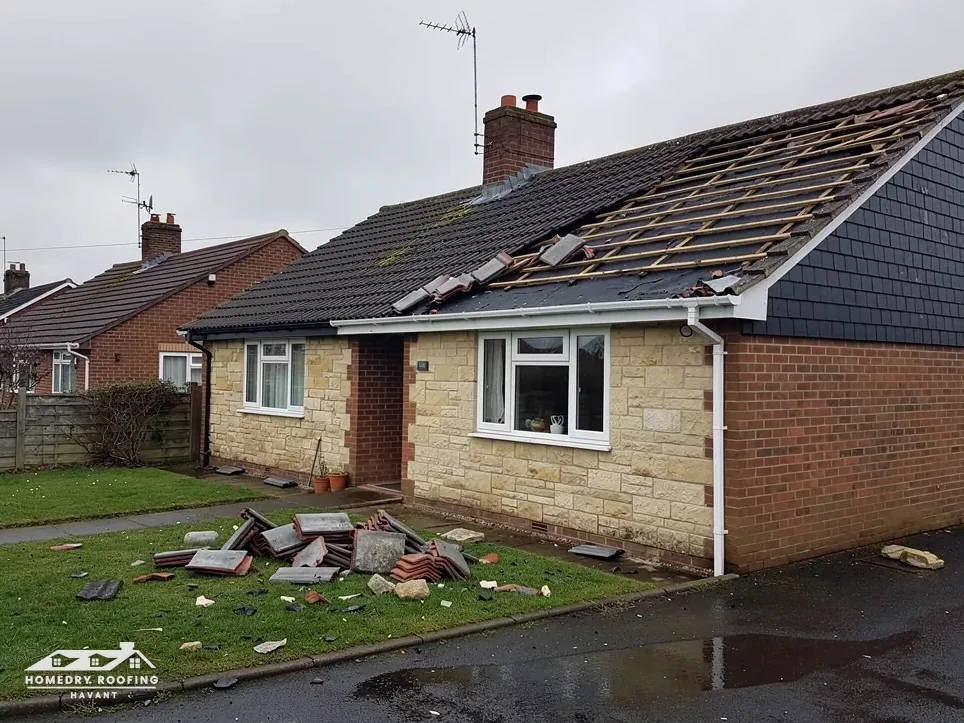
A tile that has dropped out of line, or turned up in the gutter, is easy to spot and easy to misread. The tile is only the part you can see. Whatever held it, whether a nail, a clip, the lug on its back or the timber it hung from, has given way, and that is the part that decides the repair.
This guide follows a slipped tile from the way it is held on, through what can be read from the ground, to the point where a tile is put back or swapped for a new one. It then covers when slipped tiles mean a wider job, with the re-roofing rules that apply in England, and the cost figures that third-party guides publish.
It sits under our pitched roofing pages. The sections run from the fixings outward, and the cause is what we trace first. The survey comes before any price.
What holds a tile on the slope
A roof tile does not sit on the roof so much as hang from it. A lug on its underside, called a nib, hooks over a timber batten. The battens are nailed across the rafters, the tiles lap down the slope, and a nail or a clip can hold each tile against the wind as well. When one slips, one of those links has let go, and finding which one is the work.
| Part | Its job | What a slip can point to |
|---|---|---|
| Nib | Hooks the tile over the batten | A snapped nib leaves the tile hanging on its fixing alone |
| Nail or clip | Holds the tile down in the wind | A loosened fixing lets the tile lift and slide |
| Batten | Carries each course | Softened or split timber lets the fixings pull out |
| Underlay | Catches what the tiles let past | A torn or tired sheet shows once tiles are lifted |
Two slipped tiles can have different causes. One has a nail that has worked loose, the other a batten that has gone soft beneath it. They look alike from the ground and they need different repairs.
Fixings matter as much as the tile. BS 5534 is the code of practice that covers slating and tiling, and Marley says installing to it "isn't required by law". Marley lists its contents as batten selection, methods of fixing, wind uplift formulas and a means of calculating fixing specifications.
Reading the slope from the ground
A first look needs no ladder. Stand back across the road, or in a neighbour's garden with their say-so, and look along the slope rather than at it. Tiles that have moved show best against the straight line of the course above and below.
- A gap in a course, where a tile has left a dark space.
- A tile that stands proud of those beside it, or sits tilted out of line.
- A tile, or pieces of one, in the gutter, on a lower roof or on the lawn.
- A ridge that sags in the middle, or a course that has lost its straight line.
- Daylight showing at the eaves from the loft, or damp on a ceiling underneath.
From inside the loft, a torch along the rafters can show daylight at a gap, a damp batten or a stained underlay. Step only on the joists, and keep clear of the ceiling boards between them.
Where a tile has gone, the underlay beneath is on show and the roof is open to the weather until the repair is done. A dated photograph from the ground helps us plan the visit, and photographs can reach us on WhatsApp or with the quote form.
HSE advises: "all roofs should be treated as fragile until a competent person has confirmed they are not." That is a reason to leave the slope to us and to keep ladders and feet off the tiles beside the gap, where the roof is least sure.
A tile on the lawn is the symptom. What let it go is still up on the roof.
When a refix is enough
Where the tile is whole, putting it back is the right repair, and we recommend it. A refix is sound when the following are true:
- The tile has no crack, and its edges and surface are intact.
- The nib is whole and still hooks over the batten.
- The batten under it is firm where the fixings go.
- The underlay beneath has no tear.
- A fixing can be renewed in a place that holds.
On the roof, the tile is lifted clear, the batten and the underlay are looked at, a new nail or clip is set, and the tile is laid back in its course. We also check the tiles around it. A loose tile is sometimes one of a group, and a roof that has lost one can be about to lose its neighbours. A refix also disturbs less of the roof than a replacement, and a refixed tile keeps the weathered colour of the roof around it, where a new tile can stand out for a while.
Exposure changes the fixing. Cupa, a slate maker, says buildings positioned on slopes, hills or coastal areas, as well as tall buildings, will be graded with higher exposure. On a coastal site that grading is higher, and BS 5534 gives the method for calculating the fixings the site needs. A tile on an exposed gable can need more than the nail it came with.
For the nails themselves, our answer on whether roof tiles need nailing goes into it.
Failed nibs, soft battens and tired nails
Some faults cannot be put back, and the tile is replaced. The table sets out how we weigh each finding.
| Finding | Repair |
|---|---|
| Whole tile, whole nib, firm batten | Refix with a new fixing |
| Cracked or broken tile | Replace the tile |
| Nib snapped off | Replace the tile |
| Batten soft or split at the fixing | New batten length, then refix or relay |
| Nail corroded or worn through | New fixing, and check the tiles beside it |
A batten that has rotted holds a nail badly, and a tile on it can slide however well it is refixed. Timber stays sound where it can dry, so the roof space matters. With a high-resistance underlay in a cold roof, Marley gives 25 mm of eaves ventilation at 15° or less and 10 mm above 15°. High resistance means the sheet does not let moisture through as vapour, so the roof depends on that ventilation.
A nail needs sound timber to hold it. Where an old nail has left a hole wider than itself, the fixing has nothing to bite on, so the new nail goes into sound timber beside it and the old hole is left behind.
A new batten length means lifting the tiles around it and laying them back to the same gauge, so the laps stay as they were. That is why a soft batten is a larger job than a slipped tile suggests. A patch of mortar or sealant over the gap leaves the weak batten behind it, and we repair the cause.
When slipped tiles mean a wider job
One tile out of line is a repair. Several slipped across one slope, or a roof that keeps shedding tiles after each repair, asks a different question: is the covering at the end of its working life, or is the fault in what lies beneath it? Tiles that slide in a line down the slope, rather than out of one spot, point to the batten or the underlay under that line.
HomeBuilding gives approximate lifespans of 100 years or more for Welsh slate, 60 to 80 years for clay tiles and 40 to 50 years for plain concrete tiles. Marley says "Typically, roof tiles are expected to last for around 60 years" and adds "This is not a guarantee or warranty of its longevity." The two sources do not agree, so each is named here.
If the answer is a re-cover, the rules for England apply:
- A new covering that is 15 per cent or more heavier needs building regulations approval.
- Under the Portal's test, a re-cover that touches under 25 per cent of the building envelope and under 50 per cent of the roof normally needs no application.
- Class C of the 2015 order normally allows a house roof to be re-covered as permitted development, once Article 4 directions and listed status have been checked.
A new tile is also chosen against the pitch. Marley's minimum pitches for its concrete tiles run from 12.5° for its Mendip 12.5 concrete tile to 35° for its plain concrete tile, and the data sheet for the product is the one to follow. Our planning guide for roof work sets out Class C and listed homes.
Access, nests and the written price
For a few tiles a ladder or a roof ladder is enough. A tall house, a steep slope or a spot over a porch can call for scaffold, which goes into the written quote. A scaffold that takes up pavement or road space needs a highway licence, which we arrange with our scaffolder.
Cost guides give the scale, and they are not our prices.
| Source | Job | As published |
|---|---|---|
| Which? Trusted Traders, November 2025 | Replace one to six broken or missing standard roof tiles | £75 to £400, excluding VAT |
| MyJobQuote, 2026 | Roof repair | "around £650" on average |
Which? says South East prices are likely to land high on its scale. Checkatrade's June 2026 table puts concrete tile repairs at £90 to £120 per m², with rates based on a maximum of 3 m². A per-m² rate says nothing about the total for your roof, so it is never multiplied up. Ask whoever quotes to state whether VAT and scaffolding come inside the figure, so that you can lay one quote next to another. Ours is one total price after a survey.
We look before a tile comes off, because a tiled slope can shelter a nest or a roost. The Wildlife and Countryside Act covers wild birds' nests that are in use or being built: taking, damaging or destroying one intentionally is an offence. Damaging or destroying a bat roost is an offence whatever the intent, and repairing or replacing a roof is among the activities GOV.UK lists for bats.