
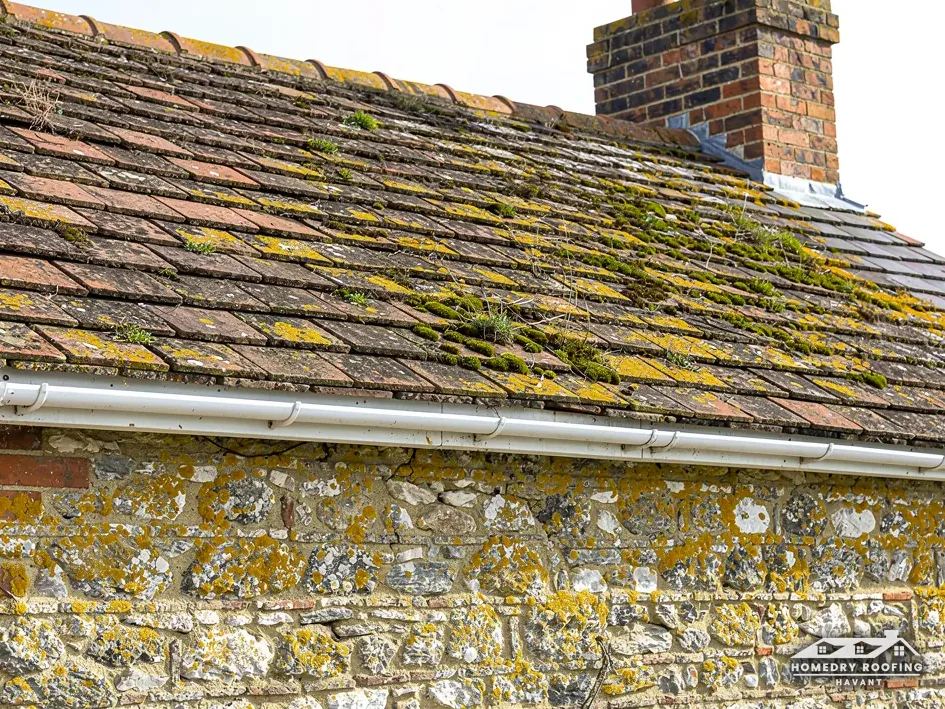
A tiled or slated roof is a layered system. The covering sheds most of the rain, battens hold it, an underlay sits beneath, and metalwork closes the joints at the ridge, the valleys and the walls. A problem in any one layer can let water through to a ceiling that is nowhere near it, which is why the sign you can see is a poor guide to the place that needs work.
This guide works through the faults a survey looks for. It starts with a table of signs and what each can point to, then takes slipped tiles, ridge and hip mortar, the underlay and ventilation, and the lifespans that are published for each covering. It ends with how a repair is told from a re-cover, and the published cost figures.
Our pitched roofing page covers the whole service. The guide to tracing and fixing pitched roof leaks follows a single stain back to its source.
Signs of failure and what each can point to
None of these signs proves a cause on its own. Each one narrows the search, and the survey then confirms which layer is at fault.
| What you see | What it can point to | What the survey checks |
|---|---|---|
| A tile out of line, cracked or missing | A fixing or batten that has let go, or a tile that has broken | The tile, its fixings and the batten beneath it |
| A ridge or hip line that has opened up | A bed of mortar that has split or fallen out | How the ridge tiles are bedded and fixed |
| A brown mark on a ceiling | Water arriving, from an opening further up the slope | The loft, then the slope above the mark |
| Daylight or damp timber in the loft | A missing tile, or an underlay that has torn or slipped | Underlay, battens and the course above |
| Lead lifting beside a wall or stack | A flashing joint that has opened | The joint, the lead and the soakers under the covering |
| Water spilling over a gutter | A blockage or a gutter that has moved | The gutter, the eaves and the last course of tiles |
Several of these can appear together, and a roof with one visible fault can have a second one beside it. For that reason a quote that deals with a single visible tile needs a survey behind it.
Tiles that slip, crack or work loose
A tile stays put through its own weight and through its fixings. When one slips, the question is why, because replacing the tile without answering that leaves the cause in the roof.
- The nail or clip has corroded, loosened or never been fitted to that tile.
- The batten beneath has softened, so the fixing has nothing firm to hold.
- A tile above has broken, and the pieces have pushed the course below out of line.
- The tiles were laid at a pitch below what that tile needs, so the roof has never shed water as the maker intended.
Each cause has a different remedy: a tile refixed, a length of batten renewed or a whole course relaid. The survey says which applies before the written quote is made up.
Fixing is also a matter of the site. Cupa, a slate maker, says "Most significant is the environment, with the two main factors being exposure to wind and rain." It adds that "Buildings positioned on slopes, hills or coastal areas as well as tall buildings will be graded with higher exposure." A coastal home is graded for higher exposure, and the BS 5534 calculation is made for the site, which means two houses in one street can need different fixing specifications.
Marley says "Installing to BS 5534 isn't required by law". BSI lists BS 5534:2014+A2:2018 as current. The guide to slipped roof tiles sets out when a tile is refixed and when it is replaced.
Replace the tile without finding why it slipped, and the same cause is still in the roof.
Ridge and hip tiles that have let go
The ridge is the highest line of the roof, where two slopes meet, and on a hipped roof the hips run down its outside corners. Ridge and hip tiles are traditionally bedded in mortar, and mortar is the part of that joint that can crack.
BS 5534 is a code of practice, not law, and Marley says mortar alone can no longer be relied on as the only means of securing the roof covering. BS 8612:2018, which BSI lists as current, is the specification for dry-fixed ridge, hip and verge systems, where the tiles are held mechanically and not by mortar alone.
What the survey looks for
- Cracked or crumbling mortar along the bed.
- Ridge tiles that rock when touched, or that have shifted along the line.
- Gaps at the ends where the ridge meets a gable or a chimney.
- Whether the existing roof can be re-bedded and mechanically fixed or needs the dry-fix method.
Where mortar has failed along the whole ridge, we say whether the tiles can be lifted, re-bedded and fixed again, or whether the dry-fix method suits the roof better, and we give the reason. The written quote names which route has been priced, so two quotes can be set side by side.
Published guides help with the money side. Checkatrade's June 2026 repair table puts ridge tile repairs at £50 to £70 per metre. Which? Trusted Traders (November 2025) give £80 to £300, excluding VAT, for putting in a new ridge tile. MyJobQuote says "In 2026, the average ridge tile replacement costs between £225 and £550." These are three different measures, so they are never added together, and none is our price.
Underlay, ventilation and the loft
Beneath the battens sits the underlay, and under that the loft. The loft gives a close view of what the covering is doing, because water that gets past a tile shows up here before it shows on a ceiling.
A high-resistance underlay, known as HR, is not vapour-permeable. Marley's guidance for a cold roof with an HR underlay is "25mm along the length of the eaves for pitches of 15° or less; 10mm along the length of the eaves for pitches of more than 15°." BSI lists BS 5250:2021, its code of practice for the management of moisture in buildings, as current but under review.
What a loft check shows
- Underlay that has torn, slipped or sagged between the rafters.
- Damp or darkened timber under a particular tile or valley.
- Daylight where a tile is missing.
- Eaves vents that insulation has been pushed across.
- Condensation on the underside of the underlay in cold weather.
Moisture in a loft is not always a leak, since it can be condensation from the house below. Ventilation and the underlay are judged together for that reason. Our answer on roof ventilation at the eaves explains the gap at the eaves in more detail.
A roof that is re-covered can be given a new underlay in the same job, at a point where the battens and rafters are open to inspection and timber that has stayed wet can be seen.
Age, wear and published lifespans
Lifespans are published for materials, not for individual roofs. They help in judging whether a roof is nearing the end of its useful years, but a covering that was badly fixed can fail early and a well-kept one can outlast its range.
| Covering | As published |
|---|---|
| Welsh slate | "100+ years" |
| Spanish natural slate | "75-100 years" |
| Clay tile | "60-80 years" (approx) |
| Plain concrete tile | "40-50 years" |
Marley adds two statements of its own. For clay roof tiles it says the BRE determined a minimum life expectancy of 60 years. For roof tiles in general its expectation is around 60 years, and it adds that this is not a promise of longevity. The sources differ, so both are named, and the BRE figure belongs to clay only.
The survey asks whether the tiles themselves are sound or whether the fixings and underlay have reached the end first. A covering can be in good shape on a roof whose underlay has perished, and a re-cover can then be the sounder choice.
A different covering also changes the load on the structure. Approved Document A treats a roof load increased by more than 15% as a significant change, and the Planning Portal says approval is needed for a new covering 15 per cent or more heavier, so a change of material is checked first. Neither says whether slate or tile is the heavier change, so the survey works from the actual product.
Repair or re-cover
We recommend a repair first where it is sound. These points push a roof towards a repair or towards a re-cover.
- A repair suits a roof with a limited fault in sound tiles on sound battens, such as a few slipped tiles or a ridge that needs refixing.
- A re-cover suits a roof with widespread broken tiles, battens that have rotted, or an underlay that has failed across the slope.
- A part re-cover can suit a slope that has failed while the rest is sound.
Published repair figures give scale. Checkatrade lists concrete tile repairs at £90 to £120 per m², clay at £110 to £160 per m² and natural slate at £150 to £220 per m². Its rates are for up to a maximum of 3 m², and we do not multiply them into a total. For putting right between one and six broken or missing standard tiles, Which? Trusted Traders give £75 to £400, and MyJobQuote says "The average roof repair cost is around £650 in 2026." Which? give £7,000 to £21,000, excluding VAT, for a whole new roof on an average three-bedroom house (November 2025), and say prices in the South East are likely to be at the upper end of the scale. MyJobQuote says "The average new roof costs around £5,250 in the UK." Those two disagree, which is a reason to treat both as scale rather than as a quote. Your own written price is one total, given after a survey.
For a re-cover, the Planning Portal sets a threshold: no building regulations application is normally needed below 25 per cent of the building envelope and below 50 per cent of the roof. That test applies to houses in England.