
Asbestos comes first
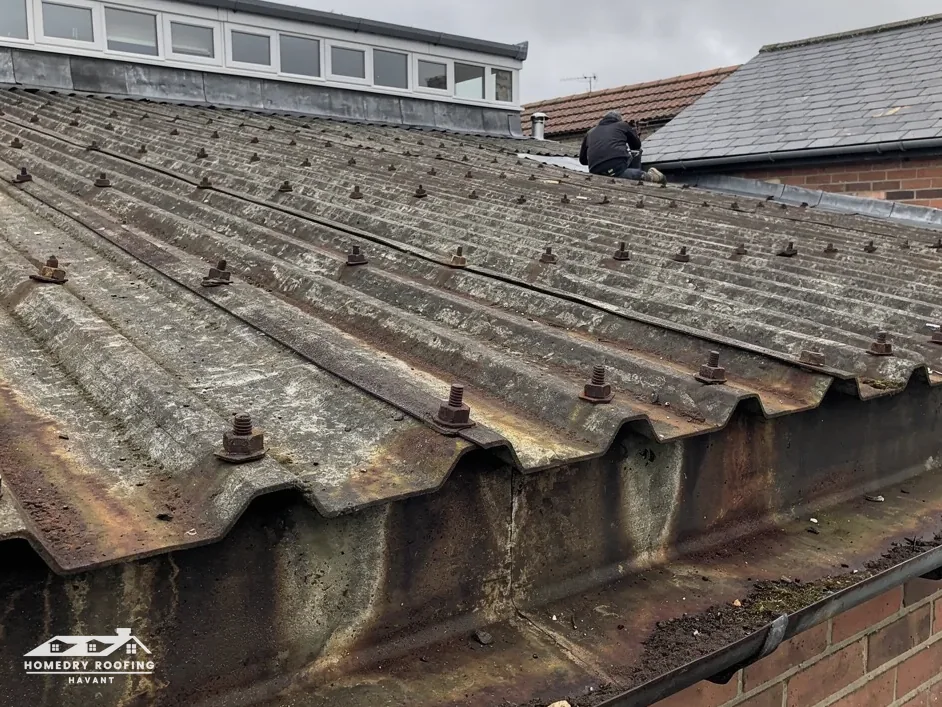
On a commercial building, the choice between the two routes cannot be made until you know what the existing roof is. For a building built or refurbished before 2000, HSE's advice is to assume asbestos is in it, and a sheeted roof on an older unit is where that matters. A roof cannot be identified from the yard alone, so nothing is assumed from a distance.
If the sheets are asbestos cement, the survey records their condition, because HSE's categories depend on whether sheets can be lifted off whole or have already broken into pieces. The same sheets are fragile whichever route follows, and HSE's guidance A14 puts asbestos cement roofs among those that are always fragile.
Under the Control of Asbestos Regulations 2012, commercial premises carry a duty to manage asbestos, which sits with the party responsible for maintenance and repair, or with whoever controls the building. That person needs to be part of the decision. Our page on asbestos cement industrial roofs explains how the removal side is run, and it also explains how the duty to manage asbestos works in practice.
What the survey weighs
Once the asbestos question is settled, the survey looks at the roof itself. The points below push the answer one way or the other, and each is recorded with photographs where it can be seen safely:
- the condition of the deck and supports, which is hidden under the covering
- whether the existing insulation is wet, which cannot be judged from outside
- the load the structure can take, which matters if a second layer is proposed
- the state of rooflights, flashings and gutters, which are usually replaced either way
- how long the building will be used and whether it is let, sold or due for redevelopment
A roof whose structure is sound and whose covering has simply aged is a candidate for overcladding. A roof with wet insulation, a damaged deck or a structure that cannot carry more weight points to stripping, because a new covering over a failed base inherits the failure. We explain what we found, with photographs, and tell you which route we recommend and why. If both routes are workable, you are told how they differ in disruption and in what each leaves behind, so the decision is yours.
Energy rules and who is on site
Either route may bring Part L into play. In AD L Volume 2, renovating more than 50% of a roof's surface brings the whole roof up for improvement, and a major renovation is one that touches more than 25% of the surface area of the external building envelope. Laying a replacement waterproof layer on a flat roof is also renovation in its terms.
That is why the survey records the roof's insulation before the route is chosen. An overclad roof that also adds insulation may reach the renovated roof standard anyway, and a stripped roof is rebuilt to it. If the improved standard cannot be met, the upgrade goes as far as is feasible within a 15 year payback, and the survey records which case applies. Building control can confirm the route before work starts, and our page on commercial roof Part L sets out the numbers.
Stripping can bring a second firm into the project, for example one removing asbestos, and more than one contractor means the client must name a principal contractor and a principal designer in writing.
Disruption, access and the price
Stripping exposes the building while the old covering is off, so it is done in sections with temporary weather protection, and the sequence is worked out with you at the survey and agreed in writing before work begins, with the areas below kept clear. Overcladding keeps the old roof as the weather barrier while the new one goes on, which can suit a building that must stay open, and the survey also looks at how the new fixings will be carried by the structure below. Our page on roof work in an occupied building covers that side.
Neither route has a published price we could cite. The price is settled after a survey and comes as a single written total that covers whichever route is chosen. Ask the quote to state the route, what happens to the old covering and its waste, and whether access equipment and VAT are included.
If the survey shows that an overclad is the right choice today but a strip is likely within a few years, say so, because it changes what you spend now. The commercial roofing page covers the wider range of work on shops, offices and units.