
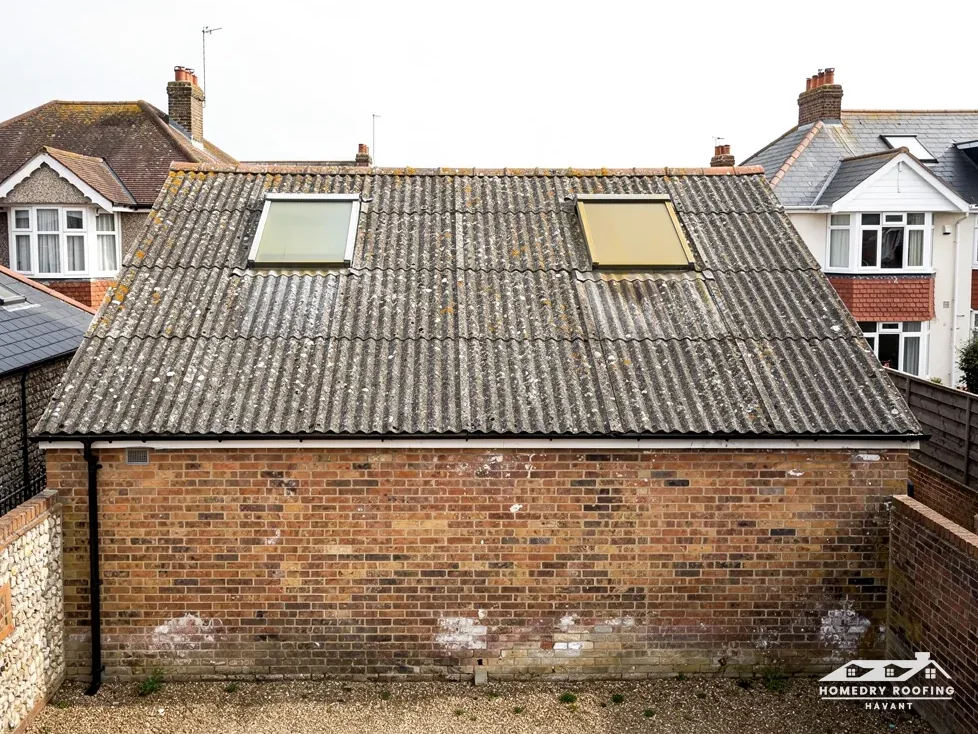
Roof work is where HSE puts its warning first. It says "almost one in five deaths in construction work involve roof work. Some are specialist roofers, but many are just repairing and cleaning roofs." The people hurt are not only strangers to the trade. They include people who went up to look at a stain or clear a gutter.
A unit roof raises the stakes because it is large, flat or shallow, and made of sheets and lights that look alike from a distance. The sheets can be asbestos cement, profiled metal or fibre sheet, and the rooflights set into them can be plastic or glass. Which of them will carry a person is a question for a competent person, not a guess.
This guide gives HSE's own lines, then what they mean for sheeted roofs, rooflights and asbestos cement, who agrees the arrangements on a commercial job and what we do before anyone steps onto the roof. No price appears here, because a survey comes first.
What HSE says about every roof
HSE's roof work guidance is blunt about the starting position. It says "all roofs should be treated as fragile until a competent person has confirmed they are not." The sentence does not exempt a roof because it is new, because it has been walked on before or because the material is thick. It puts the burden on a person with the competence to say otherwise.
It goes further about sheeted roofs. HSE says not to trust any sheeted roof, whatever the material, to bear the weight of a person. That covers metal sheet, fibre sheet, cement sheet and composite panels alike, and the ridge and the purlins are included in the warning.
Confirmation is also specific to the part of the roof it covers. A competent person who clears one bay has said nothing about the next, so the result is written down by area and not carried over from one part of the roof to another.
Three consequences follow for a unit.
- A roof is never inspected on the assumption that it will hold, and the first question is how to reach it without standing on it.
- A roof that carries foot traffic day to day, for example for plant maintenance, is not shown to be safe by that fact.
- The decision that a roof is not fragile belongs to a competent person and is made on the roof's construction, not on appearance.
On a commercial job, that is why the survey and the repair are planned as two separate steps. The survey is planned around access that does not rely on the sheets, and only then is the repair method chosen.
Why rooflights get a warning of their own
HSE singles them out: "Fragile rooflights are a particular hazard." A rooflight is a panel set into a roof so that daylight reaches the floor below. On a unit it usually sits in the same plane as the sheets around it, and from the walkway at the roof edge or from a distance it can read as one more sheet.
That is the trap, and HSE adds that some rooflights are difficult to see in certain light conditions and others may be hidden by paint. A person who steps onto the sheets to reach a different part of the roof can find that the next panel is a rooflight and not a sheet. The panel is meant to let light through, and it is not a part of the roof built to carry weight.
Age does not change the starting assumption, and neither does a coat of paint over the roof. We treat each rooflight on a unit as fragile until we have been told, by someone competent to say, that it is not.
For the client this changes what a roof survey asks for. We ask how many rooflights there are, where they are, whether they have been replaced and who last worked on the roof, and we plan the route to each part of the roof around them. The count goes on the survey record, with the position of each light marked from a safe vantage point and not from memory.
On a unit roof the rooflight can read as one more sheet, which is the whole of the hazard.
Asbestos cement sheets are always fragile
Where a unit has cement sheets, a second warning applies on top of the first. HSE's sheet A14 says "AC roofs are always fragile". For asbestos cement there is no case-by-case question: the answer is already given.
That matters for two reasons. The first is access, because nobody works on an asbestos cement roof by stepping on the sheets. The second is the sheet itself, because a person who goes through a cement sheet breaks it, and broken sheet changes which asbestos rules apply to the job. Whether the sheets stay whole decides which asbestos rules apply, and that is set out in the guide linked below.
A fall and a regulatory problem can arrive together on the same roof. That is why we treat the two subjects as one when a survey finds, or is told about, cement sheets:
- The sheets are recorded and treated as fragile.
- Access is planned from below, from an edge protected by scaffolding, or by mobile access equipment.
- The dutyholder is asked for the asbestos assessment, which our guide to the duty to manage asbestos explains.
HSE advises assuming asbestos is present in any building built or refurbished before 2000, so a unit of that age with a sheeted roof is treated this way from the first visit.
The client benefits from hearing this at the first visit. A repair that would have meant stepping on the sheets becomes a repair planned from a platform, and the cost of that platform is understood before the price is agreed, not after.
What each surface means at the survey
The table sets HSE's lines beside what they change in our plan for a roof visit.
| Surface | HSE's line | At the survey |
|---|---|---|
| Any roof | Fragile until a competent person confirms it is not | Access planned that does not depend on the roof |
| Any sheeted roof | Not to be trusted to bear a person, whatever the material | Ridge and purlins included in the caution |
| Rooflights | A particular hazard | Counted, located and kept clear of the route |
| Asbestos cement | Always fragile | Recorded, and the assessment requested |
The table also shows what the survey is not. It is not a walk across the roof to see how it feels. A unit roof can be read from an access platform, from a hatch where one exists, from edge protection or from the ground with the right equipment, and the reading is planned before the visit.
Where the roof cannot be read safely from outside, the client is told and the next step is access equipment, not optimism. That adds a line to the job, and the written price covers it as one total after the survey.
We write down the result as a plain statement of which parts of the roof are fragile or unconfirmed, so that the next contractor or maintenance visit inherits the information. Each item goes onto a roof plan with its location, so a facilities team can read the result without ringing us.
Who agrees the arrangements on a commercial job
On a commercial job the client has duties, and they bear directly on roof work. HSE says "Client duties apply in full to commercial clients (for domestic clients the duties normally pass to other dutyholders)." The client is any individual or organisation that carries out a construction project as part of a business, so the occupier of a unit, a landlord or a facilities manager who commissions roof work is in that category.
Regulation 4(1) of CDM 2015 asks the client to "make suitable arrangements for managing a project, including the allocation of sufficient time and other resources." For a fragile roof that means time to plan safe access and the resources to provide it, and neither is an extra.
Where more than one contractor is involved, or it is reasonably foreseeable that more than one will be, regulation 5(1) has the client put two appointments in writing, the principal designer and the principal contractor. A rooflight replacement by a glazing firm and a re-sheeting by a roofing firm on the same roof is the kind of arrangement that brings the second rule in.
A construction phase plan is needed on every project, and on a unit roof it records the fragile areas, the access method and the protection around rooflights. Our answer on access on a commercial roof goes through what the roofer needs on site. At the first visit we ask three questions, and the answers show whether one contractor or several will be involved, which is the test regulation 5(1) uses:
- who else works on the roof;
- who holds the keys to roof access;
- whether a construction phase plan already exists from earlier work.
Replacing rooflights, and what comes before the roof opens
A rooflight that is replaced on a commercial building is held to the energy rules for its element. Approved Document L Volume 2, 2021 edition, Table 4.1 sets 2.2 W/(m²·K) for rooflights, and the 2021 edition stays in use until 24 March 2027. The roof sheets around it take their own figures, so the part of the job that is only the rooflight is a separate check with your building control body. Our guide to Part L on a commercial roof gives the figures for the roof itself.
Opening a roof brings two more checks. Bats come first: GOV.UK names repairing or replacing a roof as work that can disturb them, and damaging or destroying a roost, whether or not that was the intention, is an offence. Nests are covered too: it is an offence to intentionally take, damage or destroy a wild bird's nest while it is in use or being built.
The order of work on a unit therefore runs like this:
- Survey the roof from safe access and record sheets, rooflights and fixings.
- Ask for the asbestos assessment and note any cement sheets.
- Check for bats and nests before any covering is lifted.
- Agree the access, the protection and the client's role under CDM.
- Receive one written total price.
Each of those steps changes the work, so the price follows the survey. The wider range sits on our commercial roofing page.