
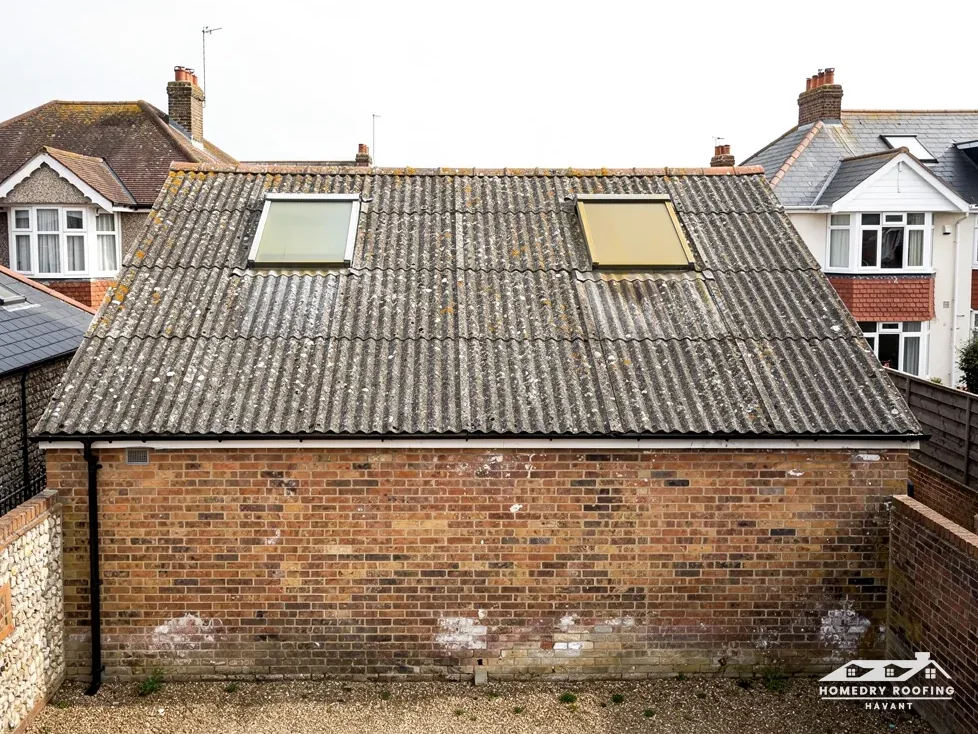
A commercial roof on a building built or refurbished before 2000 may carry asbestos, and nobody can tell by looking up at it from the yard. What the law asks of the person responsible for the building is an assessment first and a plan second, and only then a roofer on the roof.
On non-domestic premises, the Control of Asbestos Regulations 2012 place a duty to manage asbestos on whoever holds the maintenance or repair obligation or controls the premises. That might be an owner-occupier, a landlord, a managing agent or a tenant with a repairing lease, and in some buildings it is shared between them. A roofing contractor is called in by that person, so the contractor needs the answer to the same questions before work is priced.
This guide follows the duty from the regulation to the roof: who holds it, what the assessment has to decide, which cement sheet work HSE treats as non-licensed, how the waste leaves the site and where CDM 2015 sits beside it. Prices for commercial roofs follow a survey.
Who holds the duty under regulation 4
Regulation 4 of the Control of Asbestos Regulations 2012 is headed "Duty to manage asbestos in non-domestic premises". It applies to shops, offices, warehouses, factories and farm buildings, because none of them is a home, and it makes no difference whether the roof is flat, pitched or made of profiled sheets.
The duty sits with the dutyholder. That is whoever holds the maintenance or repair obligation for the premises, or the means of getting into them, or controls the premises where nobody has that obligation by contract or tenancy. Who that is depends on the paperwork rather than on who happens to be standing on site.
- An owner who occupies the building controls it and normally carries the repair obligation, so the duty is the owner's.
- A landlord who has handed the repairs to a tenant under the lease may have passed the obligation on, so the lease wording matters.
- A managing agent can hold the duty where its contract gives it the repair obligation for the owner.
Where there is a roofing job to price, the first question at our survey is therefore who the dutyholder is, because that person owns the assessment. A contractor called in to repair the roof needs that assessment before any sheet is touched. If the building has none, that is the first thing the dutyholder arranges, and the roof work waits for it.
The roof is easy to overlook because it is out of sight. An assessment that covers the plant room and the ceiling void but stops at the roof edge is incomplete for roof work, and the dutyholder is asked to extend it before sheets are touched.
What the assessment has to decide
The regulation says the dutyholder "must ensure that a suitable and sufficient assessment is carried out as to whether asbestos is or is liable to be present in the premises." It is a written judgement about the whole building, and the roof is part of it.
HSE gives the rule of thumb for age: "If the building was built or refurbished before 2000, assume that there is asbestos in it." The test is built or refurbished before 2000, so refurbishment done before that date counts as well as first construction. An assumption is a working position, not a finding, and it holds until a competent survey replaces it with evidence.
For a roof, we ask for five things at the first visit:
- The written assessment, and the date it was last reviewed.
- Whether it names the roof sheets, the rooflight surrounds, the flue and pipe collars and the soffit boards.
- When the building was built, and when the roof or its cladding was last refurbished.
- Who holds the duty under the lease or the contract.
- Any earlier roof work, because a patch or an overlay can hide an older sheet beneath it.
If the assessment is missing, vague or silent about the roof, a survey of the roof is not the same thing as the assessment and does not replace it. We note what we can see, and the dutyholder commissions the assessment.
An assumption of asbestos is a working position that stays until a competent survey replaces it with evidence.
Cement sheets on a roof
HSE lists asbestos cement products among the materials covered by its non-licensed work guidance, and names "roof sheeting and rainwater goods" as examples. On an industrial unit or a farm building, the roof can be large sheets of this material, bolted to purlins.
Two things about it matter before anyone plans a repair.
- HSE's sheet A14 says "AC roofs are always fragile". Weathering does not make a sheet safe to walk on, and a roof that looks sound from a distance carries the same warning.
- Careful handling is the whole point. HSE's non-licensed work page covers cement products "provided the material is carefully handled/removed without breaking up", and it includes work with asbestos cement "which is weathered but not otherwise substantially damaged".
The effect on a repair is practical. A sheet that is lifted off whole, lowered by a safe method and wrapped is one job. A sheet that is cracked, walked through or dropped is another, and the second job brings in the notification rules in the next section.
We cover the fragile side of this in our guide to fragile roofs and rooflights on units, and the questions about what happens to an old cement roof at the end of its life in our answer on asbestos cement on an industrial roof. Neither replaces the dutyholder's own assessment of the building.
A cement sheet roof also carries fittings: ridge pieces, flashings, flue collars and the fixings that pass through each sheet. Every one of them is a place where the roof gets disturbed, so the survey lists them with the sheets instead of treating the sheets alone as the job.
Three kinds of work on asbestos materials
HSE sorts the work by what is being done to the material, not by the roof it sits on. For the materials a commercial roof can carry, the lines run like this.
| Material and work | Category | Condition |
|---|---|---|
| Cement sheets, careful removal | Non-licensed | Handled without breaking up; weathered but not substantially damaged |
| Cement sheets, substantially damaged or broken up | Notifiable non-licensed work | For example after fire or flood damage |
| Insulating board, such as soffit panels | Licensed | Except where the risk assessment shows short duration |
Asbestos insulating board, shortened to AIB, is a different material from cement sheet. HSE's location list includes "AIB white soffit panels to underside of roof eaves" and "Damaged AIB soffit", so an eaves board on an older unit is not covered by the cement rule just because the roof next to it is. Short-duration AIB removal as part of a refurbishment project is notifiable non-licensed work.
One roof can therefore hold two categories at once: whole cement sheets on the main slope and an insulating board soffit at the eaves. The survey lists each material separately, so that each is matched to its own rule and the roof is never given a single label.
Nobody should treat the table as a promise about a particular job. The category follows the risk assessment for that work, and the dutyholder is told which category the survey points to before a price is written.
Waste, skips and carriers
Asbestos leaves the site as hazardous waste, and the rules about the container and the paperwork are as firm as the rules about the removal.
- Container: HSE's guidance is to use a lockable skip for asbestos, and "it is not good enough to throw sheeting over a standard skip". An open skip is never the answer.
- Paperwork: the household consignment-note exemption covers domestic hazardous waste "other than asbestos waste", so it never covers asbestos, and it covers households only. A commercial job is trade waste and moves on a consignment note.
- Carrier: the carrier registers as an upper tier or lower tier waste carrier, so the dutyholder can ask which tier before the sheets leave.
The household recycling centre routes that councils publish are for householders' own small amounts. They are not a route for a business's roof, and Hampshire County Council says work by a tradesperson cannot count towards a household's DIY allowance.
We keep a simple rule on site: sheets that come off whole go into the lockable skip whole, wrapped, with the dutyholder told where they are going and who is carrying them. The waste path is agreed at the survey, not on the day the skip arrives.
The plan names the skip, the wrapping, the carrier and the destination before the first sheet comes down, and the dutyholder keeps the paperwork with the building's own records, where the next person who inherits the duty will find it.
Where CDM sits beside the duty
Asbestos is one thread on a commercial job, and CDM 2015 is another. HSE says "Client duties apply in full to commercial clients (for domestic clients the duties normally pass to other dutyholders)." A commercial client is an individual or organisation that carries out a construction project as part of a business.
Two points tie the threads together.
- Regulation 4(1): "A client must make suitable arrangements for managing a project, including the allocation of sufficient time and other resources." Time for an asbestos assessment and for a careful removal is part of that.
- Regulation 5(1) requires the client to appoint, in writing, a principal designer and principal contractor where there is more than one contractor, or where more than one is reasonably foreseeable. The count of contractors triggers the appointments, not notification.
Every project has a construction phase plan, and on an asbestos roof the plan is where the access method, the removal method and the waste path are written down. Our answer on who is the client under CDM takes the roles one by one. A change on the day, such as a cracked sheet, goes back through that plan and never through guesswork.
The sequence on our side is the survey, a note of any cement sheets, a request for the assessment, agreement on who holds the duty, and then a single written total price. The wider range of this work sits on our commercial roofing page.