
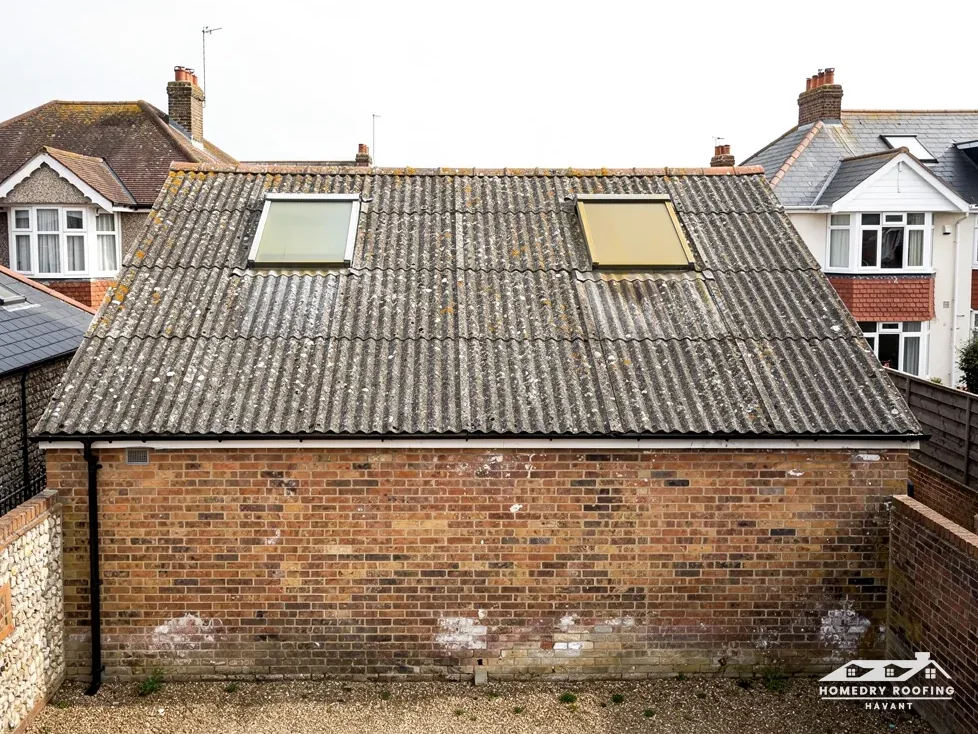
Confirming what the sheets are
On an industrial unit the first job is to establish what the roof is made of. HSE advises assuming that asbestos is present if the building was built or refurbished before 2000, so a profiled grey sheet on an older shed is treated as the real thing until a lab result says it is not.
On non-domestic premises the Control of Asbestos Regulations 2012 place a duty to manage asbestos on whoever holds the maintenance or repair obligation or controls the premises. Before the survey we ask what asbestos information already exists for the building. Our guide to the duty to manage asbestos on commercial roofs covers that duty in full.
At the survey we note, from the ground and from safe access points:
- the profile and age of the sheets, and any fixings that have rusted through
- cracks, holes and patched areas, which tell us what condition the roof is in
- rooflights set into the sheets, which are fragile in their own right
- gutters, flashings and cappings fitted alongside the sheets that may need to come off with them
A sample sent to a lab settles the material. The sample result and the building's asbestos information then decide how the job is planned.
Whole sheets and broken sheets
HSE sorts work with asbestos cement into categories by the state of the material, and the years of weather on a roof are what place it in one or the other. The two descriptions below are HSE's own.
| Condition of the sheets | HSE category |
|---|---|
| Handled with care and removed in one piece, which covers sheets that have weathered but are not otherwise badly damaged | Non-licensed work |
| Substantially damaged or broken up, as in a fire or flood | Notifiable non-licensed work (NNLW) |
Both categories turn on whether the material stays intact. Whole sheets, lifted and lowered rather than snapped or dropped, keep a job in the first. That is why the removal is planned sheet by sheet, with the order of work agreed before anyone is on site. If the survey shows that the roof has already broken up in places, you hear it before you commit to anything, because the second category changes the plan for the whole job. Weathering by itself does not move a job into the second, so age and moss on a sheet are not read as damage.
Fragile roofs, skips and waste
In HSE's guidance A14, asbestos cement roofs are listed as always fragile. Beyond that, HSE expects every roof to be assumed fragile pending a competent person's check. On a unit with long runs of sheet and rooflights, that rule sets the way the crew reaches the work, and nobody steps on the sheets themselves. The ground below the work is kept clear while sheets come off, and the site is tidied before we leave.
Waste is the second hazard. HSE's EM9 guidance says to use a lockable skip for asbestos, adding that tossing sheeting over a standard skip is not good enough. A roofer's asbestos waste is trade waste. It goes on a consignment note with a registered carrier, and that is a different route from the recycling centres that take householders' own small amounts.
Industrial units add one more point. If another firm strips the asbestos while we lay the new roof, the project has more than one contractor. Under CDM 2015, the client then makes two written appointments: one person as principal designer, another as principal contractor. Our page on who the client is under CDM explains what falls to you.
What goes back on the roof
Once the sheets are off, the replacement covering and its fixings are chosen for the building as it now stands. That might be new insulated sheeting, a single-ply membrane over a new deck or another build-up, and we explain why one suits your unit better than another. Our page on overcladding or stripping a commercial roof compares the two approaches. Once the new roof is on, regular maintenance visits are the way to keep an eye on the gutters, outlets and flashings.
The energy rules for a commercial building sit in AD L Volume 2. Until 24 March 2027 it sets 0.18 for a new flat roof and 0.16 for a new pitched roof. A renovated flat roof, or a pitched roof insulated at the rafters, works to 0.18 instead, and a pitched roof insulated at the ceiling works to 0.16, wherever that is feasible and pays back within 15 years.
Roof prices for business premises move with the building, so the figure follows the survey, as one total in writing. Check that it covers access, skips and waste carriage. The commercial roofing page lists the other work we take on for business premises.