
Why there is no rate to quote
Residential price guides give figures for typical houses. Commercial roofs have no such typical case. A shop with a flat roof over the back store, a warehouse with a long run of profiled sheet and an office with a plant deck and rooflights share almost nothing except rain.
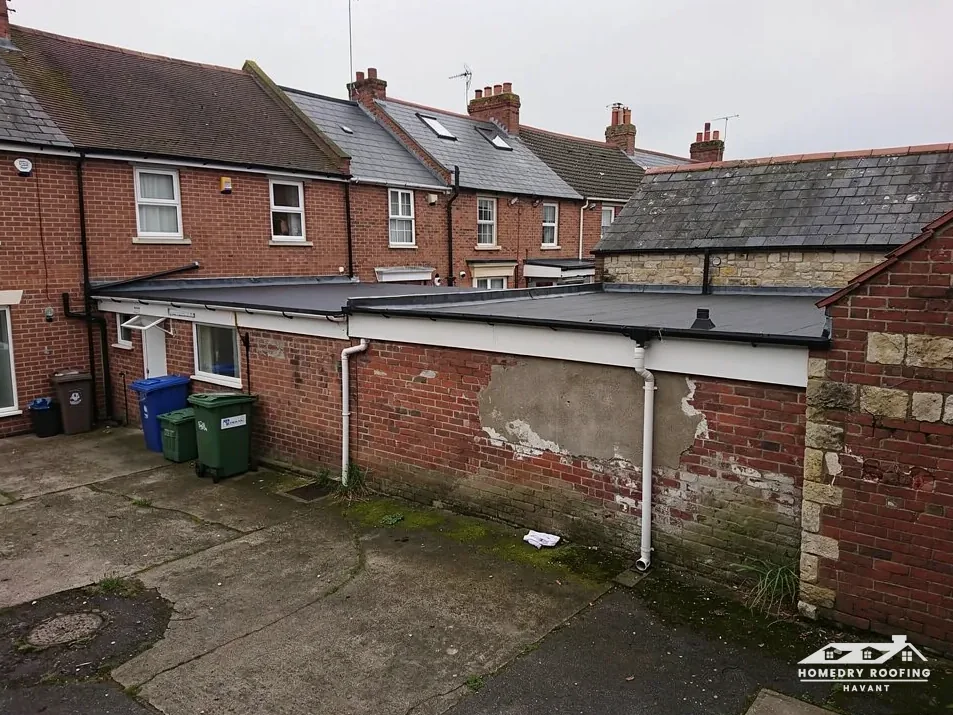
For that reason we do not publish a rate for commercial work, and we do not quote from a drawing or a photograph alone. A survey comes first, on site, and you receive one written total afterwards. Wanting a number over the phone before anyone has visited is understandable, but any figure offered with nobody on site is a guess presented as a price. Even a good photograph hides the deck, the fixings and the state of the insulation underneath.
If you need a budget figure for a board, a landlord or a lender, say so at the start. We can describe what the survey will cover and when the written price will be ready. Our commercial roofing page lists the shops, offices, units and blocks we work on.
What moves the figure
The written total reflects the job as a whole. These are the factors that move it, in words, and not a list of separate charges:
- the area and the condition of the existing roof, and how much of it needs work
- the covering, whether profiled sheet, single-ply membrane, built-up felt or tile
- how the roof is reached, and what the building needs while work is under way
- what the survey finds on and under it, including any asbestos
- the insulation the energy rules require when the roof is renovated
- how many firms the project needs, which decides the CDM duties
Taking those in turn: a roof that needs a short run of new flashing is not the same job as one that needs stripping back to the deck. A building that has to stay open, or whose roof can only be reached from a neighbouring yard, takes longer to plan and to carry out. An occupied unit adds planning that an empty one does not, as our page on roof work in an occupied building explains.
Asbestos, energy rules and extra firms
Three factors sit outside the roof itself, and a survey brings them out early.
First, asbestos. HSE's advice, for a building built or refurbished before 2000, is to assume asbestos is present. If the sheets prove to be asbestos cement, the removal method, the lockable skip and the waste carriage all enter the price. Our page on asbestos cement on an industrial roof sets out how that work runs.
Second, the energy rules. Energy rules for business premises are set out in AD L Volume 2. Its test is that the whole roof is brought up to standard when more than 50% of the surface is renovated, and recovering a flat roof with a new waterproof membrane counts as renovation. Insulation to meet that is part of the roof, and it moves the total. The survey records the layers already on the roof, so the allowance sits in the written price from the start.
Third, the number of firms. Where there is more than one contractor on the project, the client has to make two written appointments, principal designer and principal contractor, and that brings extra management with it. Where it applies, it is built into the one total, and the quote says so. Those roles belong to the project's client.
What the written quote should say
The quote gives a single total, with the scope described in plain sentences. The quote is not a menu of charges for you to pick apart. Whatever the firm, check that a commercial roof quote says:
- what work is covered, and which parts of the roof it applies to
- whether VAT is included, and which VAT treatment it assumes
- whether scaffold or other access equipment is included
- whether skips and the carriage of waste are included
- what happens if the survey or the work uncovers something unexpected
- who will be on site, and who answers your questions while work is under way
The VAT question has its own page, because the construction reverse charge can apply to a commercial job and never to a homeowner's: does the VAT reverse charge apply? covers it.
It is worth keeping a copy of the survey notes and photographs alongside the quote. If the answer on point five is vague, ask for it to be put in writing before you accept. One total price means the sum on the quote is the sum you are asked to agree, for the work the quote describes.