
When a roof needs looking at, the first question is how. A roofer may offer to climb a ladder, send up a drone, look from inside the loft, or some mix of the three. Each way gives a different view of the same roof, and each has a blind spot. Picking one without knowing what it cannot see is how a fault gets missed on a visit that looked thorough.
The roof is a layered thing. There is a weather face you can see from outside, a structure under it you can see only from inside, and a set of joints where the two meet at flashings, valleys, ridges and eaves. No single viewpoint takes in all three. A drone is strong on the first, a loft is strong on the second, and a ladder gets close to the joints at the eaves.
This post goes through the three in turn, says what each can and cannot show, and finishes with how they fit together on a survey, what third parties quote for an inspection, and why photographs matter if an insurer is involved.
What an inspection is meant to answer
Before comparing methods, be clear about the question. An inspection can have different purposes, and the reason sets how far the survey has to reach.
- A leak or a stain: the aim is to trace the route the water took, from the ridge to the point where it showed.
- A storm or an impact: the aim is to find and record damage, perhaps for an insurer.
- A purchase: the aim is to know what the roof is like before the money changes hands.
- Routine upkeep: the aim is to spot minor faults before they grow.
A leak needs the inside as much as the outside, because water runs along timbers and membranes and may appear a long way from the point where it entered. A purchase needs a view of everything reachable, and a clear note of what could not be seen. A storm check needs dated photographs, taken as soon as it is safe to take them and before anything is moved.
Whatever the reason, safety shapes the method. HSE advises that a roof is handled as fragile until a competent person has judged otherwise, and reports that almost one in five deaths in construction work involve roof work. That is a reason to use a viewpoint that keeps people off the surface wherever it can, and to put edge protection or a scaffold in place where someone has to go up. HSE's advice is on its roof work page.
From the ground: what is visible
The ground is the lowest-cost viewpoint and the safest, and it shows a fair amount. From the road or the garden, with binoculars or a zoom lens, a roofer can read the general state of a slope.
From the ground you can see:
- The line of the ridge and whether it sags or dips.
- Tiles or slates that have slipped, tilted or gone missing.
- The condition of the chimney stack and its flashings, from below.
- Gutters that sag, overflow or have plants growing in them.
- Growth across a slope, and where the roof is shaded.
What the ground cannot show is a lot. A cracked tile can look whole from the pavement. A flashing that has lifted at its back edge is invisible from below. The underside of the covering, the felt and the timbers are out of sight altogether. A ground view is an opening move, not a finding, and a roofer who writes a report from the pavement alone is describing a roof they have not examined.
A good ground survey also notes the things that are not roof faults but point to them. A damp patch on a bedroom ceiling, a bedroom wall that stains after rain, or water marks beside a chimney breast are signs to report alongside the photographs, with the date each was noticed, because a roofer can follow them back along the path the rain took. For the question of how much a roofer can tell without going up, our answer on whether you can inspect a roof from the ground gives the detail. For an owner, taking dated photographs from the ground is worth doing whatever else follows, and it costs nothing.
From a ladder: close, but limited by reach
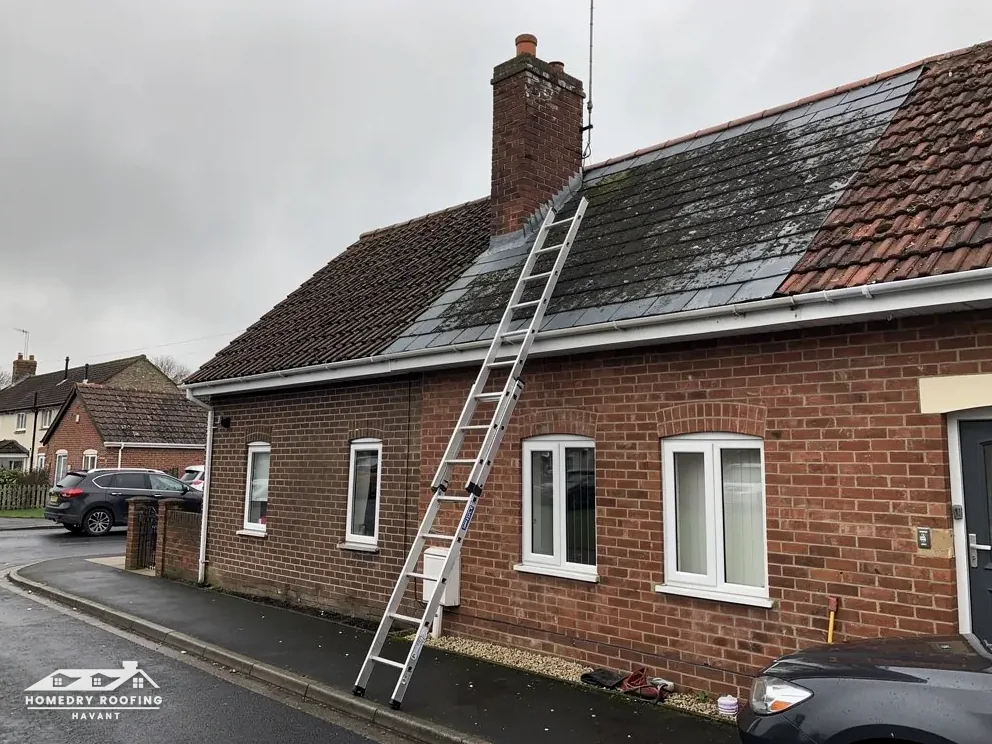
A ladder brings the eye within arm's length of the eaves, the lower courses, the gutters and the fascia. At that range a roofer can see what the ground hides: hairline cracks, slipped nails, the state of the mortar and the condition of the gutter joints. It is also where the hand can lift a tile edge, press a flashing or test a fixing.
The limits are plain.
- A ladder reaches the edge, not the middle of the roof.
- Steep slopes, valleys and the high side of a chimney are out of range.
- Safety rests on the ladder, its footing and its tie, and the person using it.
- The top courses and the ridge may need a different approach altogether.
For anything beyond the lower edge, a roofer has to choose between going onto the roof and finding another viewpoint. Walking on a roof is where the danger lies, since tiles, slates, sheeting and rooflights can all give way. If the survey needs more than a ladder can reach, edge protection or a scaffold makes the work safe, and we arrange the licence with our scaffolder where the scaffold stands on the public highway.
One practical point: the ladder is a tool for the survey, not a way to reach a repair on a high roof. If the survey turns up work above the eaves, the repair needs its own safe access, and the written total allows for it. A ladder inspection is good for the eaves and the details at the roof's edge. It is not a full survey of a roof, and a report that says it is should say what was and was not reached.
From the loft: how the roof is built
The loft is easily left out, and it shows what neither the ground nor a ladder can. From the hatch, a roofer can see the underside of the covering, the timbers that hold it up, the felt or membrane between, and any sign that water has been getting in.
In a loft, the survey looks for:
- Stains, tide marks or damp patches on timbers, which can trace a leak back along its route.
- Daylight through the covering, which marks a gap.
- The state of the felt or membrane, and whether it is torn or sagging.
- Timber that looks soft, dark or damaged.
- The state of any insulation, and whether it blocks the eaves.
The loft has a limit of its own. It cannot show the outer face of the covering, the state of the ridge from above, or the flashings on the outside. And where the roof has been insulated with spray foam, it can show very little. RICS says a timber roof structure under spray foam "cannot be fully seen or inspected". You can read the point in its consumer guide on spray foam, and our answer on inspecting a roof with spray foam deals with what follows.
For a leak, the loft is where the trail can start, so it earns its place on any survey. Take care if you look yourself: step only on the joists or on boards laid across them, because the ceiling below will not carry your weight, and keep a torch in hand so you do not need to lean on anything.
From a drone: a high view with no hands
A drone gives a picture of the outer face of the roof from above, which the ground and a ladder cannot match. It can take in a whole slope at once, reach a ridge, a chimney top or a roof valley that is awkward to see, and record it in photographs that can be zoomed and kept. For a high or complex roof, that is a real advantage, and it keeps people off the surface.
It also has limits that are worth knowing before you pay for one.
- It sees the top surface only, never the underside or the loft.
- It cannot touch anything, so it cannot lift a tile, test a fixing or press a flashing.
- Photographs flatten depth, so a lifted edge or a hairline crack can be missed.
- The picture depends on the light, the angle and the person who reads it.
So a drone is an aid to a survey, not a substitute for one. It tells a roofer where to look closely, and it records what was seen. How a drone is flown is the operator's business, so ask whoever offers the service to explain how they work and what they will hand over.
Where a roof is tall, steep or crowded by neighbouring buildings, the drone can save a scaffold that would otherwise be needed only for a look. That is a fair saving, and it comes with the limits above. The photographs are also a handy record to compare against a later visit, since the same slope can be shot from the same position. If you are shown drone photographs as the whole of an inspection, ask what else was looked at. A good answer will name the loft, the eaves or a follow-up visit.
Putting the methods together, and what it costs
For a roof of any size the useful answer is a mix. The ground gives the overview, the ladder gives the detail at the edge, the loft gives the structure and the drone fills the gaps on a high roof. Which parts a roof needs depends on its shape and height, and on what you have asked.
Third-party figures for an inspection give a sense of scale. MyJobQuote (September 2026) puts the average cost of a roof inspection in the UK between £150 and £400, and says a standard roof inspection costs between £200 and £300. It puts the average cost of a roof survey at around £300 on a separate page. These are third-party figures with no VAT basis, so they show scale and nothing more. A written total from us comes after we have looked at what your roof needs.
If a claim is involved, photographs matter. The Financial Ombudsman Service says it will usually look at expert reports and photos when it takes a property's condition into account after a storm, so a dated photographic record, from any of the viewpoints above, is useful evidence.
Our roof inspections page explains how we survey, and our guide to what a roof condition report covers shows what a written result should contain. Ask for the methods used to be listed, and for any part that could not be reached to be named. A report that admits where the survey stopped is more use than one that implies it saw everything.
Filed under Roof inspections