
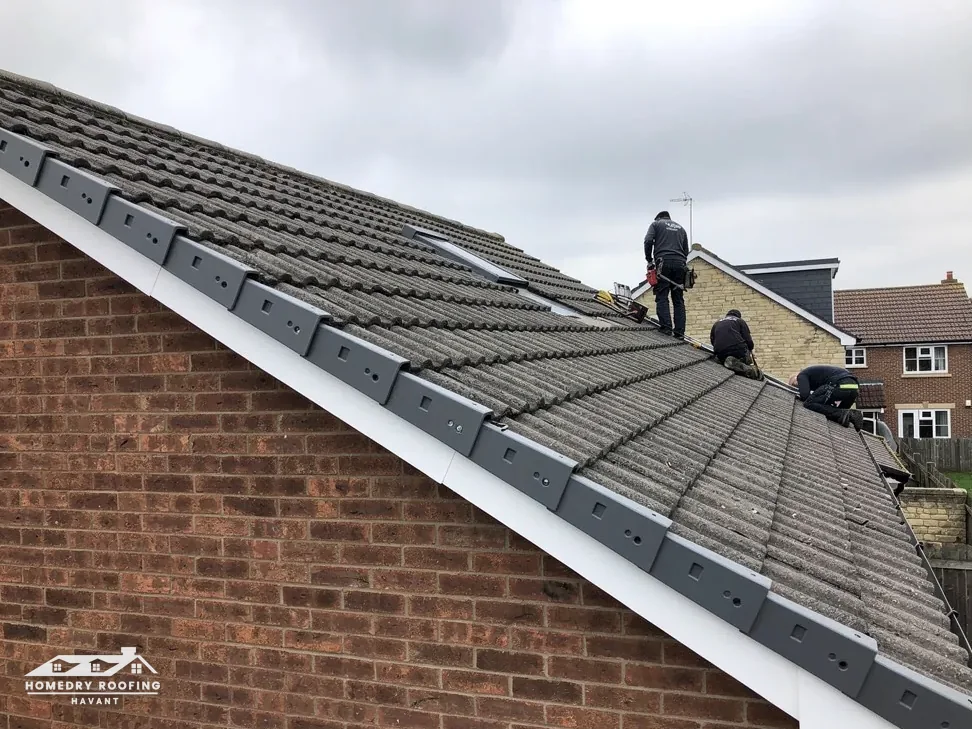
Verges
The sloping side edge of a roof, finishing beside a gable wall.
A loose edge piece or a soft bargeboard lets rain slip behind the last row.

Whitehill is 22.1 road miles north of Havant; its gable edges, hips and flat extension roofs are surveyed one by one before a single written total price is set.
10-year workmanship guarantee, in writing
The sloping side edge of a roof, finishing beside a gable wall.
A loose edge piece or a soft bargeboard lets rain slip behind the last row.
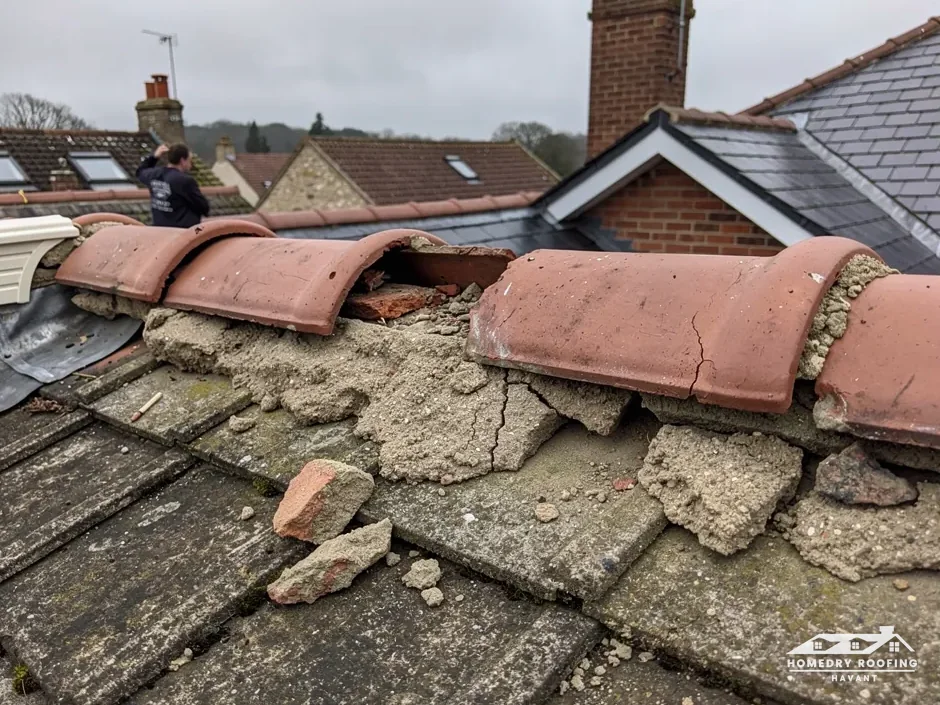
The sloping line running from ridge to eaves at an outward corner of the roof.
Capping pieces along it can loosen and leave a gap for the rain to use.
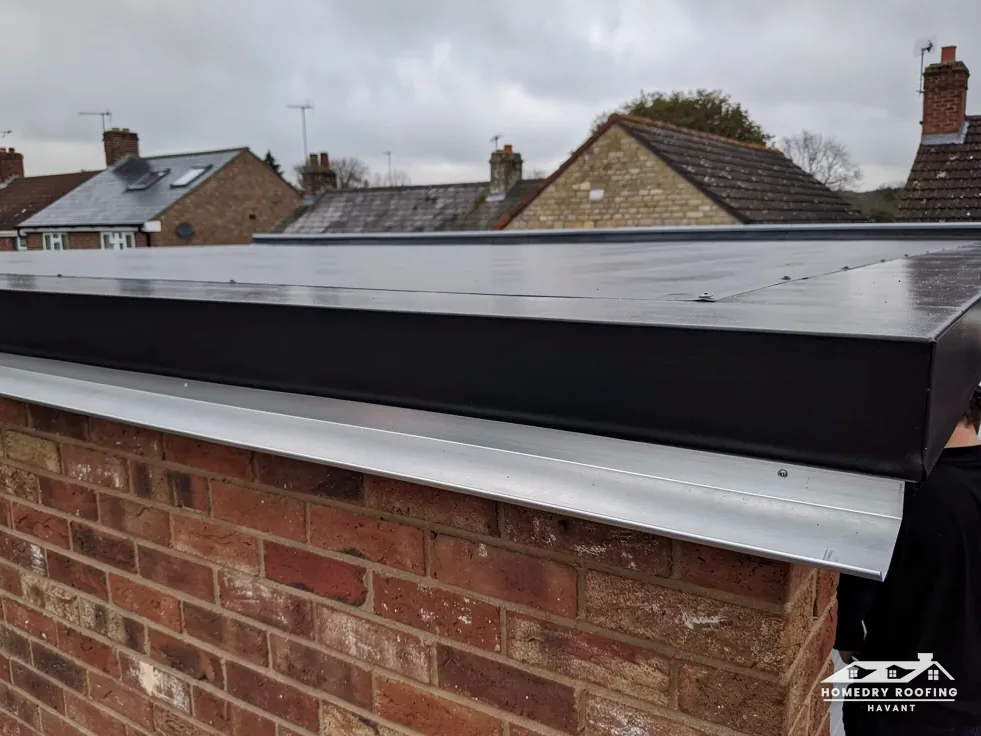
The raised lip formed where an extension roof turns up to meet the brickwork of the house.
A split in that lip, or standing water below it, sends rain behind the covering.
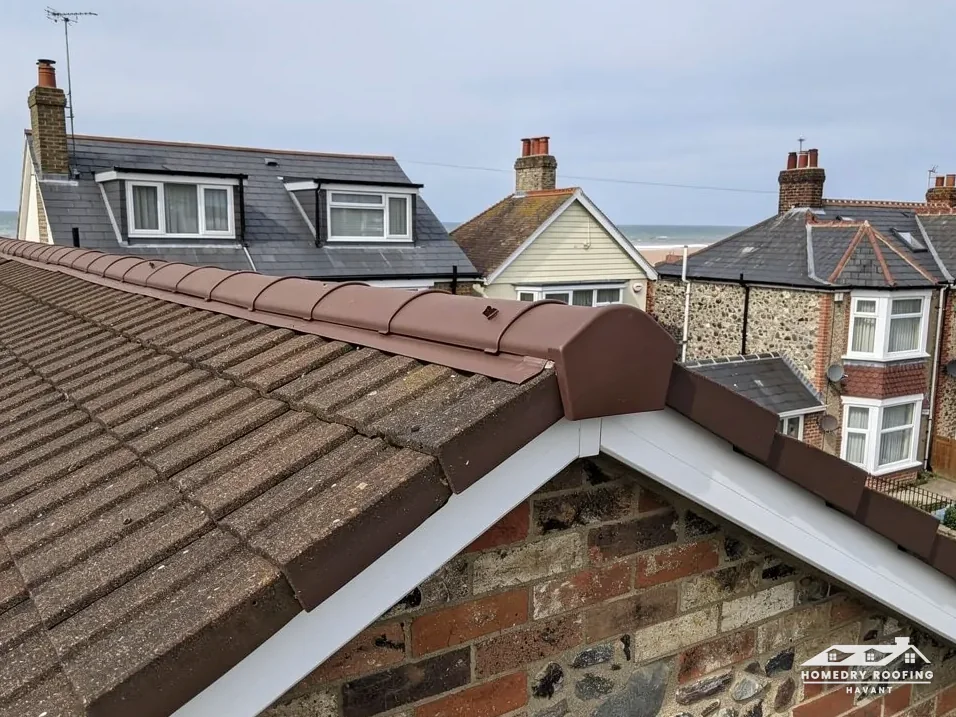
The verge is the sloping side edge of a roof, at the gable wall. A loose piece there lets rain slip under the last row of the covering and on to the timbers, so every one gets a hand test from the ladder.
At a gable end the roof finishes along its verge, a sloping side edge where the last row of covering meets the gable wall. If a piece there works loose, rain gets under that row and reaches the roof timbers without leaving any mark on the slope. Hips are the sloping lines where two slopes meet at a projecting corner, and each carries capping pieces and fixings of its own. A Whitehill survey runs a hand and an eye along both: the verge for loose or cracked pieces and open pointing, the hips for gaps between capping and slope, and the bargeboard below, the board fixed along the verge under the edge pieces, for softness, pressing it with a thumb to find rot. Our dry ridge and verge page describes how these lines are refixed, and our pitched roofing page covers the slopes they border.
Conservation areas around Whitehill include Blackmoor, River Wey and Headley Mill. East Hampshire District Council can say if your road sits within one of them, since it holds the boundary maps. A change of covering on a house normally stays within permitted development, conservation area or not, but if an Article 4 direction applies to your address the council will tell you what it withdraws, so check with East Hampshire District Council. The planning permission guide on this site covers the wider rules.
Bowl Barrow 50m South of Hogmoor Lodge is a scheduled monument near the centre of Whitehill. Works to a scheduled monument itself need scheduled monument consent under section 2 of the 1979 Ancient Monuments and Archaeological Areas Act, a rule that attaches to the monument and not to roof coverings elsewhere. A house with a list entry to its own name is a separate case, where listed building consent reaches any work touching its special character.
Where the covering stops, the roof's weakest line begins.
From the pavement a verge shows as a thin line and a hip as a ridge of capping, so a loose piece is easy to miss. We check them from the ladder, close enough to see cracked mortar and to test each piece by hand, and inside the loft we search for chinks of light or staining at the same corners. A short run of refixing is offered before any talk of re-covering, and the report says which pieces moved.
Daylight or a brown stain at the top corner of a gable-end bedroom, or damp creeping slowly down the end wall below the roof edge.
A cracked or loose piece along the verge, open pointing beneath it, or a gap along the line of a hip.
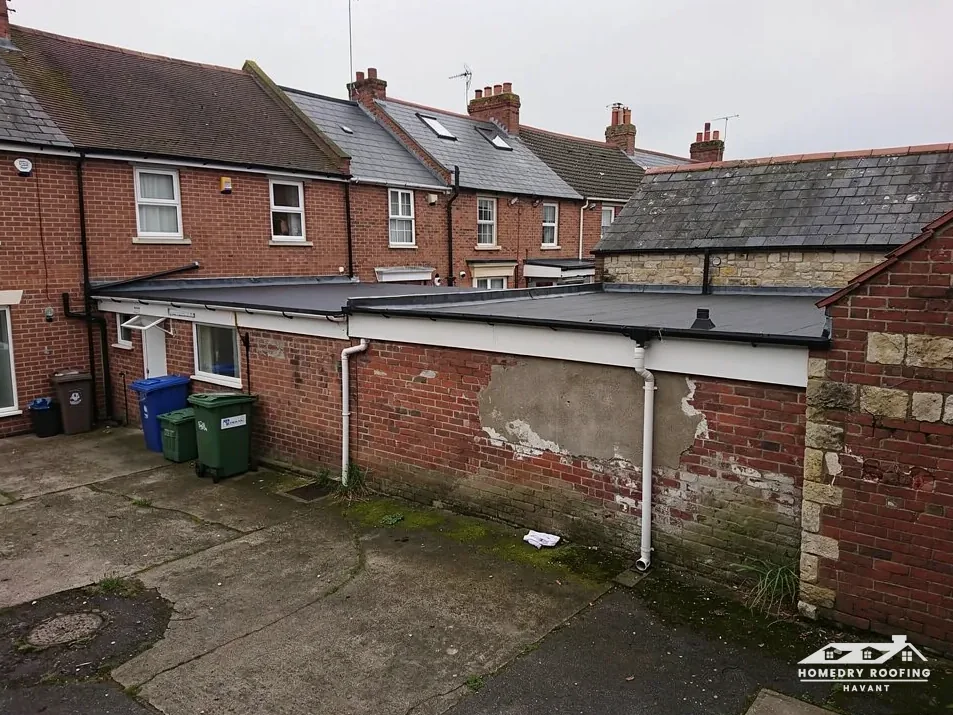
Either the slope is too slight for the water to run off, or the drain is choked. Clearing a drain is quick; a slight slope means the covering is relaid, and we explain which applies before any price is given.
A flat extension roof is never quite level. Its covering is laid to fall gently towards an outlet, bends upward against the house wall to form the upstand, and is closed against the brickwork by a flashing. We go up the day after rain where we can and look at three things: ponding that has not drained, splits or blisters along the upstand, and the outlet itself, clear or choked. The gutter and fascia beneath get the same attention, with the fascia board pressed for softness and each bracket checked for movement under a full run of water, since the rain has to leave the roof there. Our flat roofing page explains the coverings and when a patch is a sound answer.
Where water lingers, the cause is a slope that is wrong or a choked drain, and the two remedies are very different. A choked outlet is a small task to clear. A wrong slope means the membrane must come up and go down again, which is a larger decision, so you are told which of the two applies, with the reason, ahead of any figure. If the membrane is in good order and only the upstand has split, that edge can be mended without disturbing the rest.
Building control in Whitehill is handled by East Hampshire District Council's building control service, and 01730 234207 is the number for application queries and inspections. Re-covering a flat roof counts as a re-roof, like any other, so the Planning Portal's test applies to it, and the question is put to that service by us, with the job described, before any date is agreed. Scaffold for the eaves of an extension beside a road brings a licence from Hampshire County Council, set out in the answers below.
Water that stays on a flat roof is telling you something.
A pool that lingers is evidence, and useful evidence. A shallow film that clears is a different thing from water still lying there days after the rain, and where the pool sits tells us whether the outlet, the slope or the edge is at fault. We photograph it from the same spot each time, so the diagnosis goes in writing and the next wet spell can be judged against it.
The verge and the hips are felt as much as seen. From the ladder head we try each edge piece with a hand for movement, look at the pointing beneath for cracks and gaps, and check the bargeboard under it for soft spots. Hips get the same treatment along their length. Up in the loft we search for chinks of light or staining at the same corners. If a short length has loosened it can be refixed on its own, and the report names the pieces and the reasons; if the whole edge has worked loose, the photographs show that instead.
The amount of building affected, and the weight of what goes on. The Planning Portal puts it in two limits: touching less than 25 per cent of the building envelope and less than 50 per cent of the roof normally brings no building regulations application, though a covering weighing 15 per cent or more beyond the old one needs approval however small the area. Building control in Whitehill is East Hampshire District Council's service, and 01730 234207 is the number for application queries and inspections. We ask the service first, then relay the answer plainly.
Yes. Highways here belong to Hampshire County Council, not the district council, and a licence under section 169 of the Highways Act 1980 is the price of putting poles or boards where the public walk or drive. Hampshire County Council charges £211.90 on application for the first 2 weeks and £72 for each additional 2-week period; before the start, ten clear working days have to elapse between applying and starting, so the date we give you leaves room for that. Hampshire County Council also says: "Scaffolding companies must apply on behalf of their customers." We arrange it with our scaffolder, and your written price tells you whether scaffold is in it.
Those are conservation areas around Whitehill: Blackmoor, River Wey and Headley Mill, each with a boundary of its own. Whether your own road falls inside one is for East Hampshire District Council to confirm from its boundary maps, so ask before you plan a re-roof. Fresh covering on a house is ordinarily permitted development in a conservation area as well, and the planning permission guide on this site explains where each rule comes from. If the council tells you your address is inside one, mention it and the survey notes will record it.
Ask East Hampshire District Council. In an Article 4 area the council has taken specified permitted development rights away from a defined patch of land, so a neighbour's answer cannot be assumed to hold for your address. Check with East Hampshire District Council before work begins and file what it says with your papers. We note any direction you mention on the survey sheet, and the planning permission guide on this site covers the rights that stay in place when none applies, so you can see where you stand.
Bowl Barrow 50m South of Hogmoor Lodge is a scheduled monument, entry 1013048 on the National Heritage List, and it lies near the centre of Whitehill. Works to a scheduled monument itself need consent under the 1979 Ancient Monuments and Archaeological Areas Act, section 2, which attaches to the monument, not to a roof covering elsewhere. If your property adjoins protected land, ask East Hampshire District Council before you plan work. A house that appears on the list itself is different, since listed building consent reaches any work that touches its character.
We go up after rain. A pool still lying there days later means the slope is wrong or the drain is choked, and its position helps: water standing beside the outlet suggests a blockage, whereas a pool mid-roof suggests the slope. We also read the upstand and the joints for splits. The report names the cause and states whether clearing, patching or relaying is called for, with photographs attached, ahead of any figure. A flat roof that simply needs its outlet cleared is told so, and left alone.
Repair is the first option we give, whenever the timber and covering are in good order and a single spot is at fault. A loose verge piece, a split in a flat roof lip or a worn flashing is mended on its own. Where the covering has failed across a whole slope, a patch would simply send the water to the next weak spot, and the survey photographs show why. Either way you receive one written total price, which states whether scaffold and VAT are included, with the drive and the pavement swept when we go, and any waste taken away with us.
You'll get one written total price.
Fill in what you like. It opens WhatsApp with your message ready to send.