
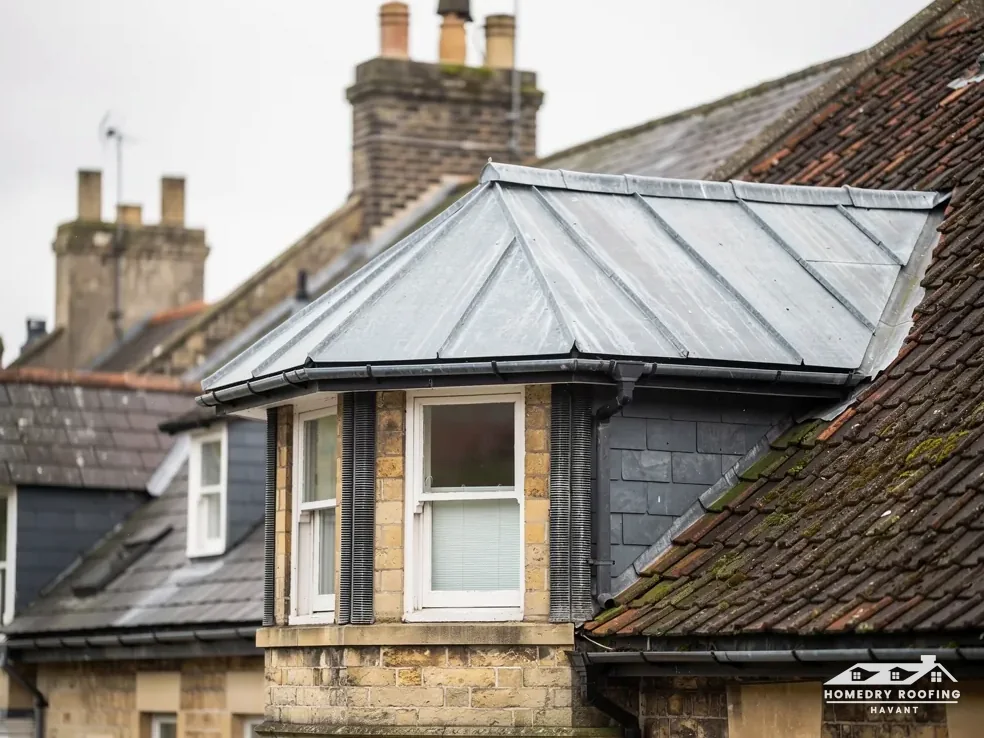
Abutments
Every spot where the covering runs up to a gable wall, a porch front or a neighbour.
A strip of lead let into the brickwork shuts rain out for as long as its edge stays down.

Greatham is 19.3 road miles north of Havant, and each wall joint, stack and gutter there is traced to its source before one written total price is given.
10-year workmanship guarantee, in writing
Every spot where the covering runs up to a gable wall, a porch front or a neighbour.
A strip of lead let into the brickwork shuts rain out for as long as its edge stays down.
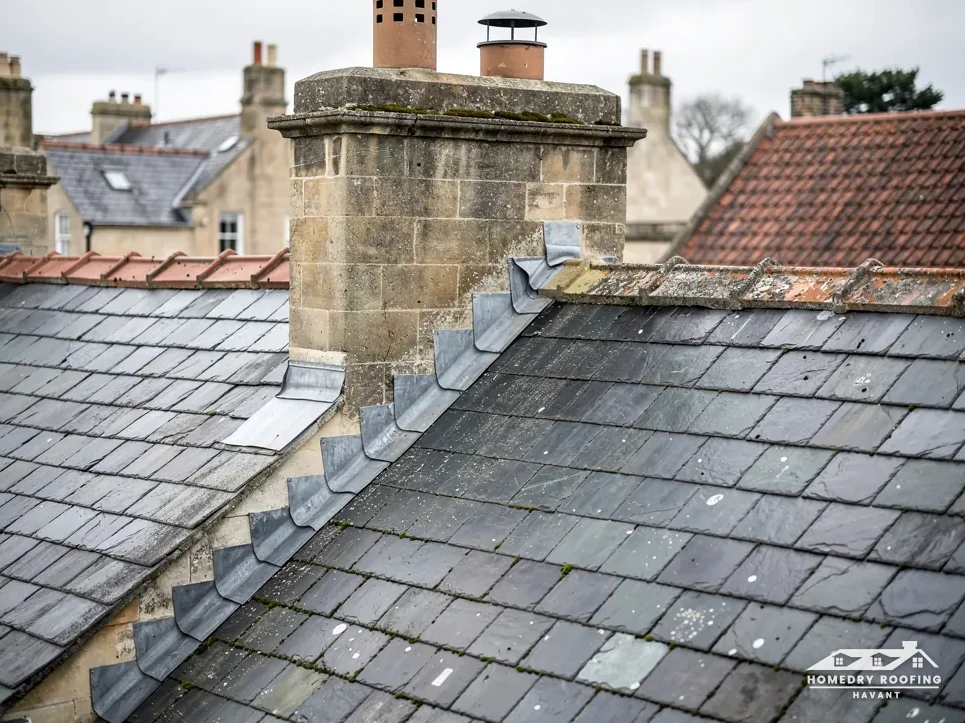
Where a chimney stack rises through the slope and a flashing wraps its base.
A cracked mortar fillet or lifted lead edge lets rain run in beside the breast.

The spot at ground level where a downpipe lets the roof's rain go at last.
A blocked gully, or a pipe turned towards a wall, leaves water standing at the foot.
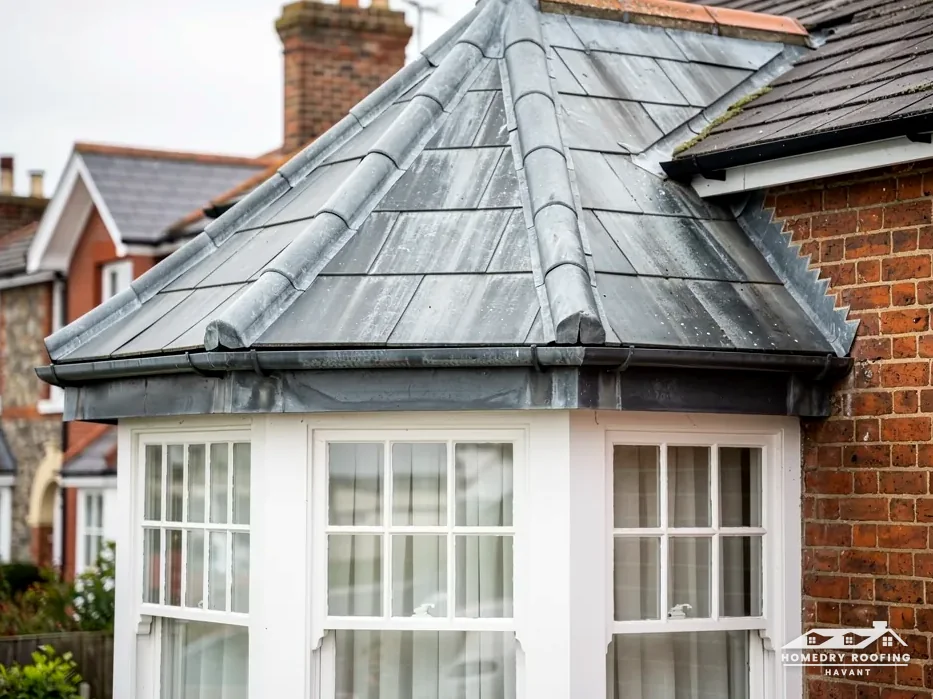
Any roof is as weak as the joint where it meets a wall.
A village roof meets its walls in more places than a first look suggests: a gable against a neighbouring wall, a porch roof against the front, a chimney stack rising through the slope. Each of those joints is an abutment, the line where the covering stops at brickwork, and each carries a flashing, which is a strip of metal let into the wall and dressed down over the covering. A Greatham survey walks every one. We look for lifted edges, mortar that has crumbled around the lead, and stains in the loft that follow the line of a wall, then explain what each of them means for the roof. Our leadwork page sets out how flashings are formed, and the same visit takes in the base of every chimney stack, where flashing, fillet and pointing are read together.
On the National Heritage List, Greatham has Grade II entries for Church of St John the Baptist, Deal Farmhouse and Rooks Farmhouse. Any house carrying a list entry needs listed building consent before work that changes its character, even where the roof work is otherwise permitted development. Worship continues at Church of St John the Baptist as part of the Church of England, which puts repairs to the building under the faculty system, and the council's listed building consent process does not apply to it.
The village sits within the South Downs National Park and has a conservation area of its own. Planning there belongs to South Downs National Park Authority, yet you start with East Hampshire District Council, which usually processes applications for the Authority unless one is called in. Our planning guide for roof work sets out the rules for roof changes in places like this, so we leave them there and keep this page to what the survey will look at.
Consent decides who has to approve the work, never what the roof needs. Whether the address is a farmhouse with a list entry, a house in the conservation area or an ordinary home, the survey follows the rain from ridge to drain, records the cause and puts it in writing. If someone else has to agree, we tell you who it is, and the findings go with the application.
A brown stain on a bedroom wall that follows the line of the roof above and darkens after a wet week.
Lead with its edge raised, or a crumbled mortar line, where the covering runs up against brickwork.
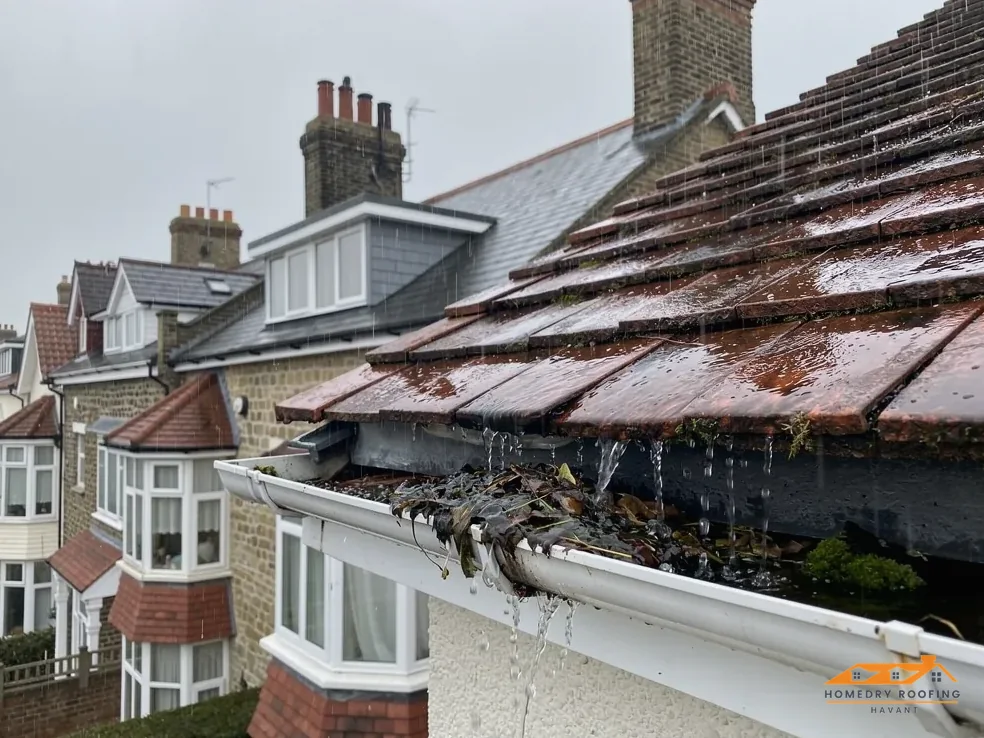
A roof may be in good order and still cause damp if its rain is left to stand against a wall. We follow the water from the gutter to the gully, and tell you if a pipe end should be moved further away.
Rain that has crossed the covering has to leave the roof somewhere, and a Greatham survey follows it to the end. We check gutters for sagging runs, open joints and standing leaves, brackets for loose fixings, and the fascia boards behind them, pressed with a finger to feel for softness. Brett Martin advises a fall of 1 mm for every 600 mm towards the outlet, so we sight along each run to see whether water would drain or linger. Downpipes are checked for cracks and blocked shoes. Our gutters, soffits and fascias page lists the work involved.
Flood Zone 3 takes in land near Greatham, as shown on the Environment Agency's flood map. Flood Zone 3 describes flooding at ground level and puts no duty on a roof: the covering gets one survey method in every zone. The one point that carries over is drainage. Where a pipe empties at ground level we look at where the water goes next, and we advise carrying a run further from the wall if it would otherwise soak the foot of the brickwork. Water left standing against old masonry is a slower problem than a leak, and a harder one to trace back to its cause, which is why we treat the pipe end as part of the roof.
Scaffold comes next. Work at the eaves of a house beside a village lane can mean boards on the verge or the road, and a licence from Hampshire County Council is then needed under the Highways Act. Your written price says if scaffold sits inside the figure, so nothing arrives later as a surprise. A roof that has failed beyond repair is a different job, planned from the survey to the clean-up, and our pitched roofing page describes how those are handled. You see the evidence first, in photographs.
The roof's route ends where the downpipe meets the ground.
The route of the rain finishes where the downpipe meets the ground. If that point is a gully, we check that it is clear and draining; if it is a bare wall foot, we look at the brickwork for old damp. A short extension, or a shoe turned away from the wall, can end a problem that no amount of work higher up the roof would ever cure.
We look at the flashing, the metal strip let into the wall and dressed over the roof covering, and at the mortar line above it. A lifted edge, a gap or a crumbled joint sends rain behind the metal and into the timbers, so we feel along each joint from the ladder and look for matching stains in the loft. Porch roofs, gables and chimney stacks get the same attention. The survey tells you whether a joint needs re-pointing, a new strip of lead or nothing at all, with photographs of what we saw, and the written price follows from that.
Under the Planning Portal's guidance, you do not normally need a building regulations application when the work touches under 25 per cent of the building envelope and under 50 per cent of the roof. Weight is a separate test: laying a covering 15 per cent or more heavier than the existing one has to be approved. In Greatham the contact is East Hampshire District Council's building control service, on 01730 234207 for application queries and inspections. Before work begins we take the question to that service, then report its answer back in everyday words, so any decision you make rests on the council's view and not on guesswork.
Under section 169 of the Highways Act 1980, a licence must be obtained before scaffolding goes up in a position that obstructs the highway, and for Greatham that licence comes from Hampshire County Council. Hampshire County Council charges £211.90 on application for the first 2 weeks and £72 for each additional 2-week period, with at least ten clear working days required before the start date. Hampshire County Council also says: "Scaffolding companies must apply on behalf of their customers." We arrange it with our scaffolder, and your written price states whether scaffold is in the total. Scaffold kept wholly on your own land is a separate matter.
Church of St John the Baptist, a Grade II listed church where Church of England worship continues, is dealt with by the faculty system when its building needs work, not by the council's listed building consent. Deal Farmhouse and Rooks Farmhouse are Grade II listed too, and a house holding a list entry gets no such exemption: listed building consent under section 7 of the Planning (Listed Buildings and Conservation Areas) Act 1990 covers work that affects its character. Search for your own address on the National Heritage List ahead of ordering any materials or fixing dates.
Greatham lies inside the South Downs National Park, where planning rests with South Downs National Park Authority. East Hampshire District Council is the host authority and usually handles applications for the Authority, though an application the Authority calls in is dealt with by its Midhurst team. Building control sits apart from planning and remains with East Hampshire District Council, since the Authority offers no such service. Our planning guide for roof work lays out the rules for roof changes, and for a specific address East Hampshire District Council is the place to ask, ideally with the survey findings in hand so the question is concrete.
Ask East Hampshire District Council about the Greatham conservation area; it handles planning here for the Authority and can say if your own address is inside. A normal re-roof of a house stays within permitted development in a conservation area, but if an Article 4 direction applies it may take further rights away, so check with the council before you commit. A list entry adds listed building consent as a separate step. Whatever applies to your address goes into the survey notes, so you know the position before a start date is set.
Flood Zone 3 takes in land near Greatham on the Environment Agency's flood map, which charts flooding at ground level. It adds no rule for a roof covering, and a Greatham roof is surveyed no differently because of it. We keep one eye on drainage: where each downpipe empties, how freely a gully drains, and what happens if water is left standing against old masonry, which is a slow way for damp to reach a wall. Everything else in the survey is about the roof, followed in the order the rain travels, from the ridge through the slopes and valleys to the gutter.
Where one fault is clear and everything around it is sound, a repair makes sense, and that is the first thing we offer. A repair might mean a flashing, a gutter joint or a handful of slipped tiles put right. If a whole slope has given up, a patch would only shift the leak elsewhere, and the survey photographs will show you why. You then receive one written total price, with scaffold and VAT stated, and we think the price a fair one for the work. We leave the site clean when the work is done, with the lane and the garden swept.
You'll get one written total price.
Fill in what you like. It opens WhatsApp with your message ready to send.