
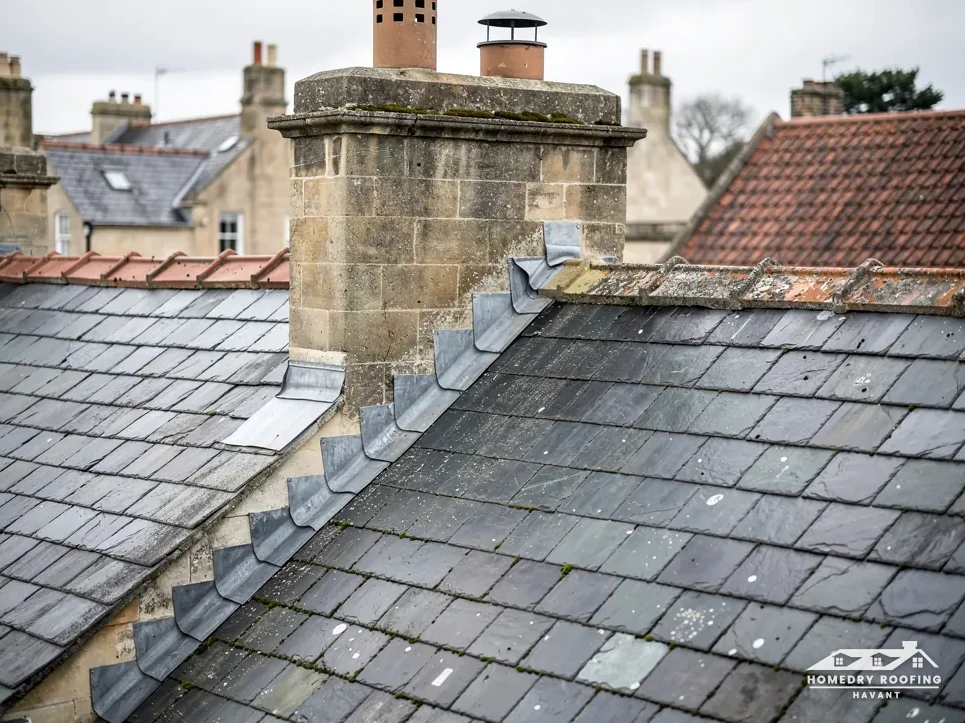
Chimneys
Where a stack leaves the roof and a lead flashing holds the slope against its sides.
Cracked pointing or a lifted lead edge sends rain down the breast inside the house.

Selborne lies 21.9 road miles north of Havant; chimneys, dormers and gutters there get a close survey of their own, and a single written total price comes after.
10-year workmanship guarantee, in writing
Where a stack leaves the roof and a lead flashing holds the slope against its sides.
Cracked pointing or a lifted lead edge sends rain down the breast inside the house.
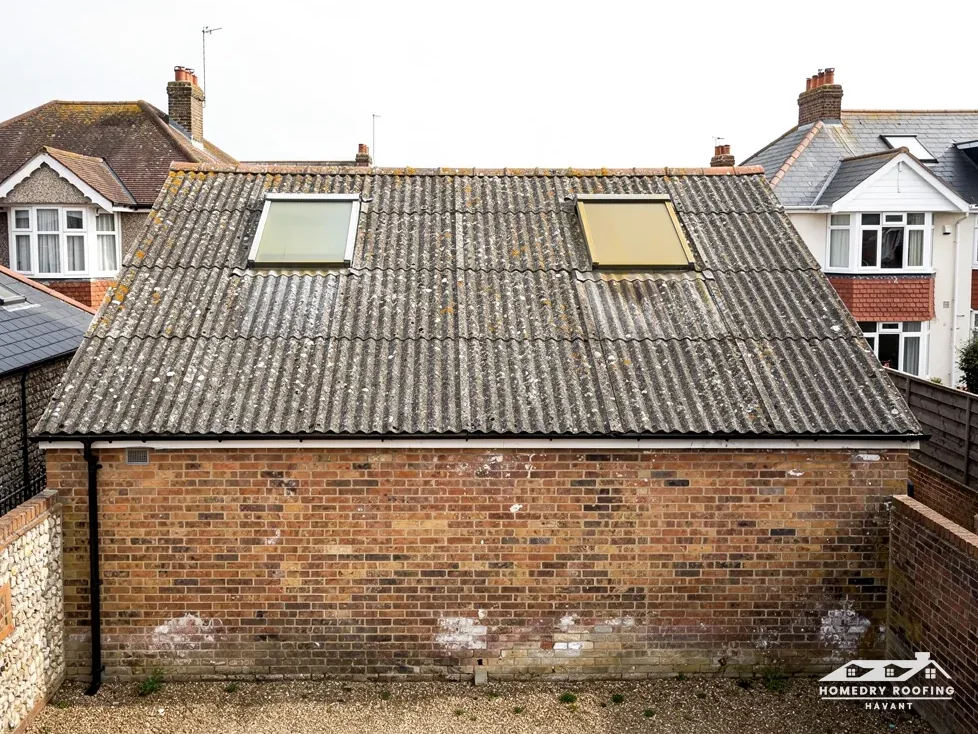
Where a small roofed box projects from the main slope, with a cheek at each side.
The joints at the cheeks and along the top are the places that take the rain.
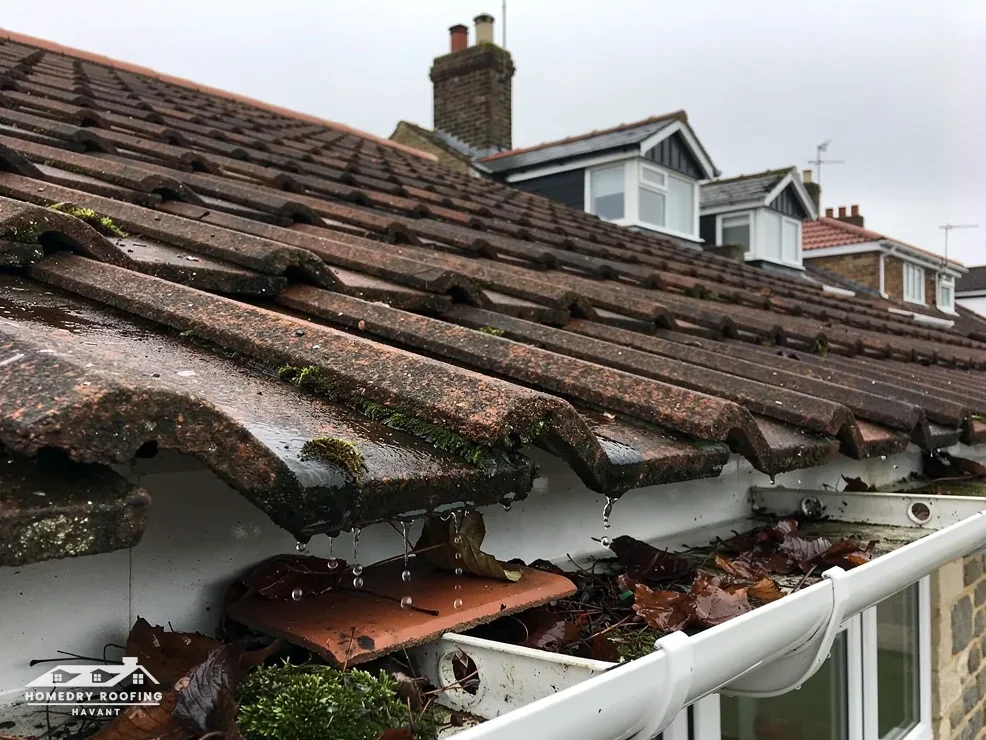
Where the eaves collect the rain of a whole slope and hand it to a single pipe.
A sagging run or a loose joint spills that water down the wall below.

A stain circling the chimney breast up in the loft shows where water has been arriving and how far it has spread. It points us to the flashing or the stack above, and we photograph it so you can see it too.
Brick or stone rising through the slope, a chimney stack stands on the roof like a short tower, and the joint round its base is where a survey slows down. Lead flashing is dressed over the covering on every side, a mortar fillet seals the upper edge, and the stack's own pointing sits above both. We read each layer in turn: lifted lead, cracked fillets, open joints in the brickwork, and the cappings and pots on top. Inside the loft, a ring of staining on the timbers around the breast gives us a fair idea of how long damp has been getting in, and whether the slope next to the stack is feeding it. Pots and cappings are checked for movement, and the chimney breast is looked at from below, where a damp patch can be traced back up to the stack. Our chimney repairs page explains what a repair involves, and our leadwork page covers the flashings.
The National Heritage List gives Grade I status to Church of St Mary and to The Wakes (Including Museum Flat and the Flat) in Selborne, and Grade II to The Limes (Queens Annex). A building holding an entry in its own name needs consent before anything is done that alters its special character, even if the job would otherwise count as permitted development. At Church of St Mary, worship continues within the Church of England, so the faculty system, not the council's listed building consent, is the route for repairs to the building.
Selborne has a conservation area and lies inside the South Downs National Park, and planning rests with South Downs National Park Authority. Your contact there is East Hampshire District Council, since it takes in applications here for the Authority as its host. Our planning guide for roof work shows which rules apply to a roof, which leaves this page to describe the survey.
The lead round a stack's foot is one of several joints we read.
Seen from the lane, a stack can look perfectly sound while its base is failing, so we read the flashing from close range and check the loft for a matching stain. We photograph what we find, so the lifted edge or the open joint is there for you to see, and the written price follows what those photographs show, never an assumption made from the ground.
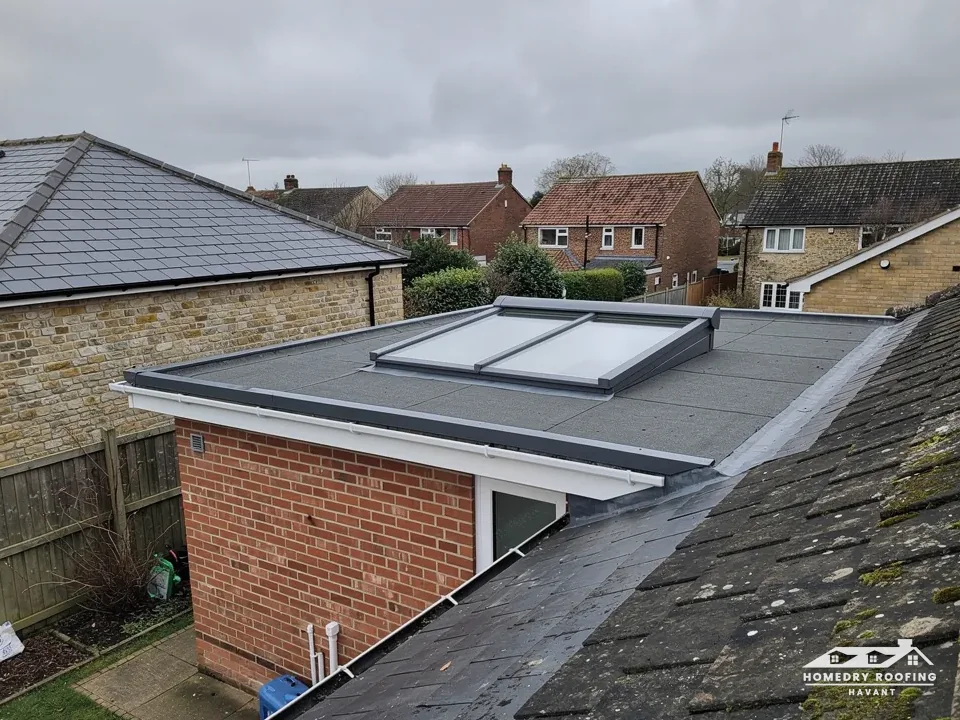
Yes, where the seal around the frame has perished or the glazing unit has failed. We look at the frame first, then the flashing round it, then the cheek above, so the work lands on the real entry point.
A dormer is a small roofed box built out from the main slope, and it adds joints to a roof: a flat or pitched top, a cheek at each side, and a line of flashing where each meets the main covering. We check the metal along those lines, the covering over the cheeks, and the window frame with its seal. Where a dormer has been added to a roof since the house was built, the way its framing joins the old rafters is worth a look from the loft. Roof windows set into the slope get their own look at the surround flashing and the glazing seals, since a unit that looks fine from the room can still be letting water past its frame. Our roof windows and skylights page explains the options when a unit has to be replaced.
Planning for a new dormer in Selborne starts with East Hampshire District Council, which usually deals with applications on behalf of South Downs National Park Authority; one the Authority calls in is handled by its own Midhurst planning team. The council's list of Article 4 directions names sites at Southlands, Oakhanger Farm Business Park and Lumbry Park. It names those sites, and nothing in it suggests that houses in the village are caught; still, where an Article 4 direction applies, rights may be withdrawn, so ask East Hampshire District Council about your own address.
Reaching a dormer can mean scaffold, and scaffold over a pavement or lane brings a licence from Hampshire County Council. The written price states if scaffold is counted in the figure, so another firm's quote can be set beside ours like for like. We photograph the cheeks and the top before and after, which leaves a record of the joints that will be hidden once the work is closed up.
Where a dormer meets the slope, every joint has to hand its water on.
A dormer packs a run of joints into a small area, and each is a place where one surface hands its water to another. We go along them in the order the rain would, from the top to the cheeks to the sill, and say which are sound, which are worn, and which need renewing rather than patching, with the reasons written down.
A damp patch on the ceiling beside a dormer window, or staining on the reveal below the sill.
A lifted flashing along the cheek, or a perished seal where the window frame meets the slope.
The stack is only part of it. We read the flashing round its base, the mortar fillet along the top edge and the pointing up the shaft, then go into the loft to see whether staining circles the breast. Slipped tiles beside the stack can send water to the same spot, so the slope above is included, and pots and cappings are checked for movement. You receive the findings with photographs, and you get a plain view of whether the lead can be repaired or the whole flashing should be renewed, and the figure for the work comes after.
Under the Planning Portal's guide, work touching less than 25 per cent of the building envelope and less than 50 per cent of the roof will not normally need a building regulations application. Heavier coverings are treated differently: a new covering 15 per cent or more heavier has to be approved. For Selborne addresses the contact is East Hampshire District Council's building control service, on 01730 234207 for application queries and inspections. We raise the question with that service ahead of fixing any date, and you are given its answer in everyday terms, which keeps the decision yours.
If poles or boards will stand on or over the highway, yes: scaffolding there needs a licence under section 169 of the Highways Act 1980, and for Selborne that licence comes from Hampshire County Council, which charges £211.90 on application for the first 2 weeks, then £72 for each additional 2-week period, and the council wants the application in well before the start, with ten clear working days as the minimum. Hampshire County Council says: "Scaffolding companies must apply on behalf of their customers." We arrange it with our scaffolder, so the start date we give you already allows for that gap.
It counts where your own building holds a National Heritage List entry. Worship continues at Church of St Mary, a Church of England church, so the faculty system covers works to that church, not the council's listed building consent. A building that has an entry itself, Grade I or Grade II, needs consent before work that would alter its special character; that holds for roof work that would otherwise be permitted development. Look your own address up on the list before anything is ordered or booked in.
South Downs National Park Authority, because planning for Selborne, which sits within the Park, rests with the Authority. East Hampshire District Council acts as host and usually processes applications for the Authority; any case the Authority calls in moves to its Midhurst planning team. Building control is not the Authority's work: East Hampshire District Council's building control service or a registered building control approver carries it out. The roof-work planning guide sets out what a dormer needs; for your own Selborne address, take the question to East Hampshire District Council with pictures of the existing roof attached, then keep the reply.
Sites at Southlands, Oakhanger Farm Business Park and Lumbry Park appear by name when East Hampshire District Council publishes its Article 4 directions as a list. They are named sites, so nothing in the list suggests that houses in the village are covered. Where an Article 4 direction does apply, rights may be withdrawn, so check with East Hampshire District Council about your own address, particularly if your home also stands in the Selborne conservation area. We note anything relevant on the survey sheet for you to take away.
Not for the roof itself. The map of flood zones kept by the Environment Agency lists land near Selborne in Zone 3; that is a measure of flooding at ground level, and it makes no rule about choosing a covering or about how one is fixed. The part that carries over is drainage. A downpipe should empty where the water can run away and not against the base of a wall, so we note each outlet while we are at the eaves and suggest a change if one is wrong. Everything else in the survey concerns the roof.
After the survey, and not before. Someone has to go up and look, so that the price describes the work the roof needs and not a guess. It arrives as one total, in writing, and says plainly if it includes VAT and scaffold, and any other quote you hold should be read for the same two items. Sound repairs come first; when a repair would not last, the photographs explain why. The written figure is fair for what the roof needs, and we sweep the garden and the lane before leaving.
You'll get one written total price.
Fill in what you like. It opens WhatsApp with your message ready to send.