
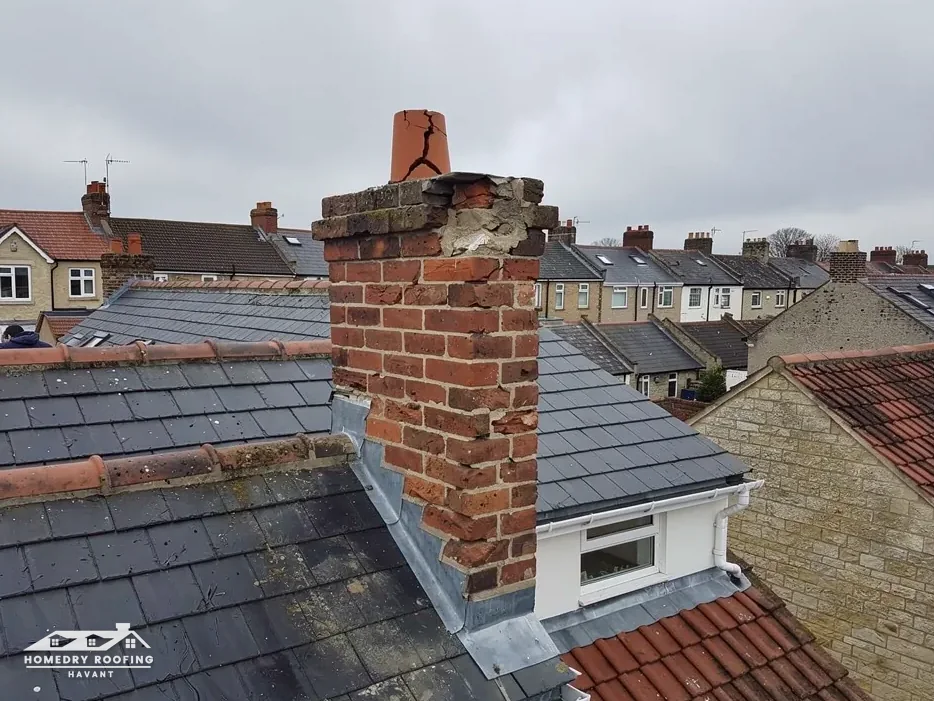
Stacks
Where a chimney leaves the slope and a lead strip hides the join with the brickwork.
A lifted strip or a cracked mortar cap lets rain reach the brick below.

Alton is 27 road miles north of Havant. Stacks, flat roofs and drainage there are each traced to the point where rain gets in, and one written total price follows the survey.
10-year workmanship guarantee, in writing
Where a chimney leaves the slope and a lead strip hides the join with the brickwork.
A lifted strip or a cracked mortar cap lets rain reach the brick below.
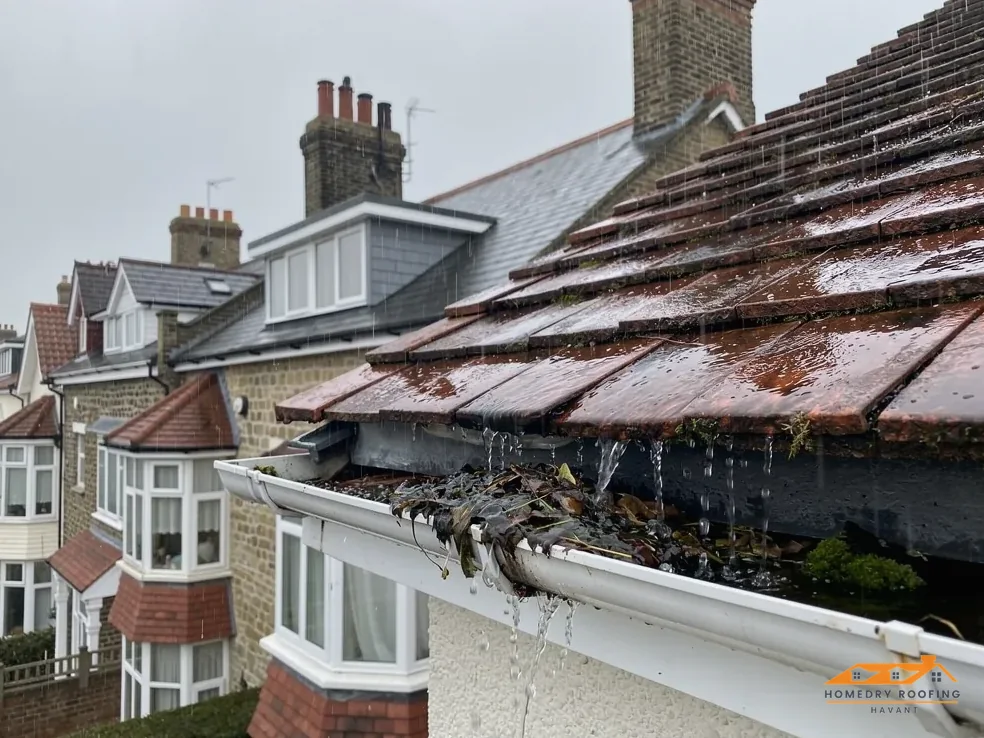
Where a roof edge ends in a low wall and a gutter runs along its foot.
That gutter carries the whole roof's water, so a blockage shows on the ceiling inside.
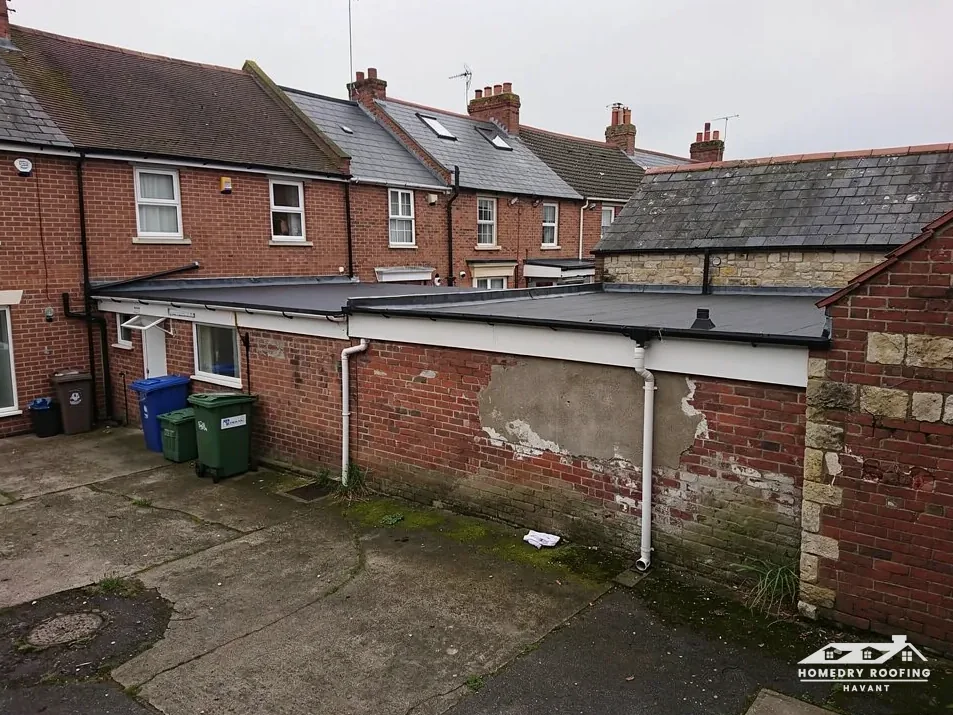
Where a flat roof or a gutter hands its water to a pipe.
A clogged outlet leaves pools that press on the covering until a seam gives.
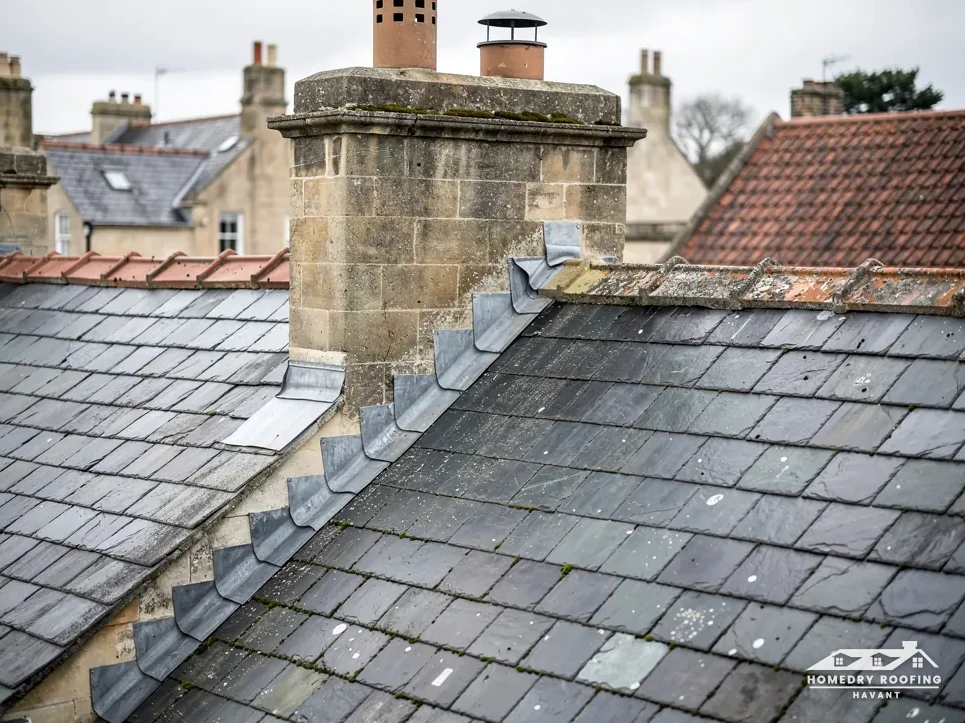
A stack stands alone on the roof, and every joint on it shows.
Standing proud of the slope, a chimney stack gets its own look in the survey. We begin at the base, where lead flashings are dressed up the brickwork and tucked into the mortar joints; a lifted edge or a gap in the pointing lets rain run behind the metal. Higher up we check the brick for loose pointing, the mortar cap on top (the flaunching) for cracks, and the pots for movement. From the loft, a torch on the timber around the chimney breast shows staining that points to the flashing, the stack or the covering beside it. Our chimney repairs page explains what a rebuild involves, and the survey says whether yours needs one or a repair to the flashing will do.
The National Heritage List holds several Alton entries. The Parish Church of St Lawrence is Grade I, Westbrooke House is Grade II* and Swan Hotel (Excluding Adjoining Dickens Bar) is Grade II. That title is a reminder that an entry has its own boundary and should be read in full before anyone orders materials. Roof work that affects a listed building's character needs listed building consent from the council. St Lawrence is a Church of England church in use, so work to it goes through the faculty system instead.
The Butts (Alton) and Alton are both conservation areas around the town centre, and East Hampshire District Council can say whether your address sits inside either. Ordinary re-roofing of a house is normally permitted development even there, yet a direction under Article 4 can take further rights away, so ask the council first. The planning guide for roof work holds the rules, and this page leaves them to it. When the council has replied, its answer comes to you in plain words, so the decision about the roof is yours.
A list entry has its own wording and its own boundary. Before anyone prices work at an older Alton address, find it on the National Heritage List, read what the entry covers and ask East Hampshire District Council whether consent is needed. On the roof we photograph the stack and its flashings, so that you and the council are looking at the same condition rather than at a description of it, and nobody argues over memory.
A brown stain on the chimney breast in an upstairs room, or paint flaking high on the wall beside it.
A lifted lead flashing at the base of the stack, or cracked mortar on its cap, where rain runs behind the metal.
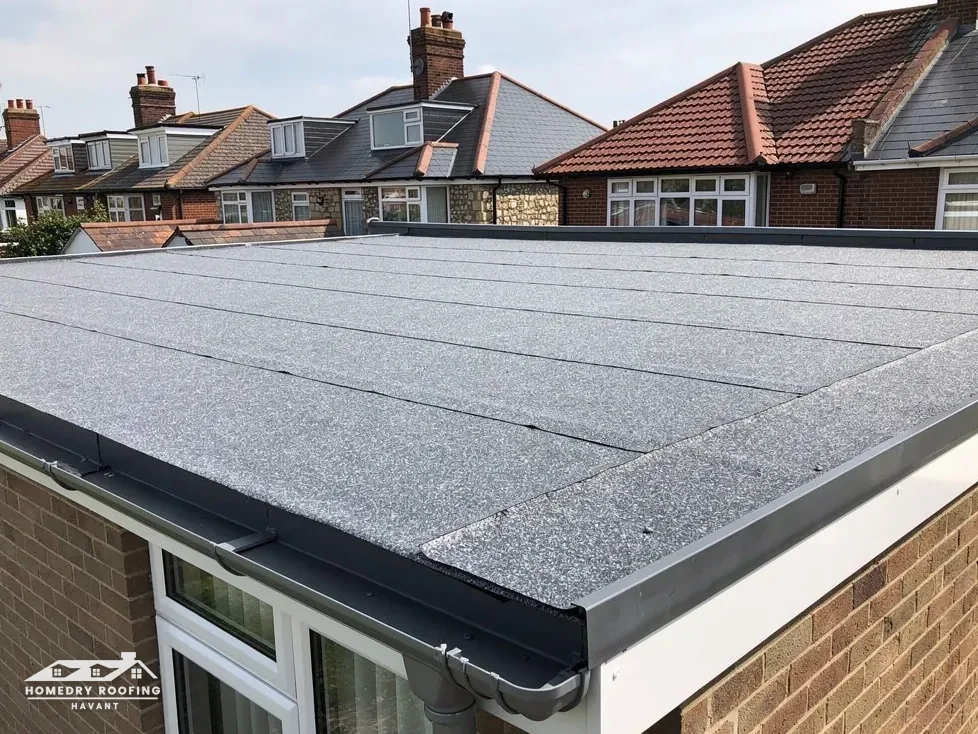
Either the fall is too shallow to carry the water to the outlet, or the outlet is partly blocked. A blocked outlet is cleared and the roof left as it is; a wrong fall means the covering has to be relaid to a better slope.
A flat roof falls only a little towards its outlet, and that small fall is the whole drainage system. The covering is turned up the house wall to form an upstand, then slopes gently away. We read all three: the upstand edge for splits and lifting, the surface for pools still lying a day after rain, and then the outlet for leaves and grit. Where water sits, either the fall is wrong or the outlet is blocked, two faults with different repairs, one an afternoon with a brush and the other a relaid covering. The flat roofing page describes the coverings we fit when a roof has to be relaid.
From the outlet the water goes to a gutter and a downpipe, and that run is where small faults add up. A joint that weeps, a bracket that has let a length sag and a pipe aimed at a wall all show from a ladder. Behind the gutter, the fascia and soffit timber is pressed to see whether it has softened, because a board that has gone soft cannot hold a gutter true. Our gutters, soffits and fascias page covers the replacement options.
The Environment Agency flood map places land near Alton in Flood Zone 3. That is a map of the ground and not a roofing rule, and it does not change how a roof is surveyed. What matters to us is that a downpipe has somewhere sensible to send its water, away from the wall foot. When the survey is finished, the findings go to you in writing, each with a photograph, and the price is settled afterwards. If the outlet turns out to be the only fault, the report says so plainly, and the repair is the small one rather than a relaid roof that nobody needed.
The roof has done its job only when the water reaches the drain.
The day after a wet night is the best time to judge a flat roof. A pool that has not drained tells you about the fall, and a dry roof with a damp ceiling below tells you the fault is at an edge or a seam instead. Take photographs from a window or a ladder if you can do so safely, and send them with the address, so the survey starts with something to compare.
We start at the base, where the lead flashing is dressed up the brickwork, and check that its top edge still sits tight in the joint. Then we look at the mortar between the bricks, the cap on top and the pots. From the loft the same stack shows damp staining on its timber, which tells us whether water is coming in at the flashing or lower down. You get the findings with photographs, and a repair that fits the fault: a flashing re-dressed, a cap relaid, or a stack rebuilt where the brick has gone. Nothing is priced until someone has been up and looked.
Look at the surface the morning after rain. A pool still sitting there means the fall is wrong or an outlet is blocked, and a blocked outlet is a clearing job, not a new roof. Then check along the upstand, the edge where the covering rises against a wall, for splits and lifting, and across the seams for blisters. A sound covering with one failed seam is repaired. A covering cracked across its whole surface is replaced. We say which case yours is, and why, in writing and with photographs, before any price is given, so you can decide with the evidence in front of you.
They are separate questions. Under the Planning Portal's guide, re-roofing does not normally need a building regulations application if it affects less than 25 per cent of the building envelope and less than 50 per cent of the roof; a new covering 15 per cent or more heavier does need approval. For building control, East Hampshire District Council's building control service answers application queries on 01730 234207. A house re-roof is normally permitted development, which our planning guide covers, and we confirm the route with the right body before the first tile comes off. You hear the outcome in plain words.
Scaffolding that obstructs the highway needs a licence under section 169 of the Highways Act 1980, and for Alton the licensing body is Hampshire County Council. Hampshire County Council's page says: "Scaffolding companies must apply on behalf of their customers." Its fee is £211.90 on application for the first 2 weeks and £72 for each additional 2-week period, and ten clear working days' notice is needed before the licence can start. We arrange it with our scaffolder, and the dates are agreed with you first, so nobody is guessing at a start day or left waiting on a pavement.
The Parish Church of St Lawrence is Grade I listed and in use as a Church of England place of worship. Works to a Church of England church in use go through the Church of England's faculty system, not through the council's listed building consent. That route belongs to the church in use. A house with its own list entry has no such exemption, and listed building consent applies to anything that changes its character, so find the entry, read it in full, and ask East Hampshire District Council before materials are ordered or a date is fixed.
The Butts (Alton) and Alton are both conservation areas around the town centre, and East Hampshire District Council holds the boundary maps that show whether an address is inside one. The council's list also names Article 4 directions at sites near Alton, among them The Stone Yard, Omega Park, Mill Lane and Waterbrook Estate. Those are named parcels and estates, not a statement about houses in the town. Further rights can go under an Article 4 direction, so check with East Hampshire District Council about your own address before any roof work is planned.
No. The Environment Agency flood map shows land near Alton in Flood Zone 3, which describes the ground and its relationship to flooding, and it is not a roofing rule. A roof is repaired by finding where rain gets in, whatever the map says about the street. The one practical link is drainage: a downpipe should discharge somewhere that carries the water away from the wall foot, and we check where each pipe in your run ends up. If a gutter has been overflowing, the survey looks at the outlet, the joints and the fall first.
It describes the work and the covering, says whether the total includes VAT and scaffold, and arrives after someone has been up and looked, not before. Ours is one written total price, with what we found set out beside it, and a repair is offered first where a repair is sound. Prices are good and fair. If another quote leaves out the scaffold or the VAT, ask for both in writing so the two can be compared fairly, because a lower figure can simply be an incomplete one, and the difference then arrives later.
You'll get one written total price.
Fill in what you like. It opens WhatsApp with your message ready to send.