
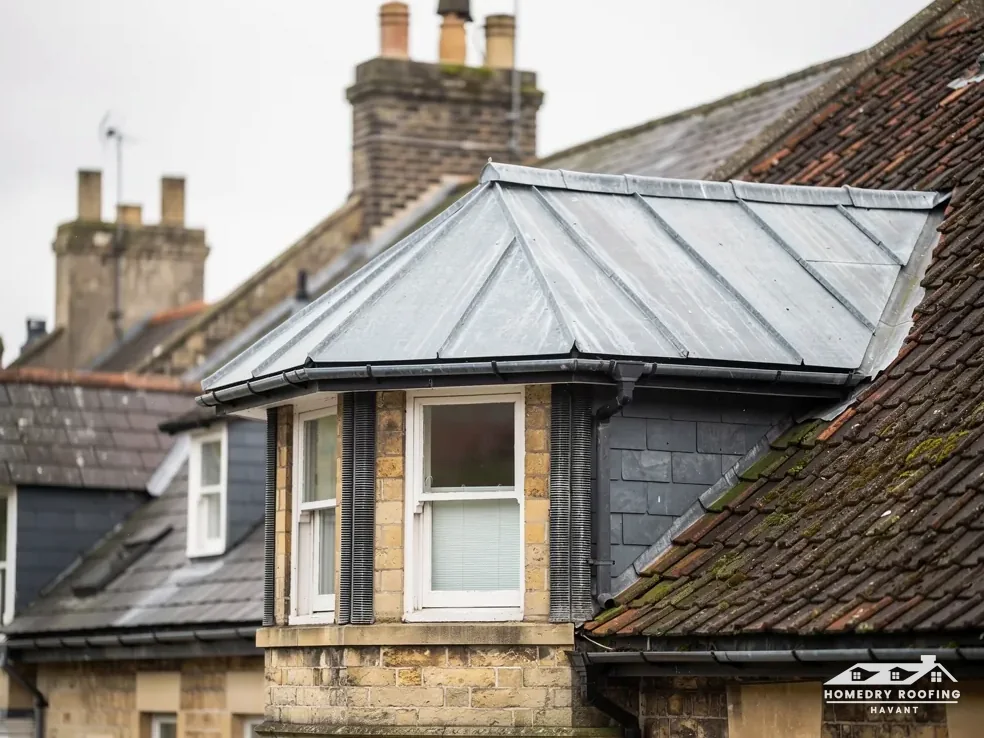
Abutments
Where a slope finishes against a wall that carries on upward above it.
A lifted edge on the metal strip along that wall lets rain run in behind it.

Lindford is 24.7 road miles north of Havant; flashings, chimney stacks and flat roof outlets there are read where they meet the walls, with one written total price to follow.
10-year workmanship guarantee, in writing
Where a slope finishes against a wall that carries on upward above it.
A lifted edge on the metal strip along that wall lets rain run in behind it.
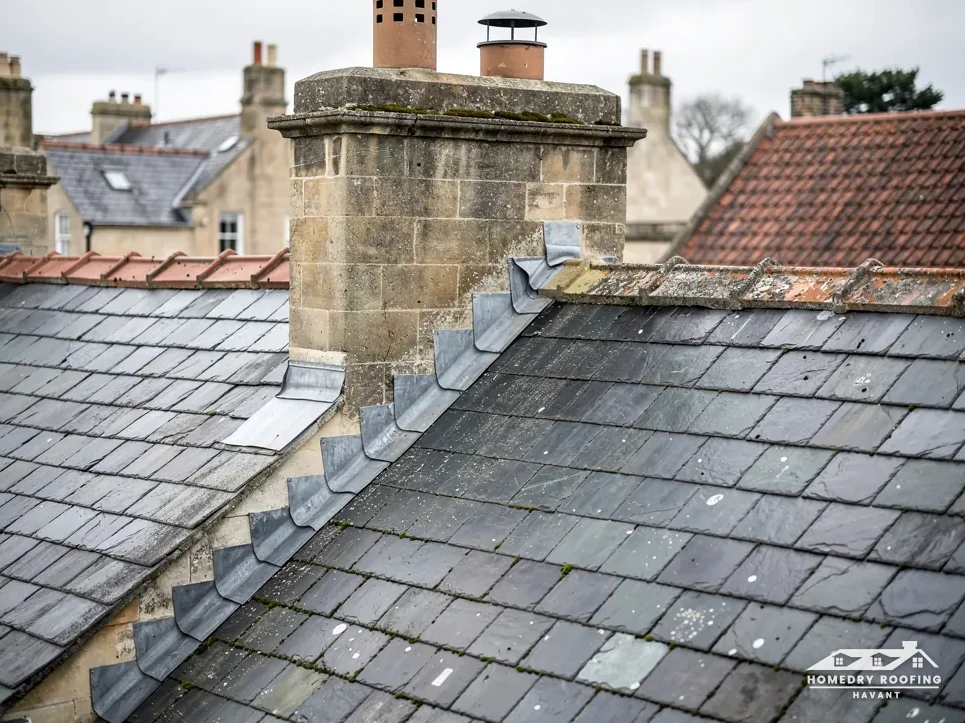
Where a stack comes up out of the slope and a flashing collar wraps its foot.
A gap at the collar or a crumbled joint above it feeds water down beside the flue.
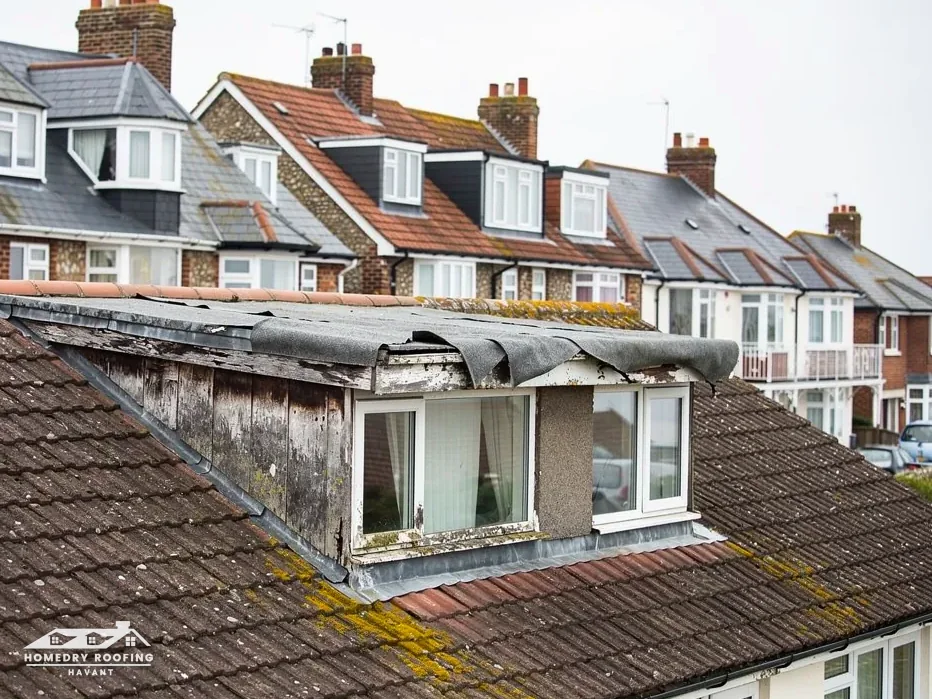
The one low spot where a flat roof empties into its pipe.
A blocked outlet leaves a pond that tests every seam in the covering.

Where roof meets wall, the metal has to do what the covering cannot.
A roof slope that stops short of open air runs into a house wall, a party wall or a chimney, and the seam between slope and masonry is closed by flashing: a strip of lead or another metal, tucked into the brickwork along its top edge and laid over the covering below. In Lindford we read each flashing along its whole length for lifted edges, gaps, and mortar that has crumbled where the metal is let into the wall. Around a chimney there are four faces to check, plus the trough behind the stack where water collects before it is shed to either side. MyJobQuote says correctly installed lead flashing can last for over 80 years, which is why a sound strip is refixed in place and not stripped out. Where a flashing has failed along one short stretch, that stretch is replaced and tied into the sound lead either side, because a patch laid over a bad edge leaves the bad edge in place. Our leadwork page describes the metal, and chimney repairs covers the stack above it.
The National Heritage List records Watermeadow Farmhouse, Hatch House Farmhouse, and Headley Mill and Adjoining House as Grade II. A listed house still has permitted development rights for a roof, yet any work that touches its character also needs listed building consent. Headley Mill and River Wey are conservation areas near Lindford, and East Hampshire District Council can tell you from its boundary maps whether your address sits inside either of them. Put the question of any Article 4 direction on your own road to East Hampshire District Council directly. Where one applies it can withdraw further permitted development rights, and the council can say whether it touches your house. The planning guide for roof work sets out the rules, and we leave them there.
The seam between metal and brick is where a wall joint first shows its age. We press along the flashing for a lifted edge, tap the mortar above it for a hollow note, and look indoors for a stain below the same wall. The finding says whether the metal can be refixed, or the pointing renewed, before any new lead is described.
A brown patch creeping across a bedroom chimney breast, or a damp line running down beside the wall of a side extension.
A lifted flashing edge at the top of the metal, or pointing that has dropped out of the groove above it.
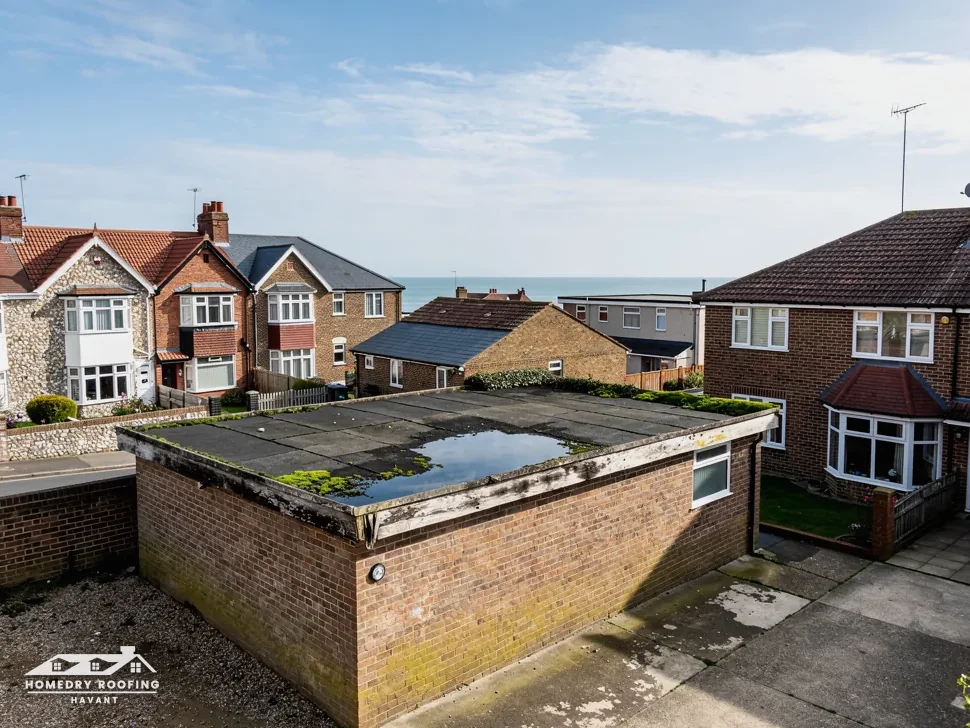
The outlet may be blocked with leaves and grit, or the roof may have settled so the water no longer runs to it. We clear the opening first and then see which way the water runs, which shows whether the fall or the outlet is the fault.
No flat roof is truly level. It is laid to a slight fall towards an outlet, and BS 6229:2025 sets a minimum finished fall of 1:80 for membrane flat roofs, so the roof is designed to a steeper fall than that, which gives the builder some margin. On a Lindford flat roof we follow the route the water takes: the surface, the seams, the upstand (the short vertical lip of covering at a wall), and then the outlet and whatever it empties into. Water still lying there a day after rain means the fall has gone slack or the outlet is choked with debris, and each wants its own cure. Our flat roofing page sets out the covering options if a roof has passed the point of repair.
The upstand gets a close look because a split or a lifted corner there lets water run behind the covering and down the wall. We also check the edge trim at the front, where the covering is lapped over the roof edge, and the junction with any rooflight upstand, since each is a joint made by hand.
Extensions and garage roofs are surveyed in the same way as the main house. A rainwater pipe from the outlet is traced down to the spot where it discharges, because a flat roof draining into a choked pipe is a pond waiting to form. A flat roof with a ceiling below it can be read from underneath for staining along the line of the joists, and from above for the pool marks left by water that has stood and dried. When we have finished, you hear whether the covering should be mended or relaid, and why, and a repair that matches the fault is preferred to a bigger job wherever the evidence supports it.
A flat roof is a slope you cannot see, and the outlet is where it ends.
Standing water on a flat roof and water coming through it are different problems that sit close together. A pond above a sound covering needs the outlet cleared or the fall corrected. A pond over a split seam needs the covering mended. We lift the debris, watch where the water drains and read the ceiling below, so the two are separated before any figure is written.
We look at the metal on every face of the stack, then at the joint where it is let into the brickwork, since a lifted edge or missing pointing there is how water gets behind it. The trough on the uphill side gets a clear look for leaves and silt. In the loft we read the chimney breast for staining that agrees with the outside. The result is a written finding that says whether the flashing can be refixed, repointed or replaced, with photographs of each face, so the reasoning can be checked against what you see on the roof.
The Planning Portal sets the test. For a Lindford house, that means no building regulations application in the normal way if the job touches less than 25 per cent of the building envelope and less than 50 per cent of the roof, and approval whenever the new covering is 15 per cent or more heavier. For a Lindford address, East Hampshire District Council's building control service handles queries on the application process and books inspections on 01730 234207. Before any tile is lifted we take the job to that service, then give you its reply in plain words, so the decision is yours and rests on what the council has said.
Hampshire County Council is the licensing body, and it says "Scaffolding companies must apply on behalf of their customers." The fee is £211.90 on application for the first 2 weeks, then £72 for each additional 2-week period. Ten clear working days must separate application from start. We arrange it with our scaffolder. The timetable is shaped by that notice period, so a start date goes into the diary only after the application has been made, and it is confirmed with you before any pole is raised over the pavement or verge.
Only for the listed building itself. Watermeadow Farmhouse and Hatch House Farmhouse are Grade II, as is Headley Mill and Adjoining House, but a listing covers one address and does not spread next door. Should your own house carry a listing, listed building consent under section 7 of the Planning (Listed Buildings and Conservation Areas) Act 1990 is where works that change its character go, and East Hampshire District Council decides it. Historic England's list can be searched with your address, and if one exists, say so when you are booking the survey.
They make the council the first call before a roofer is. Ordinary re-roofing is normally permitted development even in a conservation area, and an Article 4 direction can remove further rights, so we check with the council first. The boundary maps are held by East Hampshire District Council, and a road on the edge of an area can fall on either side of the line, which no one can judge by eye. Read our planning guide if you want the wider roof rules and where each comes from, before you pick up the phone.
The council is the one to answer that for your address, so the sensible move is to put the question to it. An Article 4 direction can withdraw permitted development rights across a defined area; only the council can place your address inside or outside one. East Hampshire's list of directions names sites and not streets of houses, which is another reason to ask about your own road. Write to East Hampshire District Council about your own address, have the reply put in writing and filed with the job papers, because it may be wanted again if you sell.
Check the ceiling below after rain, and note where the stain lies. A mark under the outlet line suggests water has backed up from a blocked opening, while a mark under a seam or the wall edge suggests the covering has opened. Then look at the surface for pooling and at the upstand for lifting. If you would rather not go on the roof, photographs from a ladder at the eaves are a fair start, and the survey does the rest, naming the place it gets in before any repair is proposed.
It should name the flashings and stacks it covers, say whether the metal is refixed or renewed, and declare VAT and scaffold inside the figure or outside it. Ours arrives as one written total price once we have been up and looked, and the findings it rests on. Where a repair is enough, that is what is quoted first, at a fair price. If a rival quote is silent on either point, ask that firm to write both in, so that the two figures can be set level before you choose between them, and the gap is the real one.
You'll get one written total price.
Fill in what you like. It opens WhatsApp with your message ready to send.