
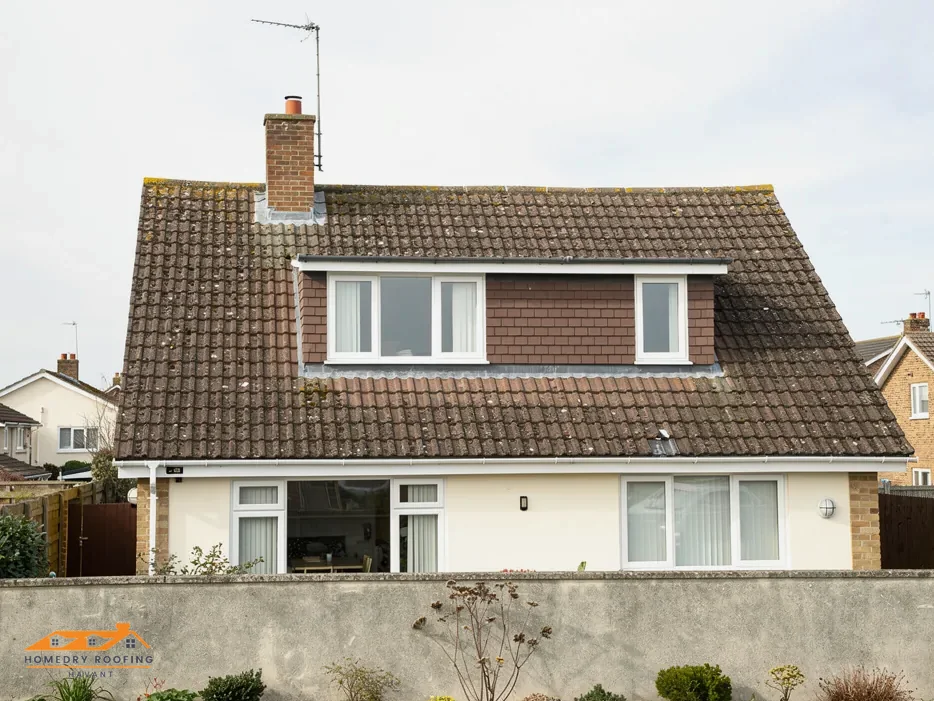
Underlay
The sheet laid over the rafters beneath the covering to catch what gets past it.
A torn or sagging length shows from the loft as a dark patch on the timber.
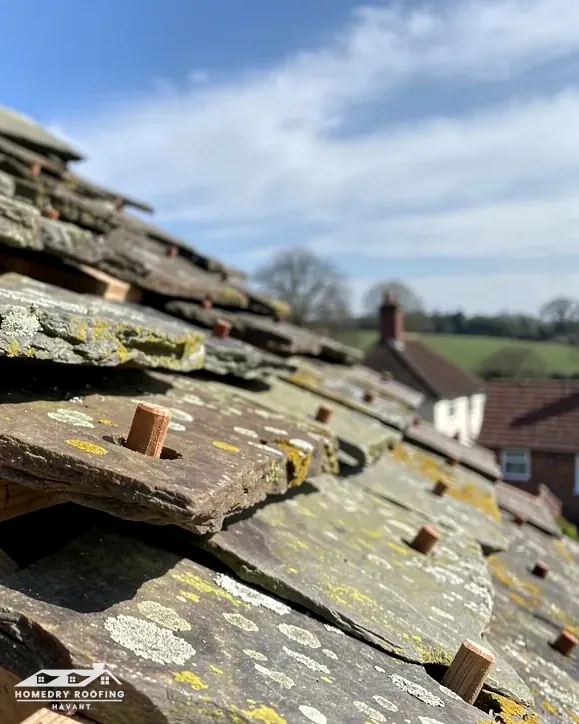
Headley is 25.4 road miles north of Havant; underlay, battens and eaves there are read from the loft and then the ladder, with one written total price to follow.
10-year workmanship guarantee, in writing
The sheet laid over the rafters beneath the covering to catch what gets past it.
A torn or sagging length shows from the loft as a dark patch on the timber.

The timber strips fixed over the rafters, which carry every tile or slate.
When a batten rots, the tile on it can slip, and rain comes through the gap.
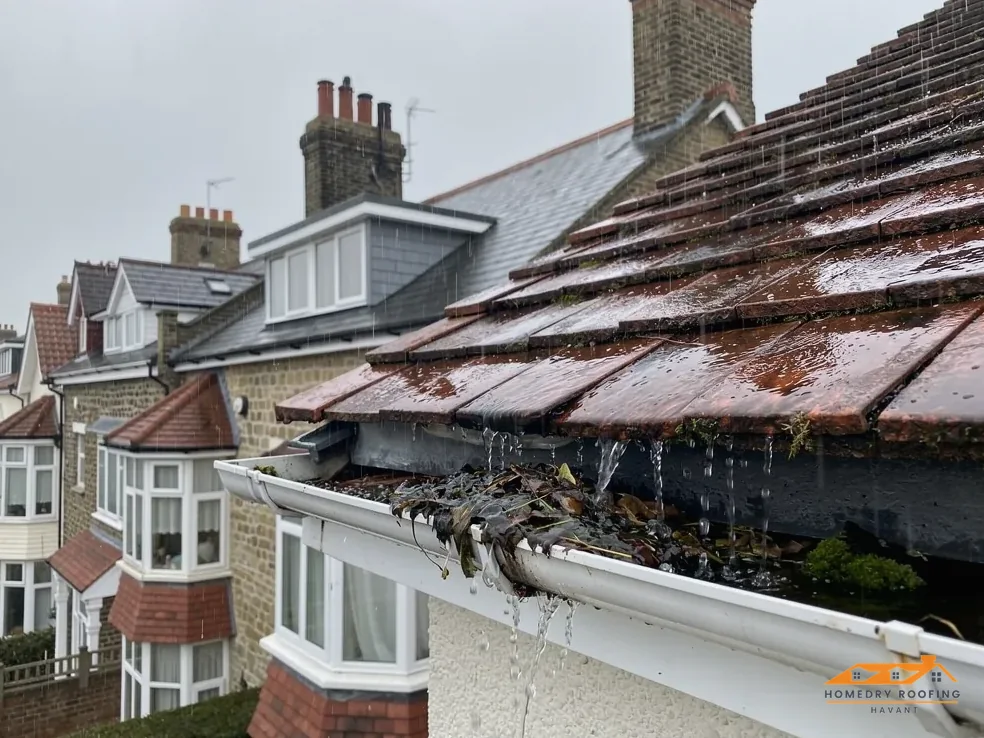
The board under the roof edge that closes the space between wall and rafter ends.
A brown tide mark along it points to water that has got behind the gutter.
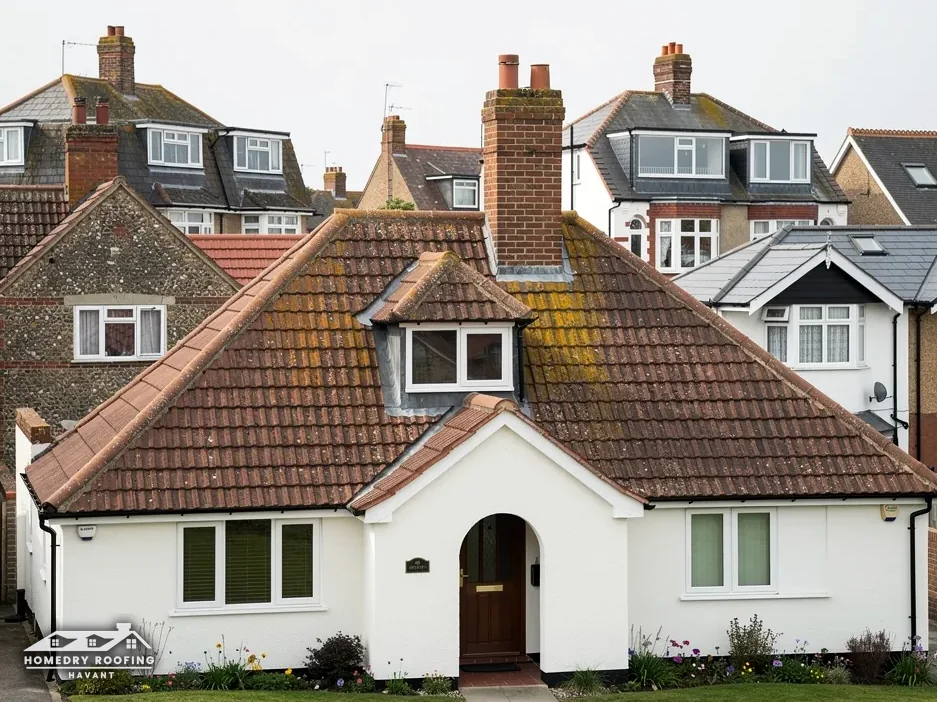
Read together, daylight and a tide mark show how water got in.
A torch in the loft can settle an argument that the outside of a roof cannot. Under the tiles or slates lie the battens they hang from, the rafters that carry the battens and, on a pitched roof, a sheet of underlay laid over the rafters to catch whatever the covering lets by. In Headley the torch goes up first, picking out daylight through the covering, tide marks on rafters and battens, torn or sagging underlay, and timber left dark or soft by standing water. Each sign is set beside what the ladder showed on the same stretch, so a repair is proposed only when the evidence from both sides agrees. Where the two disagree, we look again before anything is proposed, because a roof patched on a guess is paid for twice. Our roof inspections page explains how the findings are written up, and roof repairs covers the work that follows from them.
Headley lies in East Hampshire, and its list entries and conservation areas are the place to begin when a roof job is planned. Grade II listed, the Church of All Saints is still in use for Church of England worship, so any roof work there goes through the Church of England's faculty system, with no listed building consent from the council. The National Heritage List also has Suters at Grade II* and Yeomans Place at Grade II. Headley Arford and Headley are the two conservation areas near the village, and which side of a boundary your own house falls on is a question for East Hampshire District Council. Whether an Article 4 direction reaches one road is also for the council to answer, so put that question as well. The planning guide for roof work sets out the rules.
Daylight through the covering looks alarming and can be harmless, while a faint tide mark on a rafter can matter more. Neither means much alone. We note where each sign lies along the roof, photograph it, and go outside to find what sits above it, because the pair together tells us whether water has got in, how far, and how often.
A ceiling stain that appears only after long rain, or a musty smell in the cupboard under the roof slope.
A torn length of underlay, a slipped tile above it, or a batten that has rotted at the end.
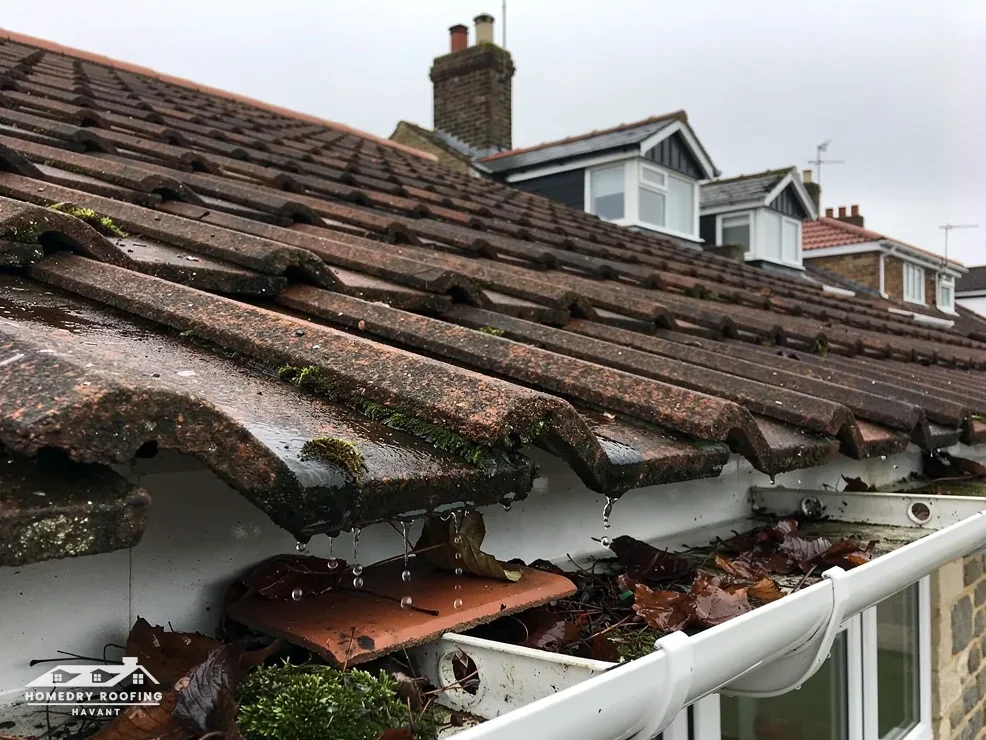
Paint will hide the mark but not the cause. If water is still getting behind the gutter, the board will stain again and the timber behind will keep soaking. We find where the water comes from first, then decide whether the board needs only a repaint.
At the lower edge of a pitched roof the covering overhangs the wall, and three parts take over from it: the fascia, the upright board across the rafter ends, which holds the gutter; the soffit beneath it; and the gutter itself. We read them from the ladder as one assembly because a fault in one shows up in the others. An overflowing gutter soaks the fascia behind it; a fascia that has gone soft lets the gutter sag; and a soffit stained brown from above can mean that water has been getting behind the board. Our gutters, soffits and fascias page lists what renewal involves.
The eaves are also where the loft and the outside air meet. A slot or vent in the soffit lets air move through the roof space, and we keep it open during any work on the boards, never painting over it or packing it with insulation. Where timber has failed over a short length, we replace that length and leave the rest, because stripping a whole elevation that is sound adds cost with no benefit to the roof, and it lets paint and joints that are doing their job stay as they are.
Behind all this sits the gutter's journey to the ground. We follow each downpipe to where it empties, since a pipe that empties onto the face of a wall will stain it, and the stain can read from indoors as a fault in the slope. Whatever we find, the written findings say what is wrong, where it is, and whether the cure is a clean, a refix or a renewal. We sweep up before leaving, and nothing is left behind in the gutter, on the path or on the lawn, which includes the moss and grit that came out of the run.
The eaves are where the roof lets go of its water, and where it shows.
A fault in the soffit or the fascia has a cause above it. A brown mark across the soffit points to water that has run behind the gutter, and a soft fascia end points to an overflow that has been going on for a long time. Reading the boards tells us where to look in the gutter, so the cure goes to the source and not to the symptom.
It shows where water has been, which the covering hides from outside. Under the tiles we look for daylight, tide marks on rafters and battens, underlay that has torn or sagged, and timber gone dark or soft. A slipped tile that looks serious from the ground may have caused nothing, while a clean-looking slope can sit above a wet rafter, and only the loft shows which case you have. We record each sign with a photograph and where it lies along the roof, then match it to the outside, so the repair is described only where both agree.
Start with the Planning Portal's test. On its figures a Headley job touching under 25 per cent of the building envelope and under 50 per cent of the roof stays clear of a building regulations application as a rule; a new covering 15 per cent or more heavier still requires approval, whatever the share. In Headley, East Hampshire District Council's building control service takes questions about the application process and inspections on 01730 234207. We speak to that service before the work is booked and report back what it says, and a structural check is advised before a heavier covering goes on.
A scaffold on or over the highway needs one. Hampshire County Council issues it and says "Scaffolding companies must apply on behalf of their customers." Its fee is £211.90 on application for the first 2 weeks and £72 for each additional 2-week period, and the council wants ten clear working days to run between lodging and the planned start. We arrange it with our scaffolder. That wait is why no first working day is promised until the application is in, and why you hear the licence dates the moment they are known, by phone or in writing.
Not through the usual route. The church is Grade II and still in worship use for the Church of England, so its roof works follow the Church of England's faculty system rather than listed building consent from the council. That arrangement belongs to the church while services continue. Where a private house has an entry in its own right, it follows the council's route instead, so check the National Heritage List against your own address before any date is fixed with a roofer, and tell us what you find when you book, so the survey notes the consent route from the start.
Not by name. Each list entry names its own building, so Suters at Grade II*, Yeomans Place at Grade II and the Church of All Saints each stand on their own entries. If your house has one, listed building consent under section 7 of the 1990 Act is the route for work that alters its special character, and East Hampshire District Council decides it. Historic England's list can be searched by address, and if you find an entry, say so when you book, so the survey records the consent route first.
They matter at the council desk before they matter on the roof. A plain re-cover of a house roof normally stays within permitted development, conservation area or not, though an Article 4 direction can take further rights away, which is why we call the council first. East Hampshire District Council places an address in Headley Arford, in Headley or in neither. A house at the edge of an area can sit either side of the line, so ask for the answer in writing, and keep it. The planning guide on this site goes through the wider picture for anyone planning more than a re-cover.
The council answers that, not a roofer, so ask and do not assume, whatever a neighbour may have been told about a nearby road. An Article 4 direction can withdraw permitted development rights across a defined area. Send East Hampshire District Council your full address and ask whether any direction applies, then keep the reply with the job papers. It takes a few minutes now and can save an awkward conversation at a sale, when a buyer's solicitor asks what was done to the roof, and under what permissions.
Look for three things: a description of the covering and what will be done to it, a plain line on VAT and scaffold, and findings you can check against the roof. Ours arrives as one written total price after the loft and ladder survey. Where a repair would do the job, that is priced first, the reasons spelled out and photographs attached, at prices we hold to be good and fair for the job. Should another quote say nothing about VAT or scaffold, ask that firm to add both before you compare totals, because a figure that looks lower can leave out costs that arrive later.
You'll get one written total price.
Fill in what you like. It opens WhatsApp with your message ready to send.