
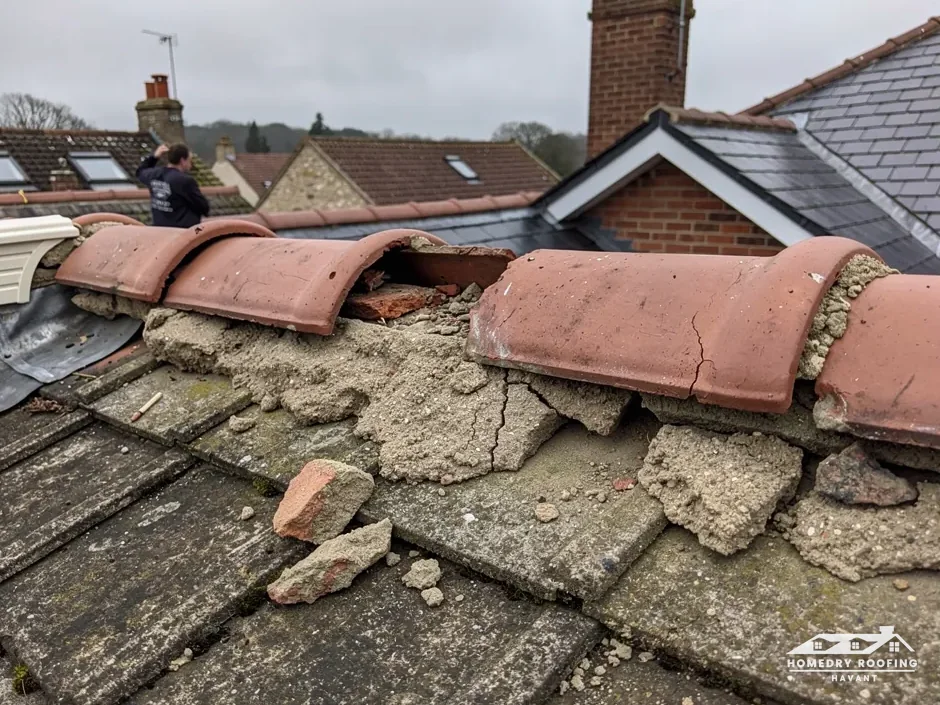
Ridges
The topmost line, shared by two slopes, with capping sitting along it.
Capping that has shifted or lost its fixing lets rain slip down beneath it.

Bordon is 23.2 road miles north of Havant; ridge lines, flat roofs and outlets there are traced to their source before one written total price is given.
10-year workmanship guarantee, in writing
The topmost line, shared by two slopes, with capping sitting along it.
Capping that has shifted or lost its fixing lets rain slip down beneath it.
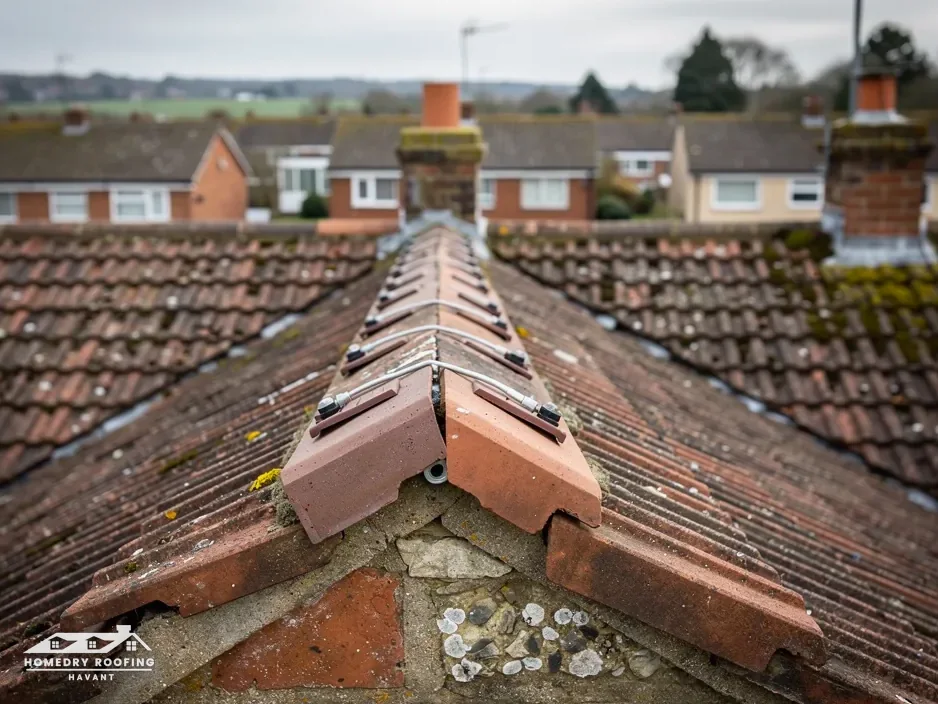
The sloping joints that run down from the ridge at the corners of a roof.
A gap where the hip leaves the ridge shows up as daylight in the loft.
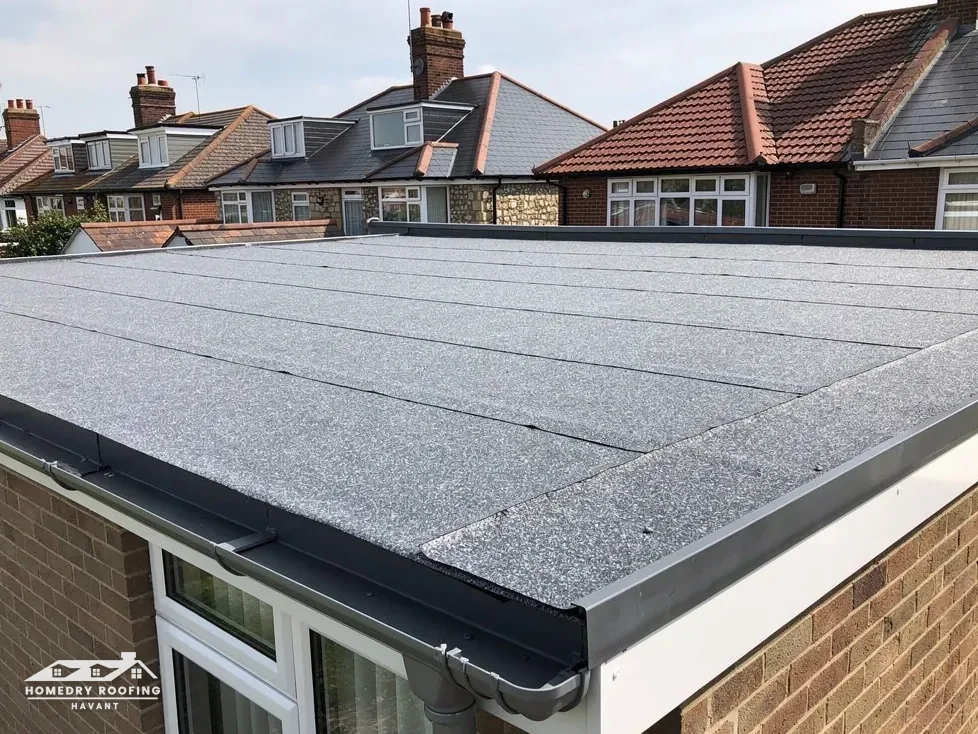
The drain openings through which a flat roof sends its rain to a gutter or pipe.
Leaves and grit in the opening leave water lying on the covering instead.
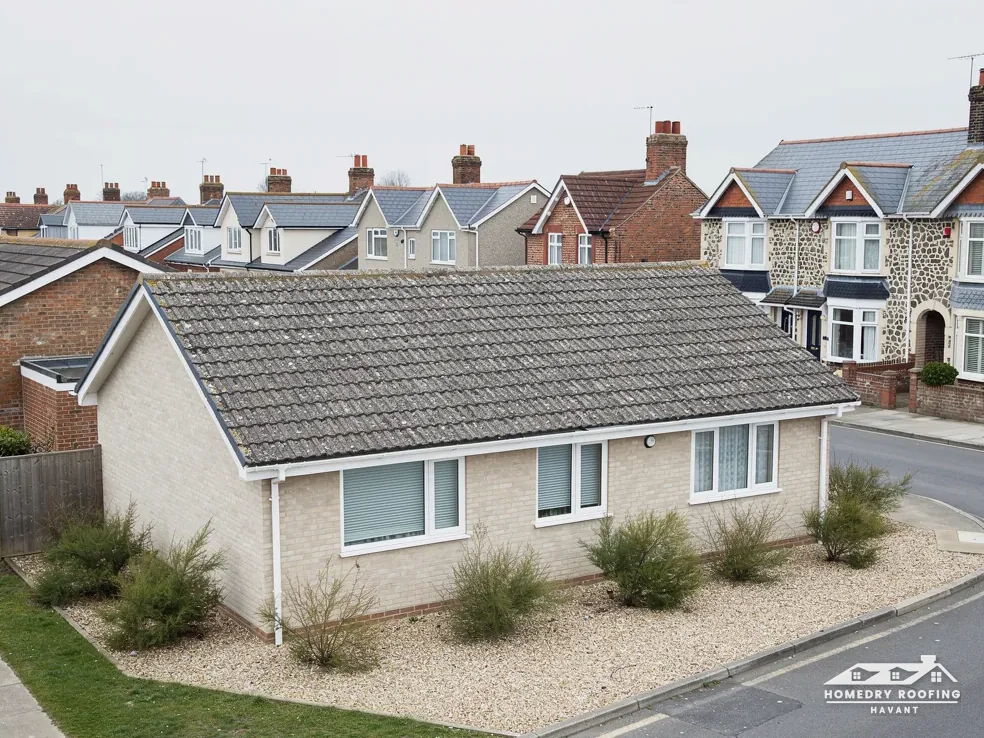
The ridge is exposed first, which is why its fixings are checked first.
Along the top of a roof the two slopes meet at the ridge, and its capping pieces take the weather first. Marley says BS 5534 requires mechanically fixed ridge and hip tiles, which is why a Bordon survey looks at what holds each piece down as well as at the piece itself. BS 5534 is a code of practice, not law, and Marley adds that mortar alone can no longer be relied on as the only means of securing the roof covering, so a ridge that depends on bedding alone is noted and explained. We look for capping that has shifted, cracked or lost its bedding, for gaps where the ridge meets a hip or a gable, and for daylight at the same spots from the loft. A slipped slope is a different fault from loose capping, and the survey tells the two apart, because one is mended at the ridge and the other lower down the slope. Our dry ridge and verge page describes the mechanical alternative to mortar, while the same visit takes in what a repair would involve.
The National Heritage List gives Grade II status to Woodlea Primary School and to Chase Farmhouse in Bordon. Those entries concern the school and the farmhouse alone. A house that is itself listed needs listed building consent for work affecting its character, in addition to the permitted development rights that still apply to its roof, so look your own address up before anything is ordered.
Conservation areas around Bordon include River Wey, Headley Mill, Blackmoor and Headley. East Hampshire District Council can say whether your road lies inside any of them, and whether an Article 4 direction touches your address, so check with East Hampshire District Council before work is planned. Our planning guide for roof work sets out the permitted rights that apply in other cases.
Capping that looks tidy can still be loose, because the fixing is what matters and the fixing is out of sight. We test each piece by hand along the ridge, the hips and the gable ends, and we note any movement. If a few pieces are at fault they are refixed; if the bedding has failed along a whole run, the survey says so, and the dry-fixed alternative is explained.
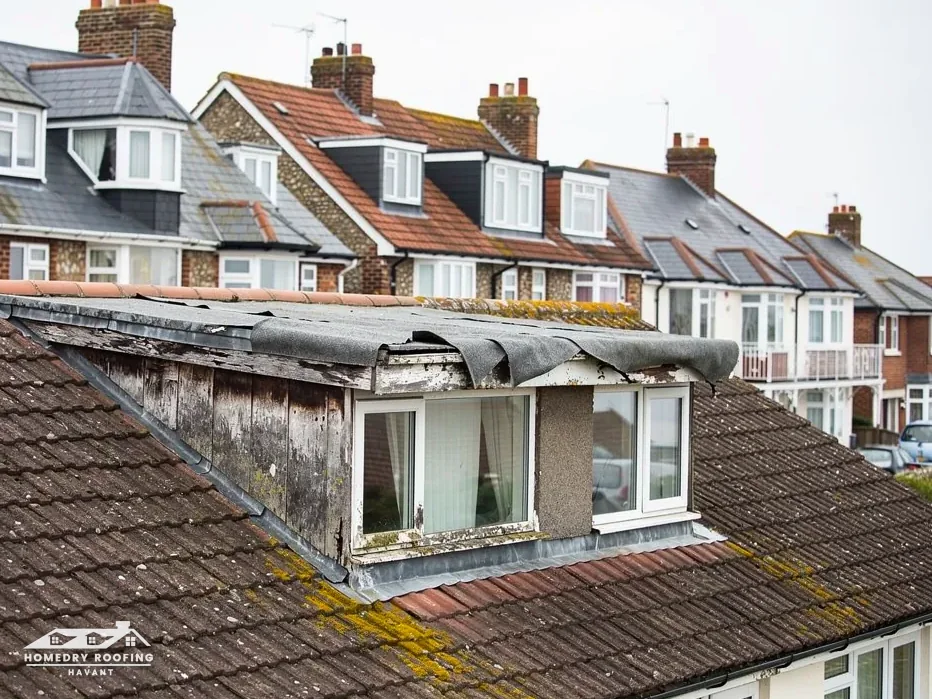
The route of the rain is the same, so the checks of fall, upstand, outlet and gutter overlap. A business unit adds questions of size and access, which is why it is quoted after its own survey.
Flat roofs are read from the outlet backwards. We find where the water is meant to leave, then follow the covering up its fall to the upstand against the house wall and along every joint. Ponding, blistering and splits show where the fall or the covering has failed, and a blocked outlet is cleared before any conclusion is drawn. We also read the joints in the covering and the state of the edge trim, where a lifted strip lets rain in at the perimeter. The gutter and downpipe it empties into are checked in the same visit, because a flat roof that sheds its water into a failing gutter just carries the problem further along the wall. Our flat roofing page explains the coverings, and the survey says if a patch is enough or the roof should be relaid.
East Hampshire's list of Article 4 directions names three sites in Bordon: Woolmer Industrial Estate, High View Business Centre and Wolfe Lodge. They are named sites, and nothing in the list says that houses in the town are caught, so for an address near any of them the question goes to East Hampshire District Council. Business premises have their own footing, and our commercial roofing page describes how a non-domestic roof is approached.
Bordon lies in Whitehill parish. Building control here is East Hampshire District Council's service, and Hampshire County Council licenses scaffold on the highway. Both are explained in the answers below, with the numbers and the notice each one needs, so that nothing about the paperwork is left to be discovered after the work has begun. If your roof is a flat one on an extension, the same two answers apply to it. Send us a photograph of the outlet beforehand if you can reach one safely, and the survey can start from it.
On a flat roof the outlet is where the whole story ends.
Starting at the outlet tells us more than starting at the edge. If the outlet is clear and the water still lies, the fall is at fault; if it is choked, the roof may be sound. We photograph the outlet and the pool together, so the report can show why a clearing job was enough, or why the covering needs relaying.
A pool on the surface that is still there days after the rain, or a brown ring on the ceiling below it.
A choked outlet, a split in the covering at the upstand, or a fall too slight to carry the water away.
The capping is the visible part; the fixing under it is what counts. We test each piece by hand for movement, look for cracks and lost bedding, and check the joints where the ridge meets a hip or a gable end. From the loft we look for daylight and staining at the same places, and for the timbers beneath. The survey separates loose capping from a slope that has slipped, because the repairs differ, and the report shows the finding in photographs, so you see the same things we saw before the written price arrives, and so a second opinion, if you want one, has the same evidence to look at.
Two tests from the Planning Portal decide it. The first is size: work touching under 25 per cent of the building envelope and under 50 per cent of the roof normally needs no building regulations application. The second is weight: a covering 15 per cent or more heavier needs approval. Bordon addresses deal with East Hampshire District Council's building control service, whose line, 01730 234207, takes application queries and inspections. We check the position with that service before booking a date, and you get the answer written down, in plain words, before any date is fixed with you or with the scaffolder.
Hampshire County Council is the licensing body for scaffolding on the highway, and requires ten clear working days from the application to the date the licence is meant to begin. The Hampshire County Council fee is £211.90 on application for the first 2 weeks and £72 for every additional 2-week period; a job that runs longer needs a fresh application, since the council does not offer extensions. Hampshire County Council says: "Scaffolding companies must apply on behalf of their customers." We arrange it with our scaffolder, so the programme we give you has the notice built in and you are not left waiting on a licence after the materials have arrived.
Both are Grade II on the National Heritage List, and those entries govern the school and the farmhouse, not their neighbours. If your own house has an entry, listed building consent reaches work that changes its character. Roof work on a listed house can still be permitted development, but the consent is required in addition, so the sequence matters: find out first, then agree the work, then book a date. Searching the list for your address takes a few minutes, and it prevents a misunderstanding that would be costly to put right once a covering has been stripped.
Those three, with Headley, all lie around Bordon. Whether your road lies inside one is something only East Hampshire District Council can confirm, so ask the council before the survey and tell us what it says. An ordinary re-roof on a house is normally permitted development in a conservation area, and the planning guide on this site explains the rest. The survey notes will record whatever the council tells you, which leaves your papers complete for the day work starts, whoever asks to see them.
East Hampshire's list names Woolmer Industrial Estate, High View Business Centre and Wolfe Lodge as sites with an Article 4 direction. They are named sites, and the list gives no sign that houses in the town are covered. A direction removes rights only where it applies, and East Hampshire District Council holds the answer for your address, so check with East Hampshire District Council before work starts. Tell us what it says, and the survey sheet will carry it with the findings from the roof, so that the two sets of facts sit on one page.
The method carries over, because the rain takes the same route on any roof: ridge or upstand, slope or fall, gutter or outlet, downpipe. What changes is the context. Non-domestic roofs have their own rules and their own questions about access and who holds the repair duty, so a business unit is surveyed and quoted after its own visit, and the flat roofing and commercial roofing pages on this site describe both kinds of work. An extension roof on a house is handled as part of a house survey, with its outlet and upstand read alongside the main slopes.
It covers the whole job as one total, set down once the roof has been inspected from above and below, with the findings beside it in plain words and the photographs to back them. It says whether scaffold and VAT are included, which is the first thing to compare on any other quote you hold. Repairs are offered first when one would hold; where one would not, the photographs show why. The quote also names the covering that goes on, so the description you read is the work that gets done. Prices are good and fair; the garden, drive and pavement are swept before we leave.
You'll get one written total price.
Fill in what you like. It opens WhatsApp with your message ready to send.