
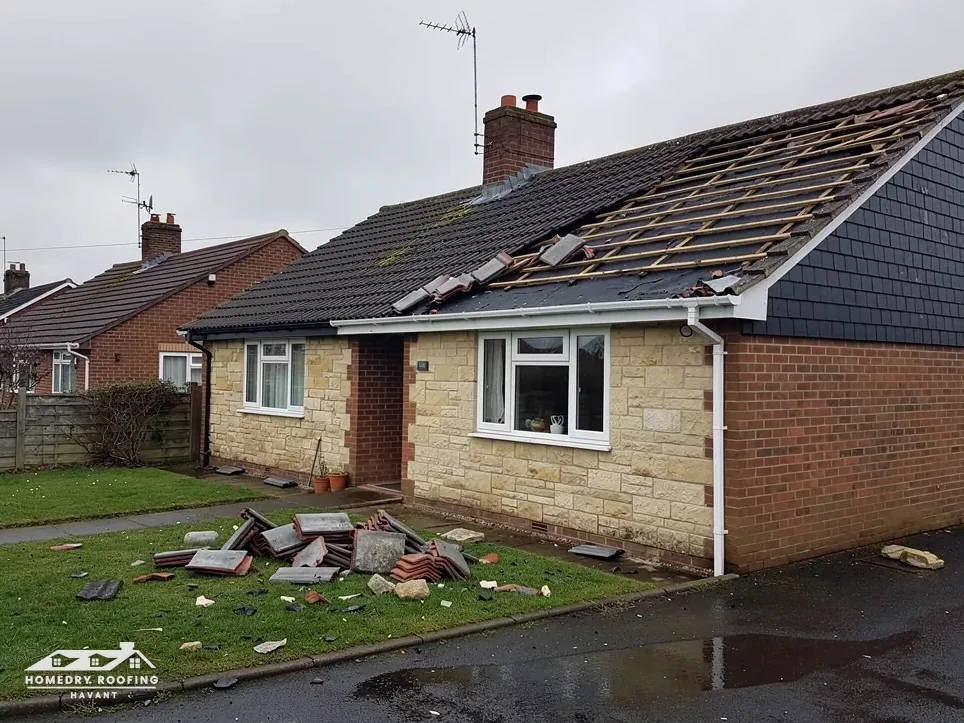
What battens and underlay each do
The covering you see from the road is the first line against the weather. Two layers sit under it, and a roof leans on both:
- The underlay, often still called felt, catches whatever gets past the covering and directs it down to the gutter.
- The battens are the timber laths running across the rafters. Every tile or slate hooks or nails to one, so they carry the covering and set its spacing.
Marley says the contents of BS 5534, the slating and tiling standard, include how battens are selected, how the covering is fixed and how wind uplift is worked out, along with ways to calculate the fixing specification. So the batten is a measured part of the design, and its size and spacing follow the covering that is going on. A roofer who talks about a roof in layers is describing it this way, each layer with its own job.
Neither layer can be seen once the roof is finished, which is the reason the strip matters. It is the one time the underlay and battens can be read at close range, instead of guessed at from the loft.
Old felt, or a breathable membrane
The underlay is chosen to suit how the roof is built. Marley's guidance on cold roofs describes two routes, with different ventilation needs at the eaves.
| Underlay | What Marley gives |
|---|---|
| High-resistance, not vapour-permeable | 25mm along the eaves at 15 degrees or less; 10mm above 15 degrees |
| Air-permeable underlay, ceiling well sealed | 3mm of eaves ventilation from normal construction, provided the UKAS third-party certification is fully in place |
A high-resistance underlay does not let water vapour through, so it relies on the air gap at the eaves. A vapour-permeable one passes moisture from the loft outwards. Which suits a given roof depends on its build-up and on the ceiling below it, and the survey settles that before the order is placed. Marley's figures are for a cold roof, where the roof space above the insulation is ventilated, so they do not describe every build-up, and the underlay's own data sheet sets the conditions that apply. BS 5250 is the standard on managing moisture in buildings, and BSI lists its 2021 edition as current, under review.
Our answer on the breathable roof membrane goes through what the term means and how it differs from a traditional sheet.
How the battens that stay are chosen
Reusing a batten is a judgement about its condition, and it is made when the covering is off and the timber is in plain view. A batten is checked for:
- Rot or damp, which shows as soft or darkened timber.
- Splits, especially along the nail lines.
- Nails that have lost their hold, or old nail holes where the new fixings would land.
- Spacing that fits the new covering, because a different tile or slate sets its own gauge.
A batten that fails any of those goes, and so does one that cannot take the fixings the new covering needs. Where the whole run has aged out, replacing every batten is cleaner than patching between sound and unsound ones.
You can ask the quote to say whether battens are renewed throughout or only where they fail. The loft shows clues from inside, such as stained timber or daylight where it should not be, and the survey records them. Our guide to when a roof needs replacing lists what the loft and the rooms below can show.
Standards, approval and what the quote says
BSI lists BS 5534:2014+A2:2018 as current. Marley says "Installing to BS 5534 isn't required by law", and that mortar "could no longer be relied upon as the only means of securing the roof covering". A roof laid to the code is laid to a recognised standard, and the specification names what goes on.
Approval is a separate matter. The Planning Portal's re-roofing test normally asks for no building regulations application when less than 25 per cent of the building envelope and less than 50 per cent of the roof is touched. Approval is needed for any covering that is 15 per cent or more heavier, and that choice can bring different battens with it. In Havant, we confirm the building regulations route with your building control body before work starts.
On price, one total is put in writing for you after the survey. Ask the quote to name the underlay and the battens as part of the job, and to show whether any VAT and the scaffold are in that total. The wider service is under new roofs.