
The renovation test in Part L
Part L of the Building Regulations covers the conservation of fuel and power, and Approved Document L Volume 1 deals with dwellings. Its paragraph 11.3 says the whole thermal element should be improved if either of two things is true:
- "More than 50% of the surface of the individual thermal element is renovated."
- The work is a major renovation, meaning more than 25% of the surface area of the external building envelope is renovated.
The Building Regulations define a thermal element as one that "means a wall, floor or roof (but does not include windows, doors, roof windows or roof-lights)". Paragraph 11.2(d) lists "Replacing the waterproof membrane on a flat roof." as renovation.
Re-covering a roof and renovating its thermal element are not always the same job, so the route is put to building control, not assumed. The Planning Portal's re-roofing test is a different question again, since it asks whether a building regulations application is needed at all, while Part L asks what standard the roof must reach. Building control is carried out by the council's building control team or by a registered building control approver. At a Havant address, your building control body is asked which route applies before any work is booked.
The figures the roof has to reach
The standard is a U-value, which measures how much heat passes through a building element, so a lower number is better. AD L 2021 sets these figures for roofs in existing dwellings:
| Case | Figure |
|---|---|
| Retained roof, Table 4.3 threshold | 0.35 |
| Renovated roof, Table 4.3 improved | 0.16 |
| New roof element, Table 4.2 | 0.15 |
Table 4.2 is for new fabric elements in existing dwellings, and Table 4.3 is for elements that already exist. Paragraph 4.12 says renovated elements should achieve the Table 4.3 column (b) figures, and that retained elements above the threshold, for example through a loft or garage conversion, should be upgraded to the same column. So 0.35 is the test for a retained roof, and 0.16 is the target for a renovated roof or for a retained one above that test.
Roof windows are held to the window figure (1.4, or Window Energy Rating Band B), and 2.2 is for rooflights only. How the roof figure is met, at the ceiling or at the rafters, depends on the build-up, so it is worked out for the roof in front of the surveyor.
When the full figure is out of reach
Part L allows for roofs where the improved figure cannot sensibly be met. Paragraph 4.13 applies where column (b) "is not technically or functionally feasible or" "would not achieve a simple payback of 15 years or less". The element is then taken to "the lowest U-value that both: a. is technically and functionally feasible and b. can achieve a simple payback not exceeding 15 years."
The paragraph adds that "Generally, a thermal element once upgraded should not have a U-value greater than 0.7W/(m2·K)."
So the rule is a test with a fallback, not a flat demand. The roof's build-up, the depth available for insulation and the cost against the saving all go into it. A survey can measure those, and the quote can show the result, without anyone guessing from the ground.
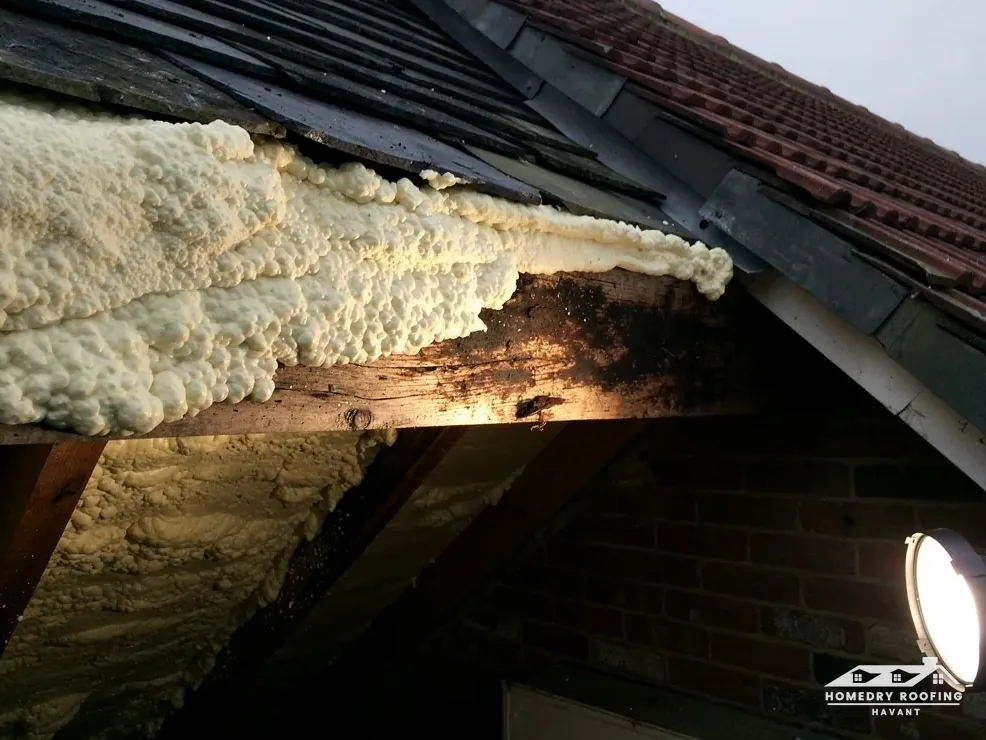
If your roof already carries spray foam, the Energy Saving Trust treats it as a permanent installation and says "you might also need to replace the structure it was applied to". Our spray foam removal pages cover that case.
The 2027 date and what to ask for
AD L 2021 took effect in England on 15 June 2022. AD L 2026 renumbers the tables to 3.2 for new elements and 3.3 for existing elements, and takes effect on 24 March 2027 for building work other than higher-risk work, and on 24 September 2027 for higher-risk work. Until then the 2021 figures above are the ones in force, and the 2026 edition is not the rule for work done now.
When you ask for a re-roof quote, put these questions in plain terms:
- Does the work renovate more than half of the roof?
- What U-value is the finished roof designed to reach?
- Is insulation included in the work and in the total?
Where a loft is being converted at the same time, a retained roof above the 0.35 threshold is a separate trigger, so say so when you ask for the quote. After the survey the quote gives you one written total, so the answers sit in the same document as the price. The wider test, including the weight limit on a new covering, is in our guide to Building Regulations for re-roofing, and the job itself is covered under new roofs.