
The first steps when a suspect material appears
A strip-out shows parts of a house that nobody has looked at in years, and a board or sheet that nobody expected can come to light on the day. The order of events matters more than speed:
- The person who found it stops and leaves it where it is, with no snapping, drilling, sweeping or brushing.
- Photographs record its position, its edges and any cracking.
- The surveyor is told, and the material is treated as asbestos until it is identified.
- The rest of the roof is planned around it, so the new covering is not laid against a board that is still waiting to be dealt with.
None of that needs a panic. Asbestos that is left whole is a known quantity, and the harm comes from breaking it up. A pause of a day to identify a board costs far less than a dusty mistake, and nobody in the house is asked to do anything except keep clear of the spot.
HSE adds that an asbestos cement roof is always fragile. Nobody stands on it to look, so the roof is read from below and from safe access arranged for the job.
Which parts of a house can hold it
HSE's own list of locations includes three items that sit on or beside a roof, and each one has its own likely spot on a house:
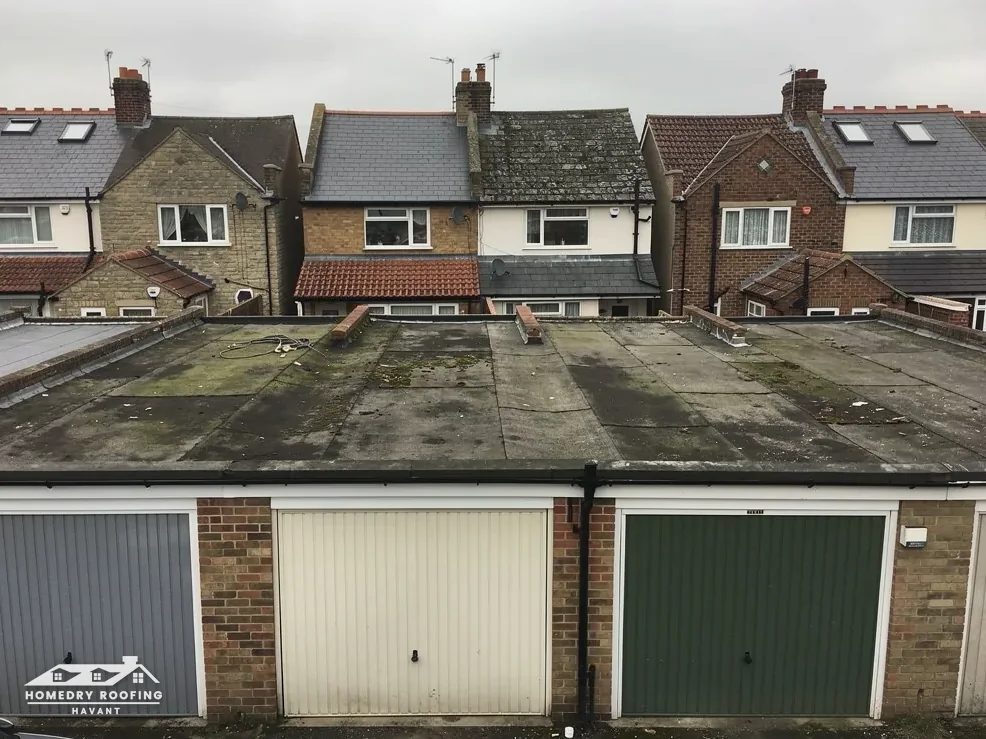
- Asbestos cement sheeting, found on garage and outbuilding roofs rather than on a house roof covered with tiles or slates.
- Asbestos cement rainwater goods, meaning old gutters and downpipes.
- Asbestos insulating board, which HSE lists as white soffit panels on the underside of the roof eaves.
That list is where the survey looks, and nobody should read it as a verdict on your house. A building built or refurbished before 2000 is the group HSE tells people to treat with suspicion, so the age of the house, and of any later work on it, is a fair question for the surveyor to ask.
The eaves are the part a re-roof touches most. Fascia boards, soffits and gutters come off or get opened up as the new roof meets the wall, and that is where insulating board is most likely to be met mid-job. It is one reason the survey asks to see the soffits before the quote is written, not once the scaffold is up.
How HSE sorts the work
HSE weighs the type of material against what the work will do to it. That gives three routes, and a roof job can land in more than one of them.
| What is happening to the material | Route |
|---|---|
| Cement sheet or gutter, taken off carefully and not broken | Non-licensed |
| Cement sheet broken up or substantially damaged | Notifiable non-licensed |
| Insulating board, short job as part of a refurbishment | Notifiable non-licensed |
| Insulating board, job not of short duration on the risk assessment | Licensed |
Weathering alone does not move a sheet out of the first row. HSE counts weathered cement as non-licensed, provided it is not otherwise substantially damaged. A cracked sheet, or one that someone has stepped through, is a different matter.
A single roof job can touch more than one row. Gutters and sheets from a garage may sit in the first, while the soffit board beside them raises a separate question, so each material is assessed on its own. If the risk assessment puts your soffits in the licensed row, the work follows that route and the written quote says so.
Waste, cost and who carries the duties
Waste has rules of its own. HSE's guidance calls for a lockable skip, and sheeting thrown over an ordinary skip falls short. GOV.UK's consignment-note exemption for domestic hazardous waste leaves out asbestos, so it does not cover household asbestos. A roofer's asbestos is trade waste that travels with a consignment note. Hampshire County Council and West Sussex County Council each publish their own rules for a householder's own small amounts, so check the council's page for your address before you load a car.
Published cost guides show the scale. MyJobQuote gives an average of around £2,750 to remove asbestos from a roof in the UK, and around £325 for an asbestos survey in 2026. They are another party's averages, and they cannot know your roof. After the survey we write down one total, and that quote should cover what happens if material is found.
CDM 2015 moves a homeowner's client duties onto the roofing contractor, or onto the principal contractor if several firms work on site. Each project also needs its own construction phase plan. The re-roof itself is covered under new roofs, and the guide on when a roof needs replacing explains how the survey sets the scope.