
Flat roof felt and underlay are different jobs
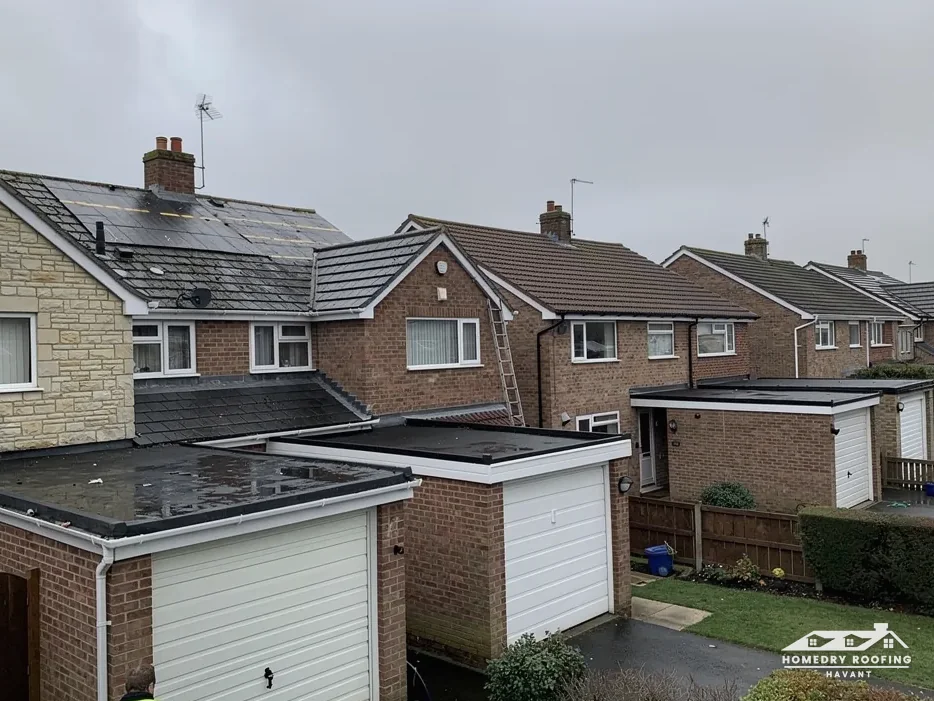
Roofing felt is a loose term that covers two very different jobs. On a flat roof, torch-on felt is the waterproof covering itself, laid in layers and open to sun, rain and frost. Under a pitched tile roof, the underlay is a sheet stretched across the rafters, hidden beneath the battens and the tiles.
The published lifespans belong to the first job. HomeBuilding gives 10 to 15 years for torch-on felt, and Less says "Torch-on felt lasts 10 to 20 years depending on quality and installation". Both describe a covering that takes the weather directly, so neither carries across to a sheet that sits under tiles.
That is why no number is given here for underlay. A figure borrowed from the flat roof would sound precise and mean nothing for your house. What can be said is that the sheet is a back-up layer, that it carries any water getting past the tiles down to the gutter, and that its condition is something a survey can read, whatever its age. A sheet can look tired from the loft and still be doing its job, and another can look tidy and have a hidden tear, so the inspection is of the sheet itself.
Two kinds of underlay and how the loft breathes
Marley draws a line between two kinds of underlay, and the kind decides what the eaves must do. HR stands for high resistance: vapour cannot pass through that sheet, so the loft has to shed its moist air another way. In a cold roof, Marley's figure is "25mm along the length of the eaves for pitches of 15° or less; 10mm along the length of the eaves for pitches of more than 15°."
- a cold roof has its insulation at ceiling level, with a cold loft above
- an HR sheet blocks vapour, so the eaves carry the ventilation
- an air-permeable sheet lets vapour through
Pair an air-permeable sheet with a ceiling that is well sealed, and Marley says "fortuitous ventilation at the eaves via normal eaves construction (3mm) is all that is required, provided the requirements of UKAS Third Party certification are fully met." Behind these figures sits BS 5250:2021 on managing moisture in buildings, which BSI lists as current and under review.
Our answer on ventilation at the eaves looks at that side in more detail.
Signs the sheet under your tiles needs attention
You cannot read an underlay from the street, but the loft gives clues. With a torch from the hatch, staying on the joists and never stepping onto the ceiling, look along the rafters for the following.
- a sheet that is torn, split or hanging in folds between the rafters
- damp or dark staining on the underside of the sheet or on the timbers
- daylight where the sheet should be continuous
- a brittle sheet that cracks when touched at the edge
- mould or water droplets on the rafters in cold weather
None of these proves the underlay is the cause of a leak, and each has other possible sources. Damp in a loft can come from a slipped tile, a blocked valley or air carrying moisture up from the house. What matters is tracing the route the water took, then finding which fault let it in. A stain that moves with the weather, or one that appears only after a night of rain, helps to narrow it down, so note when it shows and keep dated photographs.
Our guide to tracing and fixing pitched roof leaks follows that route from the stain on the ceiling back up the slope.
When the underlay gets replaced
The sheet is normally dealt with when the roof is stripped, because that is when it can be seen, lifted and renewed along with any battens that have gone. A repair gives less access. Around a repair we raise enough tiles to see the sheet and timber below, and report back on what was there.
That gives you two cases to weigh. If the sheet is sound near a repair, the repair can stay a repair. If it has failed across the slope, new tiles laid over a failed sheet only hide the problem until the next heavy rain, and a re-cover may be the better route.
Guessing the life of the sheet from the age of the house is not part of the survey. We read what is there, and the price is sent in writing after the survey. For the wider picture of work on a tiled roof, our pitched roofing page sets it out, and our guide to common pitched roof problems lists the signs that point to each fault.