
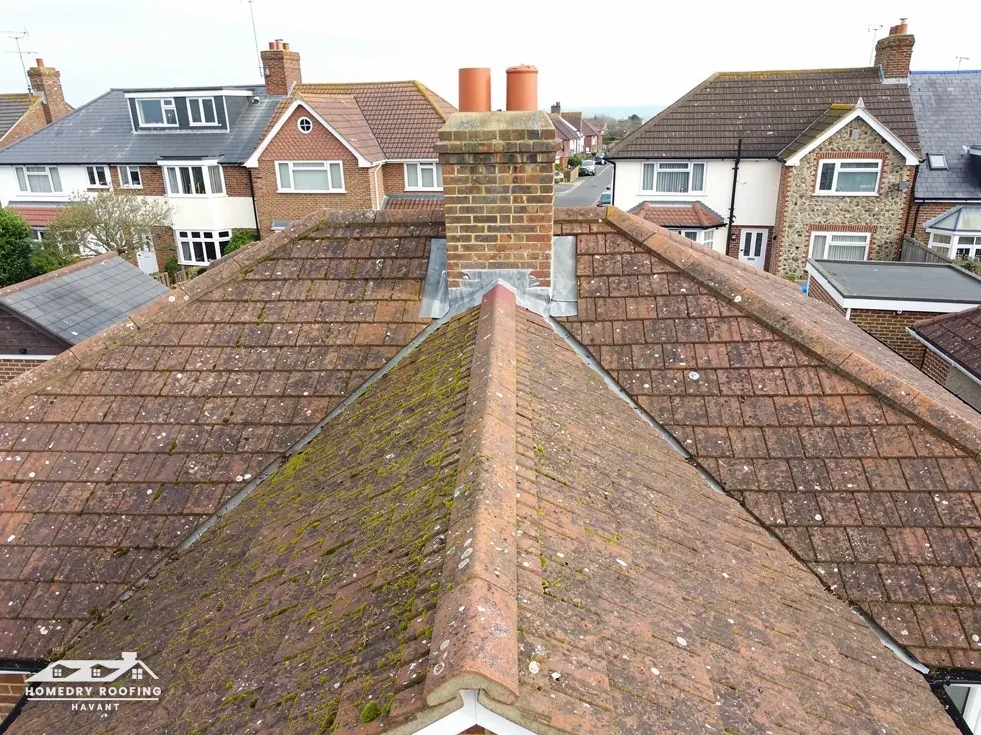
Look along a street of tiled houses and each roof has a crest of capping tiles where the two slopes meet, with more tiles running down the outside corners. For a long time those tiles were bedded in mortar and left to hold themselves there. The advice has moved on, and a quote for ridge work now has a question to answer that it did not use to face: how is each tile actually fixed?
The answer comes from BS 5534, the standard that covers slating and tiling work. This guide explains what that code is, what it is not, what Marley says about mortar, how mechanical fixing is done, why exposure changes the specification and what to ask for in a written quote.
The wider picture of dry ridge and verge work is on our dry ridge and dry verge page. This guide keeps to the single question of fixing.
Ridge and hip tiles and how mortar held them
The ridge is the crest, where two roof slopes meet. A hip is the angled run down an outside corner of the roof, where two slopes come together at a corner. Both are covered by a line of curved or angled tiles, because the slope tiles stop short of the apex and leave a gap that something has to close.
The older method sets each ridge tile on a bed of mortar laid along the crest. The mortar acts in two ways at once: it glues the tile to what lies beneath, and it fills the gap between the tile and the courses below.
That arrangement puts the whole load on the bond between mortar and tile. A ridge tile stands at the top of the roof, where the wind meets it without any shelter, and a bond that has weathered or cracked leaves the tile resting on whatever is left of the bed.
What a failed bed looks like
- Cracks along the mortar line, or dark gaps where mortar has dropped out.
- A ridge tile that rocks when touched, or one sitting out of line with its neighbours.
- Crumbs of mortar in the gutter or on the ground below.
None of these needs a ladder to spot. A look from the ground along each ridge and hip, with a phone camera zoomed in, is enough to decide whether to ask for a survey. Please leave the climbing to us.
What BS 5534 is and what it covers
BS 5534 is the code of practice for roofs that are slated or tiled, and BSI lists it as current. Marley, the tile maker, says its contents include "batten selection, methods of fixing, wind uplift formulas and a means of calculating fixing specifications". In other words, it deals with the whole job of holding a roof covering on, and ridges are one part of that job.
Two things follow from that, and both are worth keeping in view.
- The code reaches the ridge and hip tiles as part of the covering, because those tiles have to resist the wind as much as any others on the roof.
- The code gives a method for working out the fixing for a particular roof, rather than a single answer for every house.
A code of practice and a law are different things. Marley states it directly: "Installing to BS 5534 isn't required by law". The code describes how the work is done well, and a roofer, an insurer or a surveyor may all look to it when judging a job, but nobody commits an offence under an Act of Parliament by working to something less.
That is also why this guide never calls the standard the law. It is a way of doing the work that the trade has written down. Where a roof's fixing falls short of it, the gap is a matter of workmanship and risk, which a survey can weigh up for your own roof.
Listed status, or a home inside a conservation area, brings planning rules of its own, which our planning guide sets out.
A code of practice shows how the work is done well. It is not an Act of Parliament.
What the code says about mortar
Marley states that BS 5534 requires mechanically fixed ridge and hip tiles. On the mortar itself, Marley's words are that its tensile strength alone could no longer be relied upon. Put shortly, a bed of mortar is no longer trusted to be the only thing securing the roof covering.
The wording is careful, and it rewards a close reading.
- The target is mortar as the sole fixing, not mortar as a material.
- The code asks for a fixing that does not depend on a mortar bond holding.
- The words are about what holds the covering on, so a quote that says how each tile is fixed answers them.
For you, the useful reading is practical. If a ridge was bedded in mortar and nothing else, its fixing rests on a bond that weathers with time. If the roof is being worked on now, a quote can specify a fixing that holds each tile whether or not the mortar stays bonded.
Mortar is not banned, and a mortar ridge can be sound. The point of the code is the single point of failure, not the material. Some older roofs still call for mortar, and our guide on dry-fix on period and conservation roofs explains when it remains the answer.
The legal side is taken up in our answer on whether a dry ridge is a legal requirement, which gives the short form of what is written above.
What mechanical fixing means on a roof
Marley describes dry-fix as using "mechanical fasteners such as nails, screws or clips to secure roof tiles without a mortar bedding". The word to hold on to is mechanical. A mechanical fixing grips through metal and the shape of the part, not through a bond that can weather away.
On a dry-fix ridge or hip, the tiles are held by those fasteners instead of by a mortar bed. The details differ from one kit to the next, so a quote should say which one is meant and how it is fixed, in words you could repeat to a neighbour.
BS 8612:2018 is the specification covering dry-fixed systems for ridge, hip and verge work on slate and tile roofs, and BSI lists it as current. A system that comes with a fixing method written to that specification gives you something definite to check the quote against.
What a survey looks at before fixing
- The timber the fixing would go into, and whether it is sound.
- The tiles themselves: whole, cracked or already missing.
- The top courses below the ridge, because they carry the new line.
- Any earlier repair that has put new mortar over a loose tile.
Where one of those is poor, the quote says so and states what is to be done about it, because a fixing can only be as sound as the timber that receives it. A new line of tiles on a tired base is a new line of tiles on a tired base, whatever holds them.
The same survey looks at the hips and at the point where a ridge ends against a gable, since each is fixed in its own way.
Exposure and why each roof gets its own specification
Wind does not treat every roof alike. Cupa, a slate maker, says "Most significant is the environment, with the two main factors being exposure to wind and rain", and that "Buildings positioned on slopes, hills or coastal areas as well as tall buildings will be graded with higher exposure".
That sets up the central point about fixing. Coastal homes are graded for higher exposure, so the fixing specification is calculated for the site under BS 5534, and that calculation is what Marley says the code supplies: wind uplift formulas and a means of calculating fixing specifications.
Cupa names the things that raise the grading:
- A coastal position.
- A hill or a slope.
- A tall building.
- Wind and rain together, which Cupa calls the two main factors.
No wind figure is given here for any town. The calculation belongs to the survey of your own house, using your own roof and your own position, and a figure from the next street along would not be yours.
For you, the point is simple. A ridge fixing on a house in open ground, on a hillside or in a tall building is not copied from a neighbour's roof. It is worked out for that roof, and the written quote says what was used, so a second roofer can read it and see the same thing, and so the fixing can be checked against the code if anyone wishes to.
What to ask for in a ridge quote
Because the code is not law and mortar is not banned, the quality of a ridge job shows in how clearly the quote describes it. A quote you can check is worth more than one that is short. Ask for these in writing:
- How each ridge and hip tile is fixed, named in plain words: nails, screws, clips or a stated system.
- Whether the fixing is specified to BS 5534 for your roof's exposure.
- Whether any dry-fix system used is made to BS 8612:2018.
- What is done with the old mortar and the tiles that come off.
- One total price, and a note of what that price covers, with VAT and scaffold stated either way.
The price follows the survey. Published figures are given on our ridge tile replacement cost page, with their sources and dates, and they are a guide to the field and never a price for your roof.
If you are quoted something different
A quote that offers mortar alone for a ridge being renewed should say why. There are good reasons on some old roofs. If the reason is only that it is quicker to quote, ask what fixes the tile when the bond fails, and keep asking until the answer is in writing.
A quote that agrees with everything above is not proof that the job is right, but a quote that cannot answer any of it is a sign to ask again before work begins. Keep the written answers with the quote, so that the job and the paper can be compared when the work is finished.