
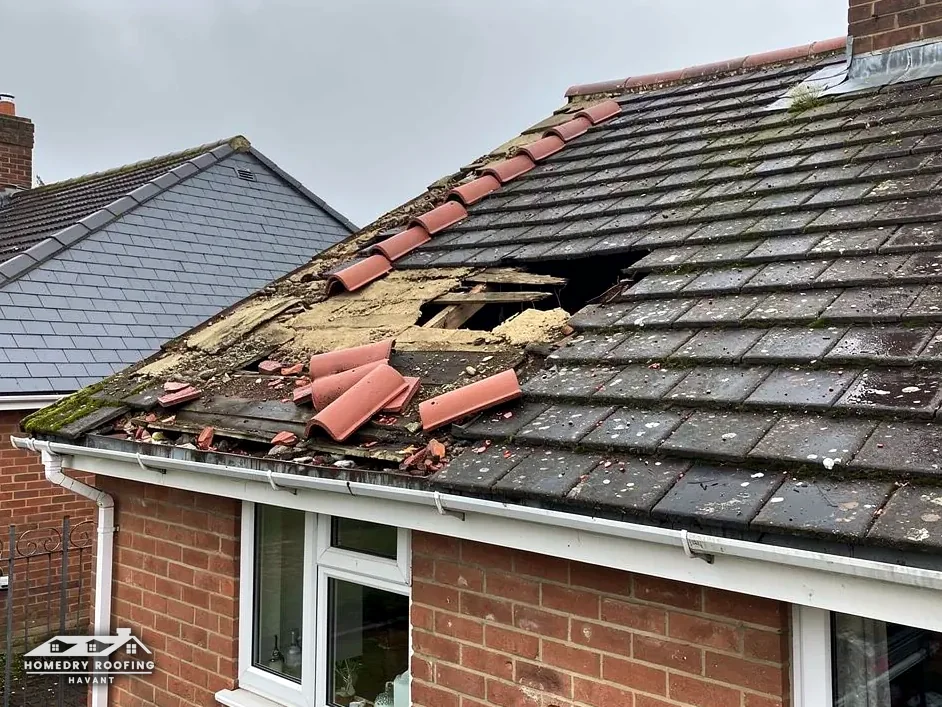
Dry-fix has become a recognised way to secure ridge, hip and verge tiles, and on a suitable roof it is a sound answer. A period house raises a second question beside the engineering one: is the roof protected, and does the protection touch the way the ridge is finished? A listed house, one inside a conservation area and one under an Article 4 direction are three different situations, and none of them is settled by guesswork. Each is checked, and each is written down before the work is priced.
This guide sets out the three situations, what the fixing standards say about mortar, when mortar is still the right answer, when dry-fix is the likelier one, how to ask the council, and what we check at a survey. It does not give a rule for any one designation, because the answer turns on the council and the property.
The main page on dry ridge and verge covers the work itself. This guide covers the question that comes first on an older or protected roof.
Listed, conservation area or Article 4: three situations
These three labels are often mixed up, and they work in different ways. The table separates them. Whichever applies, the first step is the same: find out which one you are in before a ridge is touched. It is worth confirming the status early, with the council, and keeping the answer with your house papers.
| Situation | What it brings | Who to ask |
|---|---|---|
| Listed building | Consent for work that changes how it looks and is built | The local council |
| Conservation area | Extra planning controls, though many roof changes stay permitted development | The local council |
| Article 4 direction | Permitted development rights withdrawn for what the direction names | The council that made it |
A listed house keeps its permitted development rights for roof work, yet listed building consent still applies to anything that alters its special character, so the two run side by side. Havant Borough Council states that it is a criminal offence to carry out works to a listed building without first getting permission from the council, even if you did not know the building was listed.
In a conservation area, Portsmouth City Council notes that many changes to doors, windows, roofs, chimneys and boundary walls remain permitted development, though in some cases special controls called Article 4 directions have been introduced. An Article 4 direction withdraws specified permitted development rights across a defined area. So a conservation area alone leaves a house re-roof as permitted development, while a direction inside it can take rights away, and only the council's own list tells you which streets and which works it names.
Find out which label your house carries before a ridge is touched. The label decides who has to be asked.
Why mortar has come under question
Mortar was the traditional way to hold a ridge tile and close its joints, and some period roofs still have it. Two statements from Marley explain why it has come under question. The first is that installing to BS 5534 isn't required by law. The second, from its advice on mortar and dry-fix, is that mortar alone could no longer be relied upon to hold the tiles on, because of its limited tensile strength.
Read together, they say two things. BS 5534 is a code of practice, so it is not law, and mortar has not been banned. That is the whole of the legal position as these sources give it. What the code asks is that mortar is not the only thing holding a ridge or hip tile in place. A mechanical fixing, such as a nail, screw or clip, is what holds the tile where mortar alone cannot.
- Mortar by itself is no longer a sufficient fixing for the covering.
- A ridge that is bedded in mortar and also fixed mechanically is a different thing from one held by mortar alone.
- Dry-fix systems remove the mortar bed and rely on fasteners and purpose-made parts.
That is why a period roof presents a real question and not an obvious answer. The traditional finish and the modern fixing expectation can pull in different directions. The roofer's job is to find the route that satisfies both, and to put it in front of whoever has to agree to it.
Our guide to BS 8612 dry-fix systems explains the standard that dry-fixed systems are made to.
When mortar is still the answer
Mortar is still the answer on some roofs, and a roofer who says otherwise on every roof is selling a system, not advising. The question is never which method is newer; it is which one fits this roof, this council and this house. These are the situations where it earns its place.
- The council or the listed building consent asks for the traditional finish to be kept.
- The existing ridge is sound, and the work is a repair of a local fault.
- The ridge is being rebuilt in a way that also adds a mechanical fixing.
A ridge that is sound and has cracked only at a few joints is a repair job. We repoint or rebed the affected joints, make sure the tiles are firmly held, and leave the rest alone. That keeps the roof's character and spends money on the fault, not on a new system. Our short answer on whether a dry ridge can fit any roof covers the other side of the question.
Where mortar is used, the mechanical fixing question still applies, and it is the first thing we raise with a roofer's own specification. Because Marley says mortar alone "could no longer be relied upon", a rebuilt mortar ridge on a protected roof is specified with a mechanical fixing too, where the council allows it. That keeps the look and meets the fixing expectation.
The decision is shared. On a protected roof the survey identifies the options, and the council's view settles which of them can go ahead.
When dry-fix is the likelier answer
Dry-fix suits other roofs, and a period roof can be one of them. When the ridge tiles are loose along much of the line, when the old mortar has failed repeatedly, or when the roof is not protected and the council has no interest in the finish, a mechanical system is a sensible choice.
Marley says dry-fix systems use mechanical fasteners such as nails, screws or clips to secure roof tiles without a mortar bedding, and describes the method as the most widely used way of fixing tiles on new-build and refurbishment work alike. That is the manufacturer's own claim, though it shows that dry-fix is a recognised method.
| Sign | Points toward |
|---|---|
| Council asks for the traditional finish | Mortar, with a mechanical fixing added |
| A few cracked joints, tiles firm | Repair of the mortar |
| Tiles loose along the line | Rebuild, with dry-fix an option |
| Roof not protected, repeated failure | Dry-fix system |
Appearance matters on an older house, and a dry-fix ridge looks different from a mortar one. A survey shows what the neighbouring roofs look like and what the dry-fix parts would add to the line. If the look is the question, ask to see the part before it goes up, and ask for a photograph of a finished example, so that you and the council are judging the same thing.
Asking the council the right question
On a protected roof the council has a part to play, and the way to deal with it is a specific question. Your own council is the source for what applies at your address, and a rule for one street or area does not carry over to another.
- For Langstone, Havant Borough Council describes an Article 4 direction that covers all properties in the conservation area, but only the elevations that front onto a public area. In the leaflet, alteration to the roof of the house is one of eight named alterations.
- For Homewell in Havant, the direction is dated 26 July 1985. Check with Havant Borough Council what it covers.
- For Portsmouth, directions apply to the addresses they name only, for example in Old Portsmouth, Castle Road and Campbell Road. The notice for your street gives the detail.
- For Rowlands Castle, East Hampshire District Council says it is revising its conservation area guidance, so check with the council.
For everywhere else, ask your council. Ask three things: is the house listed, is it in a conservation area, and does an Article 4 direction apply to roof work or ridges? Our guide to planning permission and building regulations for roof work sets out how these rules fit together.
Class C permitted development covers alterations to a house roof, and it carries conditions about height and projection. A ridge system that sits above the ridge it replaces is therefore a question to put to the council rather than assume away.
The council answers for your address. We bring the question, the photographs and the roof detail.
What we check at the survey
A survey on an older or protected roof has two parts: the roof itself and the paperwork around it. We look at both before a price is given, and we tell you what we find in plain terms.
- We check whether the house is listed, and whether it is in a conservation area.
- We look at the ridge and verge from the ground and, where safe, from the roof, noting the fixing, the joints and any loose tiles.
- We ask whether an Article 4 direction applies, using the council's published information.
- We say whether a repair, a mortar rebuild or a dry-fix system is the sensible next step, and why.
- We tell you what the council will need to see, and we prepare the photographs and detail for it.
The written price follows, as one total, once those questions are answered. If the answer depends on the council, the price says so and states what it assumes.
Where the council has asked for a mortar finish, we price that. Where it has no interest, we explain the choice between a repair and a dry-fix system, and the cost figures from third parties are on our BS 8612 guide for comparison.
Fixings for the ridge, whichever route is chosen, are specified for the site's exposure under BS 5534, as on any other roof. You will have the whole position on paper before a scaffold goes up: what the roof needs, what the council has said and what the price covers.