
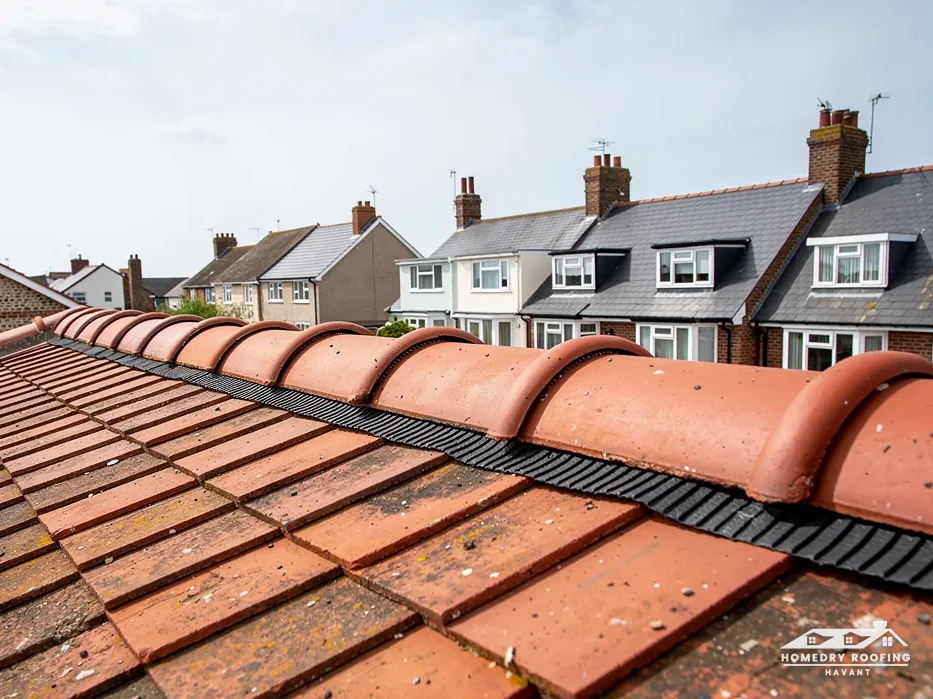
What fitting a dry ridge involves on an old roof
Where two slopes meet at the crest of the roof, the angled or curved ridge tiles cap the join, and on a mortar ridge each one sits on a bed of mortar. Fitting a dry ridge, one of the jobs on our dry ridge and verge page, means taking the old ridge tiles and bedding off and fixing a ridge system to the roof mechanically, so the grip no longer depends on mortar staying bonded to the tile below it.
The roof beneath stays as it is, with the same covering and the same pitch. The existing tiles, the battens (the thin timber strips the tiles hang from) and the rafters remain, and only the ridge line is rebuilt. That is why the job is separate from a re-roof, and why the survey looks hard at the timber the new fixings will bite into.
The fixings are chosen for how exposed the roof is. Cupa makes slate, and its guidance says sites on slopes, hills or the coast "will be graded with higher exposure". Near the coast the fixing design is done for the site under BS 5534, a code of practice that Marley says is not required by law, and our guide to mechanical fixing of ridge tiles explains why.
What the survey checks before the work
A dry ridge depends on the roof it is fixed to, so the survey comes first. On the ridge it covers:
- each ridge tile and its neighbours, for cracks and for how firmly each one sits;
- the ridge timber and the battens near the top of each slope, because the fixings bite into them;
- the old mortar, and whether any has slipped into the roof space, which can leave a gap beneath the tiles;
- the line of the ridge, in case the roof has moved and the crest no longer runs true;
- the points where the ridge meets hips, gables and any chimney stack.
Where timber has gone soft, it is mended first. If the tiles themselves are sound and just the bedding has failed, a repair can be enough, and the survey says so before anything is priced as a replacement. Our answer on whether ridge tiles can be repointed covers that middle case.
The written quote that follows is one total price, and it reports what each check found in plain words.
Listed homes, conservation areas and the council
For an ordinary house in England, work to a roof comes under Class C of the General Permitted Development Order 2015, which covers "Any other alteration to the roof of a dwellinghouse". Class C has no exclusion for conservation areas. Two things can still change the answer.
Under gov.uk guidance, an article 4 direction is how a council withdraws chosen permitted development rights across one defined area, and only the council can tell you whether one covers your street. A listed home keeps its permitted development rights for roof work, but listed building consent is also needed before any work that alters what makes the building special.
Whether a new ridge fixing affects the character of a listed building is the council's judgement, so ask before any work is booked. A flat has no permitted development rights of this kind, because the order's wording for a dwellinghouse excludes flats, so a flat owner should speak to the council as well.
Our guide to dry-fix on period and conservation roofs sets out what to ask the council and how to word it.
Building Regulations and the published prices
Under the Planning Portal's guide, re-roofing does not normally need a building regulations application if it affects less than 25 per cent of the building envelope and less than 50 per cent of the roof; a covering 15 per cent or more heavier needs approval. How those tests apply to a ridge job is for your building control body to confirm. For a Havant address we ask that body, before work starts, which route applies.
These published figures show the scale of the work and are not prices from us. Which? Trusted Traders give "Put in a new ridge tile" as £80 to £300, excluding VAT (November 2025), likely to be at the upper end in the South East. MyJobQuote says the average ridge tile replacement costs between £225 and £550 in 2026.
A dry system along a whole ridge is priced after the survey as one written total, so a range quoted for one tile is not a rate to multiply along the ridge, and neither source says what a full run would cost.