
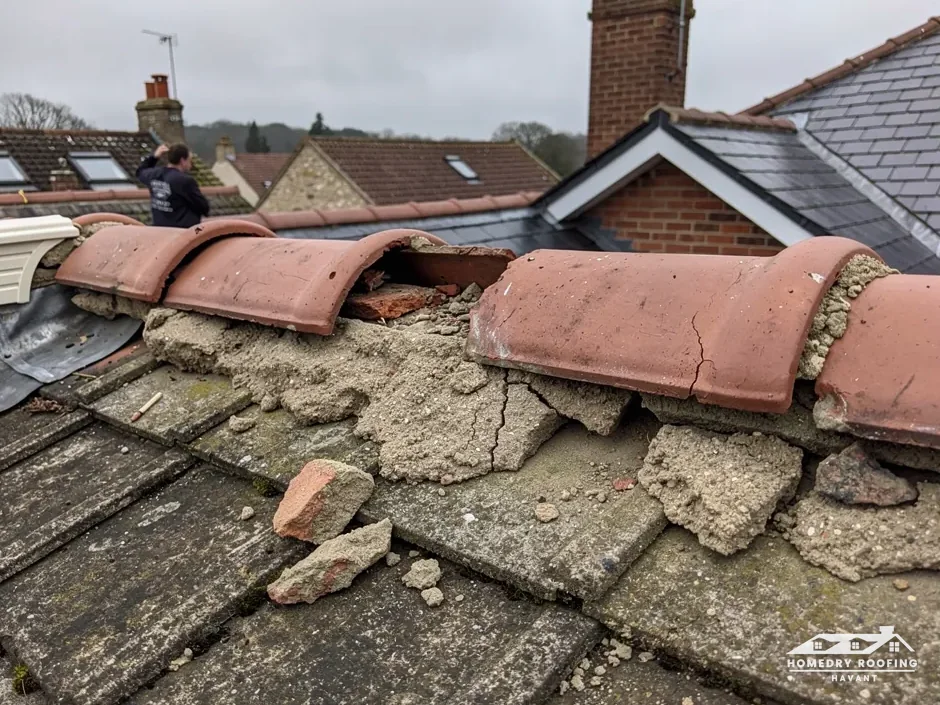
Ridge tiles run along the crest of a pitched roof, and replacing them is one of the smaller jobs on a house. Even so, the published prices for it do not line up: one prices a job, one gives a range for a whole replacement, and one gives a rate per metre. A cost guide is also revised through the year, so each figure below carries the date its page gave, and an older figure may no longer stand.
This guide gives each figure exactly as it was published, along with the source, the date and the unit, and then explains why they differ. It also covers what changes a ridge price on a real roof, how repair, re-bedding and replacement differ, and what to check in a written quote.
None of these figures is a price from us. What we charge for your roof is a single written total, set after a survey. For the work itself, see our dry ridge and dry verge page.
What replacing ridge tiles actually covers
The word replacement covers more than one job, and the guides use it loosely. At one end is a single cracked tile lifted out and a new one set in its place. At the other is the whole ridge taken off, the bedding or fixings renewed and a fresh run of tiles laid along the crest.
It helps to separate three jobs, because each one costs differently.
- Repair: one or a few tiles refixed or swapped where the rest of the ridge is sound.
- Re-bedding: sound tiles lifted, cleaned and set again on new mortar or fixings.
- Replacement: the ridge, or a long run of it, renewed with new tiles.
Which of the three a roof needs is a finding of the survey, and it is made by looking at the ridge, the hips, the timber beneath and the tiles themselves. A cracked tile does not by itself mean a whole ridge is due, and a ridge that has been patched several times can be cheaper to renew than to keep mending. If a repair is enough, we propose that first, and the survey says so. Our answer on whether ridge tiles can be repointed covers the middle case.
The way the tiles are fixed is a second question. A ridge held by mortar alone is judged differently from one held by mechanical fixings, and our guide to mechanical fixing of ridge tiles explains why. The method of fixing changes what a job involves, so it belongs in the price, and a quote that leaves it out has left something out.
The published figures, source by source
Four published figures bear on ridge work. The table gives three of them as whole-job figures in the source's own units, and a fourth, a rate per metre, follows it in a sentence of its own.
| Source | Job | Figure | Unit and date |
|---|---|---|---|
| Which? Trusted Traders | A new ridge tile | £80 to £300 | Job, excluding VAT, November 2025 |
| MyJobQuote | Average ridge tile replacement | £225 to £550 | Job, no VAT basis given, 1 October 2026 |
| MyJobQuote | Dry verge system | £500 to £2,000 | Job, no VAT basis given, 8 October 2026 |
Which? gives its figure under the heading "Put in a new ridge tile (along the top of the roof)", from a survey of 11 Which? Trusted Traders gathered in November 2025, with prices that include labour and materials but exclude VAT. Which? also warns that a job in the South East is likely to sit near the top of its scale, and Hampshire and West Sussex are both in the South East.
MyJobQuote's page says "In 2026, the average ridge tile replacement costs between £225 and £550." Its separate dry verge page says the cost "usually falls between £500 and £2,000". Neither gives a VAT basis.
Checkatrade's repair table, last updated in June 2026, lists ridge tile repairs at £50 to £70 per metre, with costs exclusive of VAT and no access equipment included. A rate per metre describes the mending of a length of ridge, so it says little about a roof where the whole run needs renewing.
Reading the figures without adding them up
These figures do not agree, and they were never meant to. They answer different questions, and treating them as a single series gives a wrong total.
- The units differ. Which? and MyJobQuote give a figure for a job. The repair table gives a rate per metre, and a per-metre rate is never multiplied by a length here to make a total.
- The jobs differ. The per metre row is for a repair; the other two cover replacement.
- The VAT basis differs. Which? and the repair table exclude it, and MyJobQuote states no basis, so it is not safe to read either way.
- The dates differ, from November 2025 to October 2026, and a figure from late 2025 may have moved by now.
Which? and MyJobQuote also overlap awkwardly. The top of the first range is £300 and the bottom of the second is £225, so the two sit side by side without agreeing on a single typical price.
The sensible way to use them is as a sense of the field, and no more than that. A tile or two replaced on a low, easy roof sits at the lower end of any of these. A long ridge with several hips, on a tall house, can sit well above it, and no single range fits every roof.
The Which? note about the South East points the same way. For a house in this part of the South East, that means reading the top of the Which? range as the likelier end, and not the middle of it.
A per-metre rate and a whole-job range are two different measurements, so they are not added together.
What moves the price of a ridge job
Two roofs with the same published range can sit very far apart in price, because the work depends on the roof. These are the things that decide it:
- The length of the ridge, and how many hips run down from it.
- The height of the house, which decides the access needed.
- Whether the existing tiles are whole and can be reused, or are cracked and need replacing.
- How the new tiles are held: mortar, mechanical fixings or a dry-fix system.
- The state of the timber beneath, which a fixing has to go into.
- A re-roof going on at the same moment, which brings its access with it.
The last of these bears on how a quote reads. Scaffold is included in the written quote, and ridge work done alongside a re-roof shares the access that the re-roof needs. A ridge done alone, on a tall house, carries its own access as part of the one price.
What a survey settles first
The survey decides whether the ridge is repaired, re-bedded or replaced, and sets out why. It also checks the hips and the points where the ridge ends, because a gable end or a chimney stack can need separate attention. The price follows the survey and states one total for the work found.
For the neighbouring job, our answer on dry verge cost gives the same kind of range for the verge edge.
Repair first, replace when the ridge says so
Cost guides cannot tell you which of these your roof is, because they never saw it. A ridge that is mostly sound is a repair job. A few loose or missing tiles can be refixed or swapped, and the rest of the line left alone, which can keep the price nearer the lower end of the range. That is the smallest end of the published figures, and it is the job we would propose first if it is enough.
A ridge is a replacement job when the pattern of failure runs along its length. A survey checks for the following signs of that:
- Mortar cracked or missing along most of the ridge, not at one end.
- Tiles that are cracked, chipped or rocking in several places.
- Earlier patches that have themselves failed, so the repair has been done more than once.
- Timber beneath that is soft or stained and will not hold a fixing.
Where several of these show together, patching can repeat the problem, and the survey may call for the ridge to be renewed. Where one shows alone, a repair may be enough.
The safety side of a loose ridge is a different matter. A tile that could fall onto a path or a door is a reason to act sooner, and the survey puts it ahead of the rest of the list. Leave the roof itself alone and take photographs from the pavement or garden.
Checking a written quote before you agree
A written quote for ridge work is easy to compare once it is set out in the same terms as the published figures above. These are the things to look for:
- One total price for the job, not a rate per metre left for you to multiply.
- A clear statement of whether VAT is in the price.
- A statement that scaffold, or other access, is included or not.
- How the ridge and hip tiles are to be fixed, named in plain words.
- What is to be done with the old tiles and mortar.
On the first point, a price quoted per metre is a rate and not a total, and it leaves the number you pay unfinished. A single figure for the work found is the form we give, after a survey, and it leaves nothing for you to multiply or add.
On the second, the published guides differ, so never assume a figure includes VAT. Which? and the per metre repair table say theirs do not, and MyJobQuote gives no basis.
If two quotes for the same ridge differ widely, one likely reason is that they describe different jobs: one repairs and one renews, or one uses mechanical fixings and one uses mortar alone. Ask each to say which job it prices, and compare like with like. A quote that will not say which job it prices cannot be compared at all.
Your written quote is one total price after a survey. You can WhatsApp photographs or use the quote form if you would like the survey planned around what is visible from the street.