
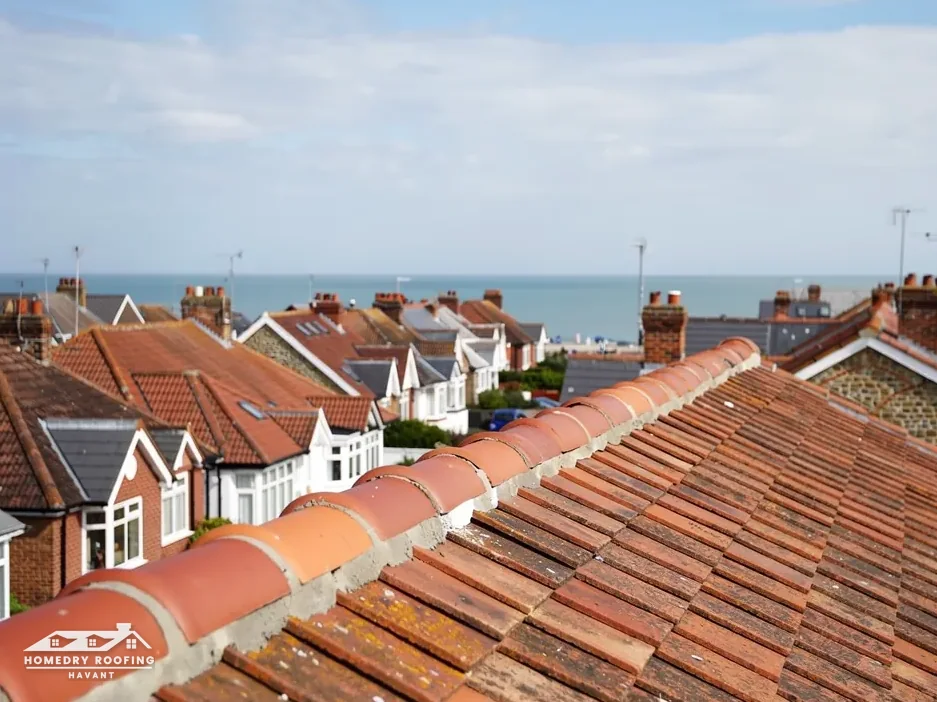
Why a loose ridge tile matters
Ridge tiles run along the highest line of the house, so a tile that works loose has a long way to fall. Wind can lift one further still, and a falling tile is a risk to anyone who walks beneath that part of the building.
The second concern is the gap. Each ridge tile helps close the join where the two slopes meet. Where one has gone, that join is open to the weather, and what lies beneath it is the roof space and the tops of the walls below.
A tile that has moved also says something about the bed or fixings under it. If the tile was held by mortar, the bed may have cracked, and the tiles beside it can be loose too, even if they have not shifted yet. Our answer on what cracked mortar under the ridge tiles means explains how that reads from the ground.
None of this makes every loose tile a crisis. It does mean the tile is not a job to leave until the next time you happen to look up, and it is a good reason to arrange a survey soon.
What to do first, and what to leave alone
Work through these in order:
- Steer people and pets away from the ground below the ridge, and move a car if a tile could land on it.
- Stay on the ground. HSE says "all roofs should be treated as fragile until a competent person has confirmed they are not."
- Photograph the ridge from the pavement, and the tile itself if it has landed, before anything is moved.
- Where a storm did it, ring your insurer before arranging anything, and keep receipts for any temporary cover that you pay for.
- Message the pictures to 07880 284133 on WhatsApp, or attach them to the quote form, and we will fix a survey with you.
Leave alone any idea of pressing the tile back in place or smearing filler under it. A tile pushed into a failed bed has nothing to hold it, and it can fall again the next time wind gets beneath it. Moving it also removes evidence the survey needs, and the break line on a fallen tile can show how it let go.
How loose ridge tiles are fixed
The repair follows from what the survey finds at the tile and beneath it. A repair is where we start, provided the neighbouring tiles and the timber are in good order, because there is no reason to renew a sound run to cure one fault.
| What the survey finds | The repair |
|---|---|
| One tile loose, bed and neighbours sound | Refix that tile, or replace it if it is cracked |
| Bed cracked under several tiles | Rebed the run on new mortar, or fix it dry |
| Timber under the ridge soft | Mend the timber first, then refix the tiles |
| Tiles chipped or breaking down | Replace the run with new ridge tiles |
Marley states that BS 5534 "requires mechanically fixed ridge and hip tiles". A repair that goes beyond one tile therefore raises the question of how the whole run will be held afterwards, and the quote should answer it in writing. Our answer on whether ridge tiles can be repointed covers the mortar side of that choice.
Insurance, temporary cover and published prices
If a storm brought the tile down, the Financial Ombudsman Service says "Rain, hail or snowfall by itself can constitute a storm", and, in its words, "we'll usually look at expert reports and photos", so the pictures you take now matter. Tell your insurer first. Where the roof needs protecting in the meantime, a temporary repair can do that while the proper fix is arranged.
The published figures give a scale, but they are third-party ranges and not our prices. Which? Trusted Traders give "Put in a new ridge tile" as £80 to £300, excluding VAT (November 2025). On MyJobQuote's 2026 page, replacing ridge tiles averages £225 to £550. Checkatrade (June 2026) lists ridge tile repairs at £50 to £70 per metre, which is a rate for repairing a length of ridge and not a basis for any total.
Our price for your roof is a single sum in writing, set after the survey, and the quote says plainly if scaffold is inside that sum. Everything we do along the ridge and the verge is described on the dry ridge and verge page.