
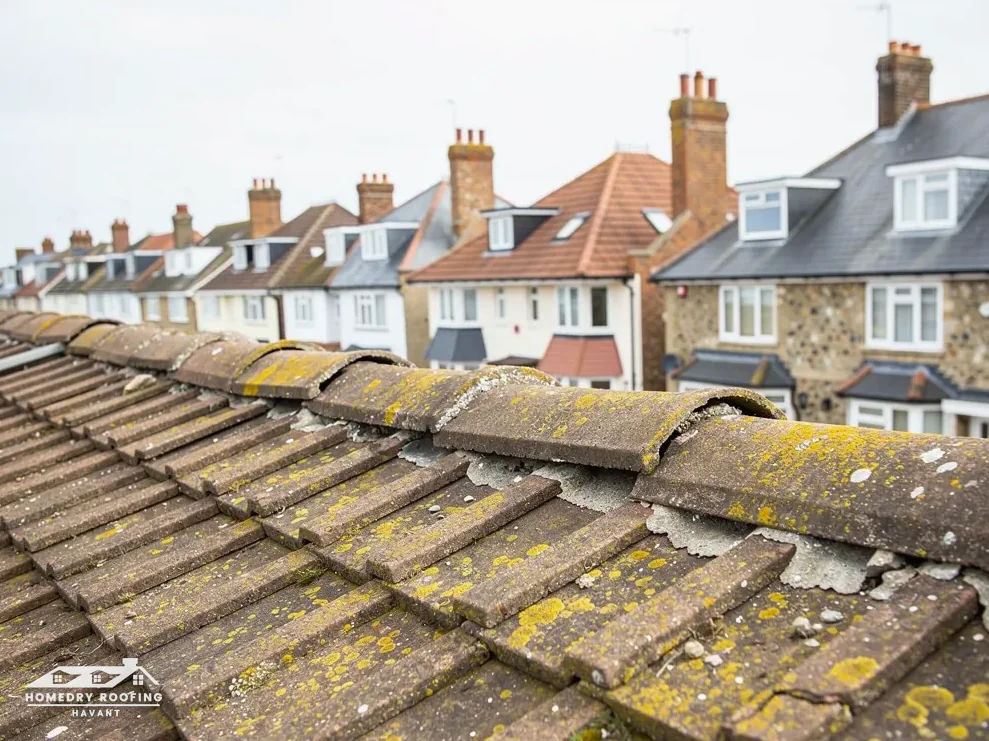
What a crack can be telling you
Ridge tiles are bedded in mortar along the crest, where two slopes of the roof come together. A crack in that mortar is a symptom, and one crack can have several causes. The table sets out the readings a survey weighs up before it names the job.
| The sight | The reading |
|---|---|
| Fine cracks in the pointing | Weathering of the finish, with the bed beneath still sound |
| A crack through the full depth of the bed | A bed that has split, so the tiles above are held less firmly |
| A gap beside one tile | A tile that has shifted, or a bed that has pulled away from it |
| Crumbs of mortar in the gutter | A bed that is losing material |
Only the survey can say which row fits your roof, because the same crack in the same place can belong to two different rows. A crack seen from the ground, with a camera zoomed in, is a good reason to book one, though it is not proof of how deep the fault runs.
Why mortar alone is no longer enough
Marley, the tile maker, says that "the tensile strength of mortar alone could no longer be relied upon". Tensile means a pulling force, such as wind trying to lift a ridge tile off the roof. Mortar copes well with a tile's weight pressing down and is weaker when something pulls the tile upward.
That is the thinking behind BS 5534, the British code of practice for tiling and slating. Marley notes that installing to it "isn't required by law", yet also that it made clear mortar could not be the only fixing for the covering. A cracked bed is therefore two questions at once, and a repair that answers only the first leaves the roof no better held than before. One is how to mend the crack, and the other is what will hold these tiles on afterwards.
Our guide to mechanical fixing of ridge tiles sets out the options. No rule bans mortar, and a mortar repair can be right where the bed is sound; it simply should not be the only thing in the specification, and the quote should say what else is.
What to do about it, and what to leave alone
Cracked mortar is no reason to climb up and look. HSE says all roofs should be treated as fragile until a competent person has confirmed they are not. Watch from the ground, take photographs in good light, and send them to us by WhatsApp, or attach them to the quote form, so the survey can be planned around what the photographs show, and so we can tell you what to look for on the day.
A few well-meant fixes make matters worse:
- smearing filler, sealant or paint across the cracks, which hides a split bed and holds no tile;
- pressing a loose tile back by hand, so it sits for a day and then drops;
- leaving a tile that has slipped above a path, a car or a doorway.
If a storm loosened the ridge and you mean to claim, the Financial Ombudsman Service says it will usually look at expert reports and photos, so the evidence is worth keeping. Photograph the damage before a tile is touched, tell your insurer, and keep receipts for any temporary repair.
For a tile that has already moved, read our answer on loose or fallen ridge tiles.
How the repair is chosen and what it can cost
A repair is proposed first where it is sound. A bed that is whole under weathered pointing can be repointed. A bed that has split through is rebedded, or replaced with a dry-fixed ridge, which holds the tiles down with mechanical fixings instead of a bed of mortar. Our dry ridge and verge page lays out the choices side by side.
For a sense of scale, these are published figures and none is a price from us. MyJobQuote gives £225 to £550 as the average for a ridge tile replacement in 2026, with no VAT basis stated. Checkatrade (June 2026) lists ridge tile repairs at £50 to £70 per metre, a rate for mending a length of ridge, which is never multiplied into a total.
What we charge is one written total, set once we have seen the roof, and the quote names the job in plain words. Check whether a quote you hold includes access equipment and VAT. Guides do not agree on either, and a quote that never mentions them can end up with both added at the finish.