
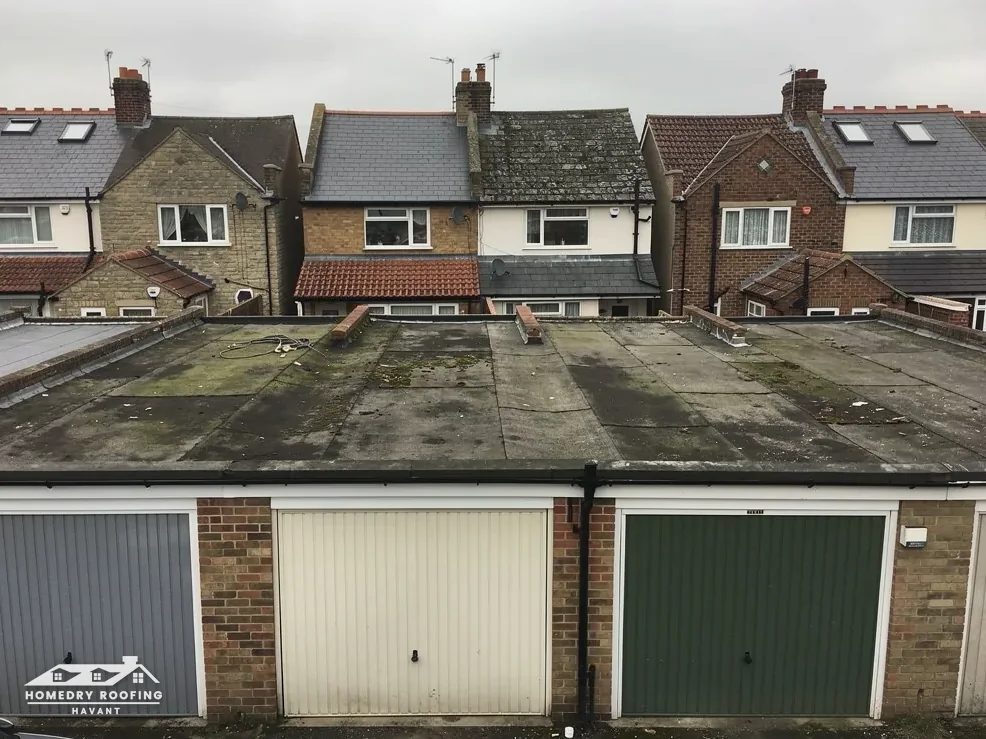
Two harbours shape the roofline around Havant. Langstone Harbour lies beside Langstone and Hayling Island, and Chichester Harbour reaches Emsworth and Bosham. Homeowners near either one often wonder whether the water brings a special set of roofing rules with it.
It brings fewer than people expect, and the ones it does bring are easy to state. One is a planning designation that covers part of the area. One is the bird and bat law that applies to every roof in the country. One is a point about how a roof covering is fixed when a house is more exposed than its neighbours.
This post goes through each in turn, and it is just as clear about what the harbours do not change. Where a rule belongs to a particular council, the council is named, and where the answer depends on your address, the council is the place to ask, because a post cannot see the line on the map where your house sits.
The National Landscape and the places inside it
Chichester Harbour is a National Landscape. Areas of Outstanding Natural Beauty were renamed National Landscapes in 2023, yet the planning rules keep the older wording: the General Permitted Development Order refers to an area of outstanding natural beauty, often shortened to AONB. The designation covers the harbour and land around it, and it matters for roof work in two ways, set out in the next section.
Which homes lie inside the boundary depends on the address. Langstone, Emsworth and Bosham are inside it. Hayling Island addresses need checking one by one, because the boundary lies close to parts of the island.
It helps to separate three kinds of land that people mix up:
- The National Landscape, a landscape designation covering the harbour and its surroundings.
- Conservation areas, which councils designate and which are separate from the landscape boundary.
- The harbour itself, which has its own protected sites, covered below.
A house can be in any one of these, in two, or in all three. Langstone is a good example of a place that touches several at once. Our post on roof work in Havant's conservation areas covers the conservation side and the Langstone Article 4 direction in detail.
None of this means the roof cannot be repaired or renewed. It means two checks, and the checks are short: first whether the address is inside the National Landscape, then whether the work is the kind that needs permission there. On Hayling Island the first check deserves care, because the boundary lies close to parts of the island and only the council can say which side of it an address falls on. Ask the council for the answer at your own address and put it in your file.
What actually changes on a roof
The headline is that ordinary re-roofing stays under the normal rules. Class C of the permitted development order, which covers any other alteration to the roof of a dwellinghouse, has no exclusion for National Landscapes, so replacing the covering on a house is handled just as it would be elsewhere.
What changes is the larger work. Land in a National Landscape counts as article 2(3) land under the order, and on that land dormers need planning permission. The point is simply stated: in Chichester Harbour National Landscape, which the planning rules still call an area of outstanding natural beauty, dormers need planning permission, while ordinary re-roofing stays under the normal rules.
| Work | Inside the National Landscape |
|---|---|
| Replacing the covering on a house | Same rules as elsewhere |
| Adding a dormer | Needs planning permission |
| Chimney, flue or soil pipe changes | Class C limits apply, as elsewhere |
| Solar panels on a roof | Class C limits apply, as elsewhere |
Building Regulations are separate again and apply wherever the house stands. For Havant addresses, the route is confirmed with your building control body before work starts. For Bosham and other Chichester addresses, the one to ask is Chichester District Council's building control team.
If the house is listed, that adds its own consent rules whatever the landscape says. Our planning permission for roof work guide covers how the national rules fit together.
Who decides, and who only advises
Being a National Landscape gives a place a designation, not planning powers. The decision on an application belongs to the council for the area: Havant Borough Council for Langstone, Emsworth and Hayling Island, and Chichester District Council for Bosham and the West Sussex side.
Because the council decides, any question about whether consent is needed at your address should go to the council, in writing, with your address and a photograph. A roofer cannot give you that answer, and a neighbour's experience may have turned on a different part of the map.
It can help to arrive with these ready:
- The full address and a photograph of the roof from the street.
- A short description of the work: re-covering, a dormer, a chimney, solar or a roof window.
- The question put plainly: does this need planning permission at this address?
The county matters as well, because scaffold on a lane beside the water is a highway question. Hampshire County Council licenses it for Langstone, Emsworth and Hayling Island addresses at £211.90 on application for the first 2 weeks and £72 for each additional 2-week period. West Sussex County Council licenses it for Bosham at £266 for one month and asks for at least 10 working days' notice. We arrange the licence with our scaffolder, and each fee belongs to its own county.
Havant Borough Council's planning queries line is customer services on 023 9244 6019. For Chichester addresses, ask Chichester District Council's planning team.
The answer you get is worth keeping. A note from the council saying that no application is needed is a useful thing to hold if the house is sold, and a roofer who has seen it can quote with confidence about what is and is not included.
Nesting birds and bats near the water
The harbours are known for wildlife, and roof work can meet it. Langstone Harbour Board lists SSSI, SPA, SAC and Ramsar designations for the harbour; the national nesting bird and bat law applies to roof work here as it does everywhere. For a house roof, the law that applies is the same national law that binds every roofer in the country.
In plain terms:
- It is an offence to intentionally take, damage or destroy a wild bird's nest while it is in use or being built.
- Damaging or destroying a bat roost is an offence whatever the intent.
- The offence turns on the nest being in use or being built, so a survey before the strip should look for them.
The safe habit is to look before you strip: under the eaves, behind the ridge, in the gaps at the verge and around the soffit, and to look again as each section of roof is opened.
A written total can deal with this in advance. It can say that the roof will be checked for nests and bat signs before the strip, and that work on the affected section pauses if either turns up. That is easier to agree before the scaffold goes up than to argue about on the day.
If a nest in use, or any sign of bats, turns up, stop and get advice before work continues. Waiting for a nest to finish being used is a cost the schedule can absorb.
You can see the harbour board's list of protected sites on the Langstone Harbour Board conservation page.
Exposure and how the covering is fixed
The one genuinely coastal point is exposure. Cupa, a slate maker, says the most significant thing is the environment, and that its two main factors are exposure to wind and rain. In its guide, coastal sites, exposed slopes and hills, and tall buildings all rate as more exposed than a house in a sheltered street.
Exposure is not only a coastal matter, since a hilltop or a tall house is graded in the same way. For a house near the harbours the useful step is to ask the question at survey. What follows is a matter of method, not of any local figure. Coastal homes are graded for higher exposure, so the fixing specification is calculated for the site under BS 5534. Marley notes that fixing to BS 5534 isn't required by law, and also says mortar alone "could no longer be relied upon" to hold the covering on.
Here is what the point means in practice:
- Ask the roofer how the fixings were chosen for your house, not for an average one.
- Ask whether the ridge, hip and verge are fixed mechanically as well as bedded.
- Ask for the result in the written total, with the work described in words.
The method is to calculate for the site, and the survey is where that starts.
The same thinking applies to dry-fixed ridge and verge systems, which have their own standard. Our post on dry ridge or mortar near the harbour looks at that choice for a harbourside roof.
A checklist before you instruct a roofer
Pull the threads together and a harbourside roof job comes down to a short list, one that fits on a single sheet and that a roofer, a surveyor or a buyer's solicitor can all read at a glance. It is the same list whether the house is in Langstone, Emsworth, Bosham or on Hayling Island, with the answers depending on the address.
- Find out whether the house is inside the National Landscape, and whether it is in a conservation area or listed.
- If the work includes a dormer, ask the council about planning permission. For ordinary re-roofing, the normal rules apply.
- Ask the council in writing if you are unsure, and keep its answer.
- Confirm the Building Regulations route with your building control body.
- Ask the roofer to look for nests and bat signs before the strip begins.
- Ask how the fixings were calculated for your site's exposure.
- Ask for the whole job as one total in writing, with scaffold named in the description.
That last line is what a survey ends in. The roofer looks at the covering, the ridge and the details, works out what the exposure calls for, and puts one total in writing. Scaffold and its licence are dealt with by us and our scaffolder, so the written price already allows for them.
For a survey and a written total on a roof near either harbour, the form is on the HomeDry Roofing Havant homepage. If you already have a quote, the checklist above is a fair test of it.