
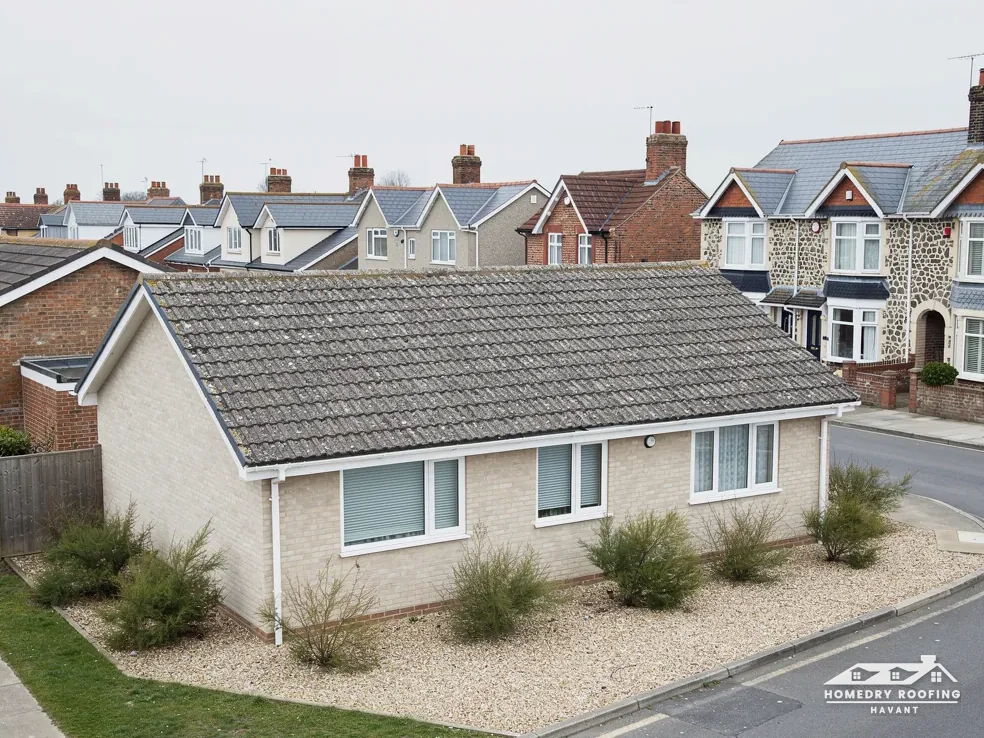
At the highest point of a pitched roof, two slopes come together, and a row of curved or angled tiles caps that join: those are the ridge tiles. For a long time they were bedded in mortar. Today a second method, dry fix, holds them on with mechanical fasteners instead, and a roofer pricing your job may offer either one, so it helps to know what each involves before the quote arrives.
The choice is not a matter of fashion. It depends on what the standards say, on how exposed your roof is, and on whether the house is old or protected enough to need a conversation with the council first. If you live near Langstone Harbour or Chichester Harbour, the exposure part of that list deserves a closer look than it would get inland.
Here the two methods are set side by side, the manufacturers and standards bodies are quoted by name, and third-party prices come with their sources. We put no wind figure on your roof, because none has been published for it; the fixing specification comes from a calculation for the site.
What the ridge has to do
A ridge looks like a simple cap, but it carries a demanding job. Rain runs down both slopes and meets at the top, wind pushes against the highest row of tiles on the building, and the covering below has to be kept clear of the weather where the two pitches join. A ridge tile that slips, cracks or lifts opens that join, and the water goes in under the covering rather than off it.
Hips, the lines running down the outside corners of a hipped roof, are capped by the same sort of tile and raise the same question. So does the verge, the sloping side edge of a gable, which has its own dry-fix systems. This post concentrates on ridge and hip tiles, with a note on verges in the cost section.
Before anyone chooses between methods, the survey looks at what is there:
- Whether the ridge tiles are bedded in mortar, fixed dry, or a mixture from earlier repairs.
- Whether the mortar has cracked, crumbled or separated from the tile.
- Whether any tile has moved, and what that has done to the covering beneath it.
- What the tiles are made of and whether a matching dry-fix system exists for them.
A survey of the whole roof matters here, since a loose ridge can sit alongside other faults at the same level: a slipped tile just below it, a cracked verge, a flashing at a nearby chimney. Looking at the ridge alone would miss them, and the repair would be priced for a roof that is not the one you have. We say what we find, give the reason, and set out the repair before the replacement where the repair is sound.
How mortar bedding and dry fix differ
Mortar bedding sets the ridge tile on a mortar bed run along the top of the roof. Dry fix leaves that bed out. Marley, a tile maker, says dry-fix systems "use mechanical fasteners such as nails, screws or clips to secure roof tiles without a mortar bedding". The two methods differ in what holds the tile, what happens when something moves, and what a repair involves.
| Point | Mortar bedding | Dry fix |
|---|---|---|
| What holds the tile | A bed of mortar, plus fixings | Nails, screws or clips |
| When it ages | Mortar can crack and part from the tile | Fixings and ridge parts are checked |
| Repair | Re-bed or repoint the tiles | Refix or replace parts |
Marley also claims that dry fix is "now the most widely used method for fixing roof tiles in both new-build and refurbishment projects". That is the manufacturer's claim about the market, so treat it as such, not as a count of roofs near you.
Neither method fixes a roof that has other faults, and neither is a reason to skip the survey. Ask the roofer to show you the existing ridge, from the loft hatch or in photographs, before any method is named. A new ridge on tiles that are slipping below it is a tidy-looking repair on a roof that still leaks, so the survey comes before any choice of method, and the choice follows from what it finds. Our guide to mechanical fixing of ridge tiles covers the fasteners in more detail.
What the standards say, and what they do not
Two British Standards sit behind this choice, and it is easy to say more about them than they say. BS 5534 is the British Standard code of practice covering how slates and tiles are fixed. Marley says it requires mechanically fixed ridge and hip tiles, and also says that installing to BS 5534 is not required by law. So it is a code of practice, not a statute that bans mortar.
On mortar itself, Marley's wording is careful. It says the strength of mortar alone can no longer be relied on as the only means of securing the roof covering. The weight of that sentence falls on the words "alone" and "only". It does not say mortar has no place on a ridge. It says mortar cannot be the sole thing holding the tile on.
Be wary of anyone who says the law requires one method or the other; the standards do not say so. The second standard is BS 8612:2018, the specification for dry-fixed ridge, hip and verge systems, which BSI Knowledge lists as current. A dry-fix system made to that specification has a defined set of requirements behind it, and you can ask a roofer which system is proposed and whether it meets the standard.
None of this makes dry fix compulsory in law. Our answer on whether dry ridge is a legal requirement deals with that question separately.
Why a house near the harbour needs a closer look
Langstone Harbour and Chichester Harbour both lie on this coast, and a house close to either is in a coastal area as far as roof specification goes. The slate maker Cupa explains why that matters: it says coastal areas, hillsides and tall buildings are all graded with higher exposure. Exposure, in turn, sets how a roof covering has to be fixed.
Marley says the contents of BS 5534 include "batten selection, methods of fixing, wind uplift formulas and a means of calculating fixing specifications." Put the two together and the practical point follows. Near the harbour, the fixings are calculated for the particular roof under BS 5534, not taken from a general rule of thumb.
In practice that means asking three things of anyone quoting for a ridge on an exposed house:
- Which fixing method is proposed, and why it suits this roof.
- Whether the specification was worked out for the site's exposure or copied from another job.
- Whether the fixings and ridge parts come from one system made to be used together.
Exposure is a matter for the calculation, and the calculation is for your roof, not the town. Inland houses fall under the same standard, only with a different grading. A roofer who can explain how the specification was reached for your house is giving you the answer; one who simply says dry fix is better is giving you an opinion.
Older roofs, listed homes and conservation areas
A ridge repair on a plain modern roof is a straightforward job. On an older house the first question may not be which method, but whether you need to speak to the council at all. Three situations are worth knowing about.
- Roof work on a listed house may stay within permitted development, yet anything affecting its character also needs listed building consent.
- Conservation areas. In a conservation area, ordinary re-roofing normally remains permitted development, dormers excepted, and an Article 4 direction can remove more rights.
- Langstone. Havant Borough Council's Article 4 direction there covers only elevations that face a public area, and the council's leaflet lists alteration to the roof of the house among the changes it controls.
Whether a change of ridge method counts as an alteration needing consent depends on the building and the direction, so we do not state it for you. The right step is the one the council itself would give: check with the council before work starts. That applies to listed homes, to houses in a conservation area, and to anyone whose street has a direction in force. If the council wants an application, we help you with what it asks for, and no work begins until the route is clear.
The planning side has its own guide, and our guide to dry fix on period and conservation roofs goes through what to ask. Where a visible ridge tile of a traditional profile is part of the character of a home, the matter is raised with the council first and the work follows its answer.
What third parties quote, and what to ask
Prices depend on the length of ridge, the roof's height and access, and whether tiles have to be replaced. We cannot price your roof without a survey, so the figures below are third-party guides, each with its source and unit.
- A November 2025 survey of 11 Which? Trusted Traders gave £80 to £300 for putting in one new ridge tile, excluding VAT.
- MyJobQuote says the average ridge tile replacement in 2026 costs between £225 and £550.
- MyJobQuote also says a dry verge system usually falls between £500 and £2,000.
- Checkatrade (June 2026) gives ridge tile repairs at £50 to £70 per metre, a repair rate that should not be multiplied up into a total.
The figures come with different units and job descriptions: one new tile, a ridge tile replacement, a verge, a repair by the metre. Read the unit before the number, since a rate for each metre and a total for a whole roof are different kinds of figure, and never multiply a per-metre repair rate by the length of your roof to produce a total. Which? also warns: "Prices are likely to be at the upper end of the scale if you live in London or the South East."
Put the same questions to every roofer: is the ridge mortar-bedded or dry-fixed, which fixings go in, and does the total include scaffold and VAT? The written quote should be one total price, and it should name who clears the crumbled mortar and broken tiles from the ridge, since someone has to bag and carry them away. If a ridge quote says nothing about the fixing method, ask for it in writing. Our dry ridge and verge service page explains how we survey and quote.
Filed under Dry ridge & verge