
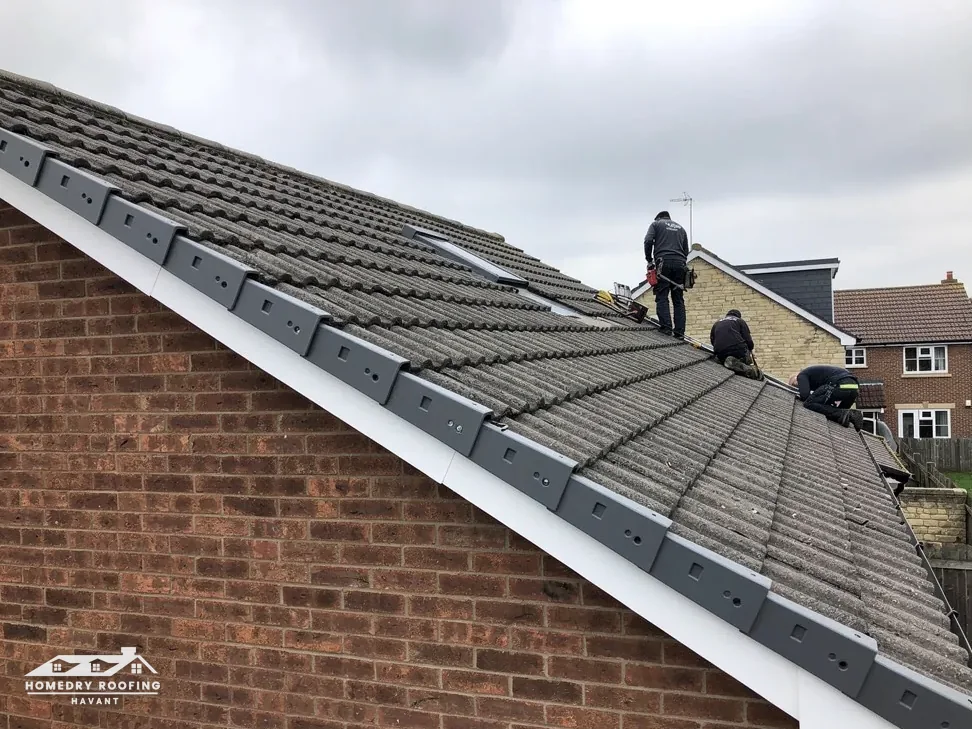
Anyone whose home lies inside a conservation area in Havant borough has a question to settle before a roofer climbs a ladder: does this need anyone's permission? The reply has three parts. Some roof work is untouched by the designation. Some work, such as dormers, loses its automatic permission. And in some places an extra layer of control, called an Article 4 direction, withdraws rights the national rules would otherwise give you.
Langstone is the place in the borough where we can say exactly what that extra layer covers, because Havant Borough Council has published the direction and a leaflet explaining it. For other places the right answer is shorter: check with the council.
This post sets out the national position first, then the Langstone direction as the council words it, then what to do about the rest of the borough. It is general information about roof work and does not replace a conversation with the planning team about your own address.
What a conservation area changes for a roof
A conservation area does not freeze a roof. For a house, changing the roof covering counts as permitted development, which means it can go ahead without a planning application unless something specific says otherwise. The relevant rule, Class C of Schedule 2 Part 1 of the General Permitted Development Order 2015, covers any other alteration to the roof of a dwellinghouse, and re-roofing falls inside it.
What the designation does change is more limited:
- Dormer windows and similar enlargements need planning permission on land in a conservation area, because the permitted development rights for them do not reach that far.
- The council can make an Article 4 direction that withdraws specified permitted development rights across a defined area.
- Flats have no permitted development rights of this kind, so the position there is different again.
In a conservation area, re-covering a house roof still falls under Class C. A dormer does not, and an Article 4 direction may take other rights away too, which is why we ask the council before we price the work. Making that check is the whole point of this post.
Planning is one question. Building Regulations are another, and they apply whether or not planning permission is needed. In Havant, we confirm the building regulations route with your building control body before work starts.
If you are reading a neighbouring council's rules, take care. Portsmouth, for instance, has Article 4 directions for named addresses in its conservation areas, and those do not apply in Havant. Each council's directions apply only to its own area, which is why the rest of this post sticks to Havant's own.
The Langstone Article 4 direction in the council's words
Havant Borough Council publishes its Article 4 directions on a single page, and the entry for the Langstone conservation area spells out its reach. Its wording is precise, so here it is, quoted rather than summarised:
"The Direction covers all properties within the Conservation Area, but only to those elevations which front onto a public area. Rear and side elevations where they do not face a highway, public footpath or public space are not included."
Two points follow. The direction is about elevations, meaning the faces of the house as seen from outside, and not the whole building at once. And what counts is whether an elevation fronts a public area. A house in Langstone whose front looks on to a road is covered on that front. The back of the same house, facing only its own garden, is not.
The council's leaflet for Langstone lists eight alterations the direction brings under control. Three of them are about the roof:
| Item in the leaflet | What it touches |
|---|---|
| Alteration to the roof of the house | Changes to the roof itself |
| Any chimney, flue and/or waste pipe work | Stacks, flues and soil pipes |
| Installation of solar equipment | Panels on a roof |
You can read the full direction on the council's Article 4 directions page. It is worth reading the council's own text rather than anyone's summary of it, ours included, before you rely on any of this for a real job.
Which side of the roof counts in Langstone
Because the direction speaks of elevations that front a public area, the first job is to stand where the public stands and look at your house. A public area in the council's wording includes a highway, a public footpath or public space. If you can see a roof slope from any of those, the elevation below it is one the direction reaches.
The direction itself talks about elevations, not roof slopes. Whether a particular slope or chimney counts as part of a street-facing elevation is a question for the planning team, and neither this post nor a roofer can settle it for you. That is not a gap in the roofing. It is a gap that only the council can close for your address.
A sensible order of work for a Langstone house looks like this:
- Note which faces of the house look on to a road, a footpath or open public space.
- List the roof work you are considering on each of them: re-covering, a chimney, a flue or soil pipe, or solar.
- Ask Havant Borough Council whether the Langstone direction brings that work under control on each face.
- Get the council's answer in writing, and give it to your roofer before the quote is agreed.
- Ask the roofer to confirm the building regulations route as well.
Planning queries go through Havant Borough Council's customer services on 023 9244 6019. A short email with photographs of the house taken from the street gives the council what it needs to reply, and it leaves you with a dated record of what you asked and what you were told, which your roofer can then work to.
Solar needs a separate note. Where the leaflet lists solar equipment, that is the direction at work on top of the national rules, so do not assume a panel layout that works elsewhere will work on a street-facing slope in Langstone.
Homewell, Emsworth and the rest of the borough
Langstone is not the only conservation area in Havant borough, and it is not the only place with a direction. Havant Borough Council's list also includes a direction for the Homewell area of Havant itself. How that direction applies to roof work is for the council to confirm, so for a house there the answer is to check with Havant Borough Council before any roof work.
Emsworth has a conservation area of its own. Whether an Article 4 direction applies to a given street is a question for the council, and so it is for every other part of the borough, Hayling Island included. The boundary is drawn on a plan, and only the council can tell you on which side of it your address falls.
It helps to know which directions have nothing to do with roofs. The council's list also carries directions about caravans, camping sites and hovercraft use on Hayling Island, and none of those concerns roof work.
So the practical approach for the borough is simple:
- If you live in Langstone, use the leaflet wording above and confirm with the council.
- If you live in Homewell, ask the council what its direction covers.
- If you live in any other conservation area, ask whether an Article 4 direction applies to your road.
- If you are unsure about the boundary, the council can tell you from your address if the house is inside it.
A wrong reading of a direction can leave you applying after the work is done, or undoing it, so the council's answer should come first and in writing.
Listed buildings and conservation areas together
A house can be both listed and in a conservation area, and the rules stack. Listed homes keep their permitted development rights for roof work, but listed building consent is needed for anything that affects the building's character. The test, set out in section 7 of the Planning (Listed Buildings and Conservation Areas) Act 1990, is whether the work would affect its character as a building of special architectural or historic interest.
The consequences of getting this wrong are serious. Havant Borough Council states it is a criminal offence to carry out works to a listed building without first obtaining the council's permission, even where you did not know the building was listed. Check the listing before you ask a roofer to start.
For a roof on a listed house, these questions come first:
- Is the building listed, and at what grade? Historic England's list will tell you.
- Does the planned work affect the roof's character, such as its covering, ridge detail or chimneys?
- Has the council confirmed in writing that consent is, or is not, needed?
- Does the roofer's quote say who is responsible for obtaining it?
Part of any survey on a listed or conservation area roof is looking at what is already there: the covering, the ridge and hip details, the chimney and the lead. That tells you what a like-for-like repair would involve before anyone talks about changing it.
The listed side of this story has its own long-form guide. Our planning permission for roof work page covers the national rules in full, including how Classes B and C treat listed homes.
Before the roof work starts: a short checklist
Put the strands together and the sequence is the same for any Havant house in a conservation area. It costs a few phone calls and it saves a great deal of trouble later.
- Find out whether the house is in a conservation area. Havant Borough Council can confirm it from your address.
- Ask about Article 4. For Langstone, start with the direction's wording; for anywhere else, ask the council what applies on your road.
- Check the listing. If the building is listed, the consent route comes before any quote.
- Confirm the Building Regulations route with your building control body, separately from planning.
- Ask for one written total that says what the roof work includes and who deals with any consent.
The rules do not forbid a good repair. A re-roof of a house falls inside Class C, and roofs in conservation areas are repaired and re-covered like any others. What the checks do is make sure you are in the permitted group and not the exception, and that the paperwork shows it if anyone asks later, whether that is a buyer's solicitor or the council.
For a survey and one written total on a roof in Langstone, Emsworth or anywhere else in the borough, use the form on the HomeDry Roofing Havant homepage. Our post on roof work near Chichester Harbour and Langstone Harbour covers the harbour landscape rules that sit alongside these, and the two are best read together if your home is near the water.