
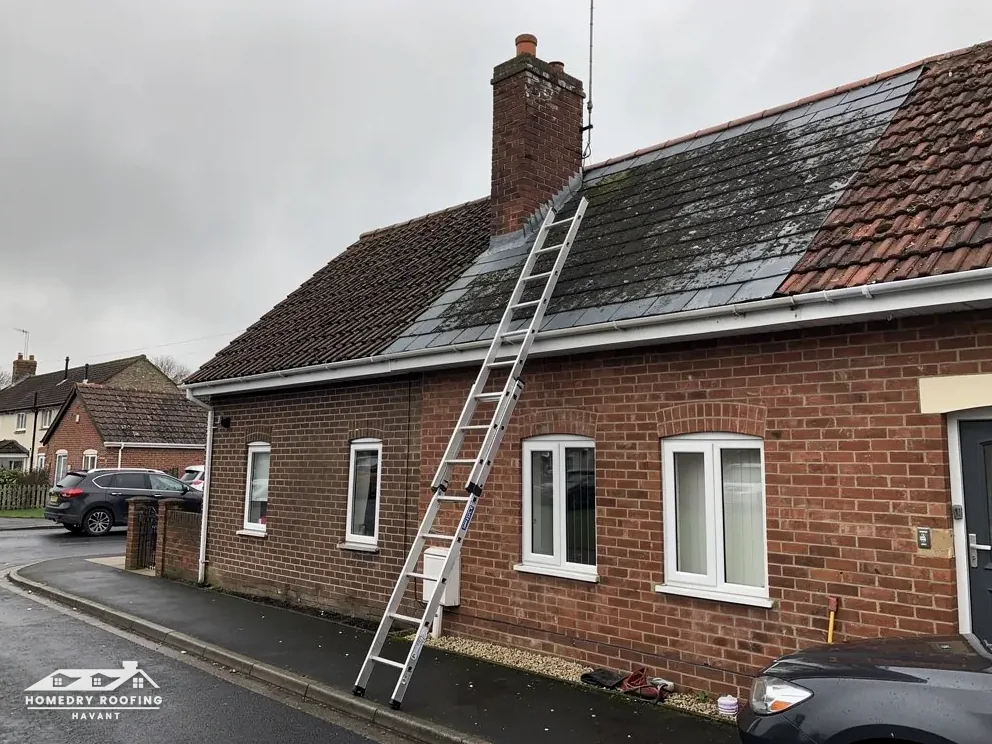
A viewing tells you about rooms, light and the garden. It tells you very little about the roof, which you see from the pavement at best and from inside the loft hatch if the seller allows it. Yet the roof is one of the largest repair bills a house can carry, and the one you inherit the day you complete.
Whether a separate roof inspection is worth paying for depends on what else you have already commissioned, on the age and type of the house, and on what the survey you do have says about the roof. A report that records the roof as not inspected, or as seen from a distance, leaves a gap that only another set of eyes can fill.
This post is for buyers. It explains what a general survey may and may not tell you about a roof, the houses where a separate look earns its cost, the particular problem of spray foam, the questions that older and protected buildings raise, what third parties quote for inspections, and how to use the findings. Where it touches the law, it quotes the source and keeps the hedges the source uses.
What a general survey can tell you about the roof
A buyer with a mortgage will have a valuation, and some pay for a fuller survey of the whole house. Either way, the roof is one part of a long list, and the person writing the report may be looking at it from the ground or from the loft hatch. A good report is open about this, and records both what the surveyor could see and what stayed out of view.
When your report arrives, look for these points on the roof:
- How the covering was viewed: through binoculars, from the loft hatch, up a ladder or in drone photographs.
- Whether the loft was entered, and whether the timbers could be seen.
- Any phrase such as "not inspected" or "could not be seen", which marks the limits of the report.
- Any advice that further investigation is needed, and by whom.
That last point is the useful one. A surveyor who recommends a specialist look at the roof has told you that the report cannot settle the question, and you should take them at their word. A roofer is a fair person to give that look, since the answer you want is the fault, the repair it needs and whether the roof wants more than that.
Nothing here criticises general surveys. They cover a whole house for a fee that reflects it. The point is that a roof is a large and costly element, and a report that says little about it is a prompt to ask for more, not a reason to skip it.
When a separate roof inspection earns its cost
Not every purchase needs one. Some do, and the signs can be visible before you make an offer.
Consider a separate roof inspection when:
- The roof is visibly uneven, with a dip in the ridge, slipped tiles or patches that differ in colour.
- You can see staining on ceilings, marks near a chimney breast or damp in an upstairs corner.
- The survey records the roof as not inspected, or inspected only from a distance.
- The loft carries spray foam on its underside, or has been converted.
- The house has had work to its roof that the seller cannot document.
- It is an older building, or a listed one, where repairs may need consent.
A seller who knows the history can help. Ask what work has been done to the roof, when, and by whom, and ask to see any paperwork. Building control is carried out by the council's building control team or by a registered building control approver, so ask whether any roof work on the house had its sign-off. You are not being difficult by asking, and a straight answer helps both sides.
If none of these signs is present, a general survey with a clear roof section may be enough. If several are, a separate look gives you facts to negotiate with, and it can be arranged for a time that fits your offer.
Our roof inspections page explains how we survey, and the guide to what a roof condition report covers shows what you should expect to see in writing.
Spray foam: the problem a buyer cannot see
Spray foam insulation is applied to the underside of a roof, in the loft, and it coats the timbers. For a buyer it creates a specific problem. RICS puts it this way: when foam covers the timber roof structure, that structure "cannot be fully seen or inspected". That means a surveyor or roofer in the loft may be unable to see the condition of the timbers, the felt or any damp behind the foam.
RICS has also reported concern in some parts of the lending market, such as equity release mortgages, over spray foam, and it advises asking your mortgage provider if their lender policy permits such products. Take it as a cue to ask your own lender early, since it says nothing about any one lender. You can read RICS's own wording in its consumer guide on spray foam insulation.
If you suspect foam in a house you want to buy:
- Ask the seller whether foam has been sprayed under the roof, and when.
- Ask for any paperwork on the installation and the product used.
- Tell your surveyor and your lender before you commit.
- Ask what the survey could and could not see in the loft.
The Energy Saving Trust adds that spray foam is considered a permanent installation, and that taking it off might mean replacing the very structure it was sprayed onto. That bears on cost if a later owner has to take it out. Our answer on inspecting a roof with spray foam explains how an inspection copes with it, and the limits it still has.
Older houses, listed homes and conservation areas
Should the house you are buying be old, or sit in a protected area, ask a few questions before you price any roof work, because the answers change what the work involves and what it needs.
- Is the house listed? Permitted development rights for roof work stay with a listed home, and listed building consent covers anything that affects the building's character.
- Is it in a conservation area? Re-roofing as such is normally permitted development, dormers are not, and an Article 4 direction may take away more.
- Is there an Article 4 direction? Government guidance describes it as a way for the local planning authority to withdraw named permitted development rights across a defined area.
The detail depends on the council. Langstone shows how local it can be: Havant Borough Council's direction there reaches the conservation area's properties, though only the elevations that face onto a public area, and the leaflet issued with it lists changing the roof among eight controlled alterations. For other places, check with the council, and do not assume that a rule from one area applies in another.
For a buyer, the sensible step is to ask the council about the property's status before you commit, since it costs little and the answer travels with the house. A roof inspection can then say what the roof needs, and the council can say what it needs by way of consent.
Our guide to what to do when a survey says the roof needs work covers the next steps once a report lands on your desk.
Newer houses, garages and age
Age shapes what to check, and it works in both directions.
For a newer house, a warranty may be in force. NHBC describes its Buildmark cover as a builder warranty and NHBC guarantee for two years after completion, and then eight years of insurance cover against defects to certain parts of the home. If the house is new or recent, ask which cover applies and when it ends, because the cover has limits and the roof is only one part.
Where the house is older, or has a garage, the asbestos question deserves a moment. HSE's guidance is to presume asbestos is there when a building went up, or was refurbished, before 2000. A garage roof of cement sheets is one place to look. HSE also describes asbestos cement roofs as always fragile. That does not mean any particular garage has asbestos, and a survey or sample is the way to know.
Points to put to the seller on age:
- When was the roof last re-covered, and is there anything in writing?
- Has the roof been repaired, and where was the repair made?
- Is there a garage, shed or extension with a different type of roof?
- Does any roof or loft work sit on the plans or the paperwork?
A roofer inspecting for a buyer should note the type of each roof on the property, and say plainly when something could not be reached. HSE says all roofs should be treated as fragile until a competent person has confirmed they are not, so nobody should walk on this one before then.
Costs, and what the report should hold
Prices vary with the roof and the method, and third-party figures show the scale. MyJobQuote's September 2026 page on inspections gives an average of £150 to £400 across the UK and £200 to £300 for a standard visit, while its October 2026 survey page gives around £300. Those figures carry no VAT basis, and they are guides, not quotes. Set against the cost of a roof repair, or the price of a house, an inspection fee is small, which is why it is worth knowing what you are paying for.
A useful report for a buyer should be written so you can act on it, and the same goes for a report you receive from us. It includes:
- Photographs of each slope, with notes of what each shows.
- A description of the covering, ridge, verges, flashings and gutters.
- The loft's condition, where the loft could be entered.
- A clear statement of what could not be seen, and why.
- What needs repair now, what can wait, and whether the roof needs replacing.
Our written total for any repair that follows comes after a survey, as one price. That matters in a negotiation, because a single figure for putting a fault right is something you can set against the asking price, where a vague worry is not. Ask the seller's agent how the sale is being run and what the timetable allows. Tell the agent and your solicitor in good time that a roof report is coming, so that the findings reach the table before exchange and not after completion, when the leverage has gone.
Compare any quote on what it covers, and look for a line on scaffold and VAT.
Filed under Roof inspections