
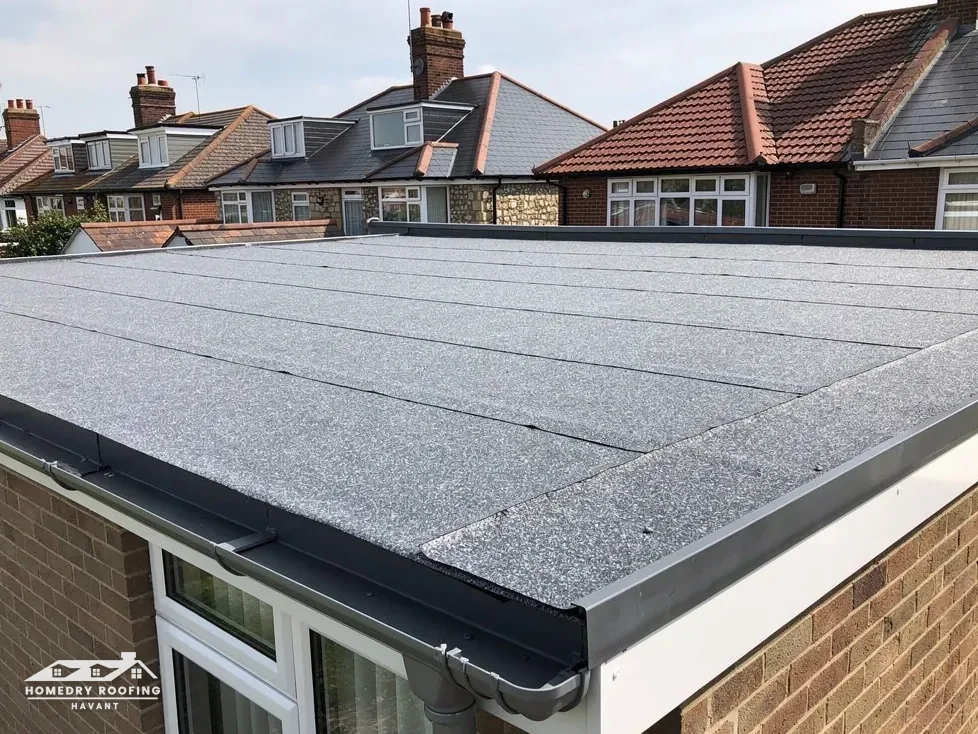
Three coverings turn up in flat roof quotes: EPDM, GRP and torch-on felt. The names do not explain themselves. EPDM is a rubber sheet, sold as rubber roofing. GRP is glass-reinforced plastic, which is also called fibreglass. Torch-on felt is bitumen felt laid in layers and bonded to the roof with a gas torch.
Each has its supporters, and the published advice on how long each lasts does not agree. HomeBuilding gives one set of figures and the home-improvement site Less gives another. This post sets both side by side instead of picking a winner, because the right covering depends on the roof in front of you and not on a league table.
It also covers the parts of a flat roof job that matter whichever sheet goes on top: the slope that sends rain to the drain, the condition of the deck underneath, and the Building Regulations rule that treats a new membrane as renovation. Prices come from third parties with their dates, never as a price for your roof.
What each of the three coverings is
The three systems are built differently, and that explains most of what you will hear about them on a quote or a doorstep.
- EPDM is a single sheet of rubber, cut to the roof and bonded down, with its own edge and corner details.
- GRP is a layer of glass fibre laid wet and set in resin, then finished with a top coat, so it forms one hard skin across the roof.
- Torch-on felt is made from layers of bitumen felt, joined and sealed to the deck with heat, so the roof carries more than one layer by design.
None of these is a lead roof. Lead and zinc are metals with their own rules, and the standard that governs flat roofs covered with continuously supported flexible membranes, BS 6229:2025, does not cover lead. The BSI lists it as current. The 2018 edition it replaced is shown as withdrawn.
A fourth option sometimes appears on quotes: a liquid coating over an old roof. That is a different decision with its own questions, and this post stays with the three full coverings.
What the names do not tell you is the work around the sheet. The deck beneath it, the upstand at the point where the roof joins a wall, the edge trim and every pipe or rooflight that pokes through are all part of the price, whatever the covering. Ask any roofer which of those details your own roof needs, because that list is where one quote differs from another. Two quotes for the same roof can be far apart simply because one has allowed for a new upstand and the other has not.
How long each is published to last
Published lifespans for flat roofs disagree, so this post names both sources instead of giving one figure as fact. HomeBuilding gives approximate lifespans, and Less quotes its own ranges. They are not promises from any manufacturer or roofer, and a poor installation or a poor deck will shorten any of them.
| Covering | HomeBuilding | Less |
|---|---|---|
| EPDM | 25 to 30 years | 30 to 50 years |
| GRP | 25 to 30 years | 25 to 40 years |
| Torch-on felt | 10 to 15 years | 10 to 20 years |
Less words its EPDM line as a rubber membrane that "typically lasts 30 to 50 years", its GRP line as lasting 25 to 40 years "with minimal maintenance", and its felt line as lasting 10 to 20 years "depending on quality and installation". HomeBuilding gives a single range for each.
Two things stand out. Both sources put felt below the other two, and they overlap most for GRP. The two EPDM ranges meet only at 30 years, so treat that one with the most caution. A range that wide is a reason to ask what the specific product and installer allow for, not a reason to trust the larger number.
Ask which product a lifespan refers to, and what the deck needs first. A figure from a cost guide describes a roof that has been well built. It does not describe a roof laid on a damp or uneven deck, or one whose details were rushed, and no cost guide can see either from outside.
What published prices show, and what they do not
Cost guides give ranges, and each one is for a particular roof. None is a price for yours. These are the third-party figures for flat roofs, with their dates and what they cover.
- Which? Trusted Traders, from a survey of 11 firms in November 2025: £1,400 to £3,500 for felt on what it calls a typical single garage (6m x 3m), and £1,950 to £4,000 for PVC or rubber EPDM on the same garage with new boards, both excluding VAT.
- MyJobQuote, 2026: the average flat roof replacement costs between £1,500 and £6,000.
- MyJobQuote on rubber roofing: at around £60 per square metre, the average rubber roof costs £1,050 fully installed.
- Checkatrade repair rates (June 2026), up to a maximum of 3 square metres and excluding VAT: EPDM rubber repairs £120 to £170 per square metre, and GRP fibreglass repairs £130 to £180 per square metre.
Both Hampshire and West Sussex sit within the South East, where Which? expects prices to be near the top of the range. MyJobQuote gives no VAT basis for its figures, so do not assume either way, and a quote should show whether its total takes in VAT and scaffold.
Two cautions. The Which? felt and EPDM ranges overlap, so price alone does not separate the coverings. And a per-square-metre repair rate is a rate for a patch, never a figure to multiply by your roof area. The price that counts is the single total that arrives in writing after a survey.
Falls, decks and details decide more than the sheet
A flat roof is not flat. It is built with a slope, so that rain runs towards an outlet or gutter, and the covering only works as well as that slope and the deck under it. Whether the covering is EPDM, GRP or felt, water that stands on it is a problem the sheet cannot fix.
BS 6229:2025 sets a minimum finished fall of 1:80 for general roof areas and internal gutters, according to the NFRC. IKO, a manufacturer, reports that to reach 1:80 the roof is designed to 1:40, as the code of practice lays down. In other words, the design aims steeper than the finished minimum, which leaves room for the tolerances of real building work.
That has a practical edge. Before you compare coverings, ask what the quote says about falls and the deck. A roof with poor falls will hold water whatever lies on top of it, and a new covering laid over a deck that has already moved carries the problem straight through. It is worth asking a roofer to explain how the finished fall will be checked, and what happens if the deck needs levelling first. The guide to flat roof falls and ponding goes through how to spot it from the ground.
Then ask about the details: upstands, edge trim, outlets, and anything that passes through the roof. A good covering with a careless detail is a leak waiting to happen at the detail. The survey is where those are found, and the written total should cover them, with the details named in the quote so nothing is left to be argued later.
Replacing the covering and the Building Regulations
Changing a flat roof covering is not only a roofing matter. In England, Approved Document L (Conservation of fuel and power, Volume 1, 2021 edition) lists a new waterproof membrane for a flat roof among the work that counts as renovation of a thermal element, and that brings the energy rules into the job.
The test sits in paragraph 11.3. Where renovation covers more than 50% of the roof surface, or the job counts as a major renovation, meaning more than 25% of the surface area of the external building envelope, the whole roof should be improved to Table 4.3 column (b). For a roof that means a U-value of 0.16 W/(m²·K), and the 0.35 beside it tests a roof being kept and not renovated. A U-value measures how much heat passes through; lower is better.
Paragraph 4.13 allows a fallback. Where the improved standard cannot be met in practice, or the saving would take longer than 15 years to repay, the roof is brought to the best figure that can be met within that payback. As a general guide, a renovated element should not finish worse than 0.7. AD L 2026 does not apply until 24 March 2027, and its tables are renumbered.
Planning is dealt with separately. Class C of the permitted development order takes in re-roofing a house, but check whether an Article 4 direction applies or the house is listed. Whichever route applies, we confirm the Building Regulations route with your building control body before work starts, so the insulation question is settled before the old covering comes off.
Choosing for your own roof
Because the sources disagree and the prices overlap, the choice comes down to the roof and to how long you expect to keep it. A short list of questions does more than any comparison chart.
- How big is the roof, and how awkward is its shape? Several corners, upstands and rooflights mean more detail work, whichever covering goes on.
- What condition is the deck in? New boards change the price, as the Which? garage ranges show.
- How long will you own the house? A covering with a longer published life suits a roof you will keep, while a shorter one may suit a short-term plan.
- How is the roof reached? Access, and the scaffold the job needs, shape the total.
- Is the old covering sound enough to repair? Repair is a different job from replacement, and the price of each is different.
None of these questions has a universal answer, which is why a comparison chart cannot choose for you. A garage roof with a simple outline and sound boards poses a different problem from a flat-roofed extension with a rooflight, two upstands and a shared wall. The covering that suits one can be an awkward fit for the other, and the price follows the detail, not the name of the sheet.
A survey answers those questions in turn. Once that is done we say whether the roof wants a repair or a full replacement, and why, and the quote comes as one written total price. If a roofer offers one covering without asking about falls, the deck or the details, press for the reasons before you sign.
For more, see how long a flat roof lasts and when to repair or replace one. Our flat roofing page covers the work itself.
Filed under Flat roofing